Nintendo Is Turning Its Game IP into a Theme Park and Film Empire
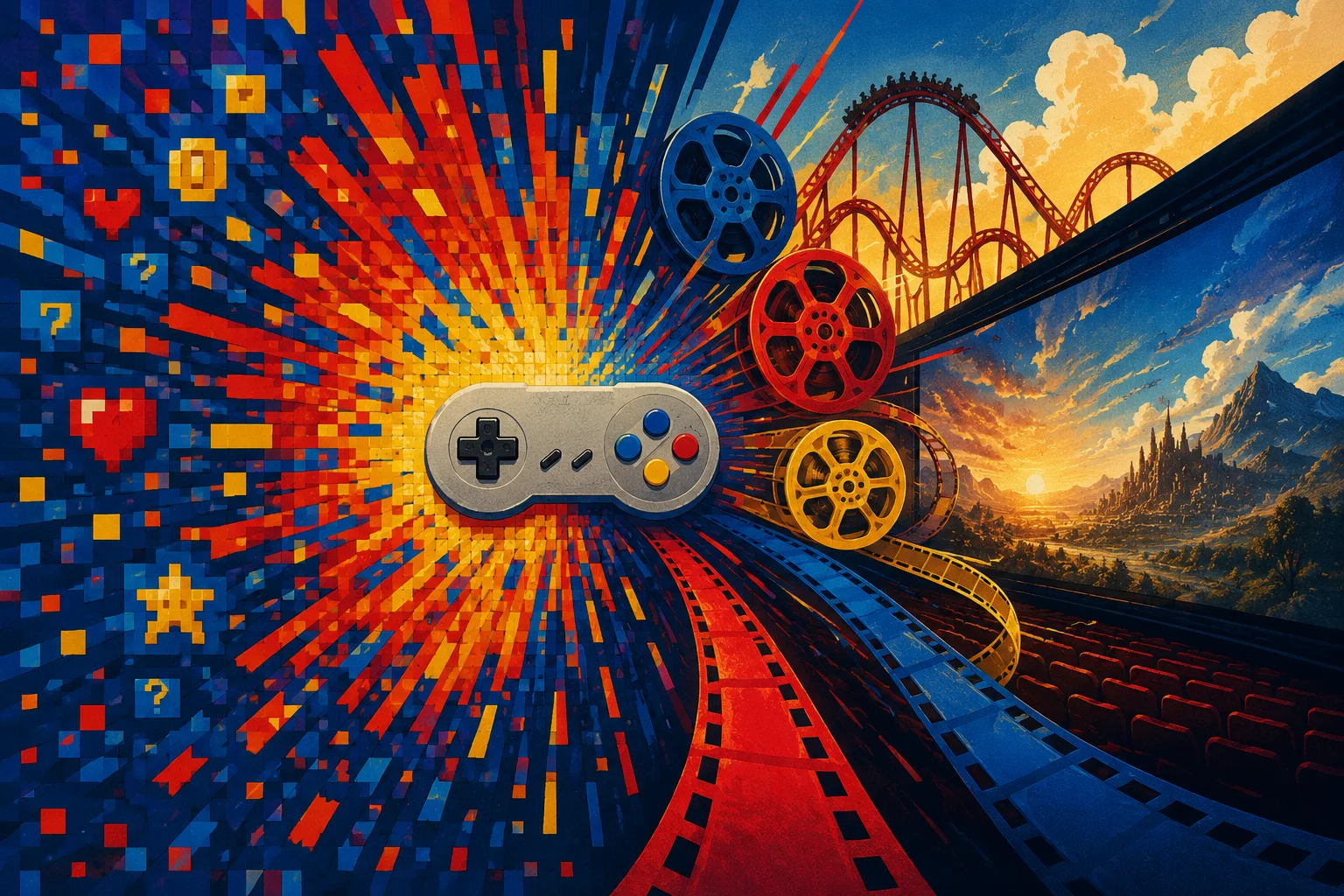
Nintendo’s FY2026 annual report confirmed that IP licensing and content revenue — encompassing theme park royalties, film and animation licensing, and merchandise — now represents a segment that did not exist as a material reporting category five years ago and that is growing faster than every other part of Nintendo’s business. Nintendo’s FY2026 investor relations materials showed the IP licensing and visual content segment contributing approximately ¥280 billion ($1.9 billion) annually, reflecting royalties from Super Nintendo World at Universal Studios Japan, Hollywood, and the newly opened Epic Universe in Orlando, combined with the ongoing box office and home entertainment tail from The Super Mario Bros. Movie and the production licence for the in-development Legend of Zelda film at Sony Pictures. For a company whose revenue model was built entirely on game software and hardware for four decades, the shift is structural.
The context matters: Nintendo spent roughly 30 years refusing to license its IP for non-game media following the commercial and reputational catastrophe of the 1993 live-action Super Mario Bros. film, which grossed $21 million against a $48 million budget and was widely regarded as damaging to both the franchise and to the concept of video game adaptations as a genre. The 2023 reversal — The Super Mario Bros. Movie with Illumination, produced with direct creative oversight from Nintendo’s Shigeru Miyamoto, generated $1.36 billion globally at the theatrical box office — was not simply a commercial success. It was a proof of concept for a different licensing model in which Nintendo retains creative veto over every material production decision rather than selling the IP to a studio that proceeds independently.
Super Nintendo World and the Theme Park Revenue Logic
Super Nintendo World at Universal Studios Japan opened in February 2021. The Hollywood version opened in February 2023. The Epic Universe park in Orlando, which opened in May 2025, contains Super Nintendo World as one of its five anchor worlds — alongside Harry Potter, Monsters, and two original Universal properties. Theme park IP licensing is fundamentally different from film licensing in its revenue structure: film deals generate upfront licence fees and a royalty percentage of box office; theme park agreements generate annual royalty payments scaled to park attendance over the life of the licence, plus merchandise royalties from park retail operations.
Super Nintendo World’s attendance performance at existing parks has validated the model substantially. The Hollywood version at Universal Studios Hollywood consistently ranks among the most-visited individual areas in the park and has driven meaningful overall attendance growth in the 18 months since opening. Epic Universe — at full capacity a $7 billion investment by Comcast and Universal, the largest theme park construction project in Florida since the original EPCOT — has Super Nintendo World as a key differentiator against Disney’s competing properties in the same geographic market. Nintendo’s Switch 2 hardware launch and the IP licensing expansion are complementary rather than competing revenue streams: the theme park and film exposure generates the broad cultural awareness that drives game franchise interest among younger audiences who then become Nintendo hardware buyers.
The Zelda Film and What Creative Control Actually Looks Like
The Legend of Zelda film at Sony Pictures is in active production as of mid-2026. Nintendo’s arrangement with Sony follows the Illumination template: Miyamoto holds a producer credit and a meaningful creative approval right over script, casting, and design. The Zelda franchise presents a more complex adaptation challenge than Mario because Link, the protagonist, is famously a non-verbal character in the game canon — his silence is the mechanism by which players project themselves into the hero role. The film must give Link a voice and character arc while preserving the franchise’s tonal identity: the high-fantasy world-building of Hyrule, the iconography of the Triforce and the Master Sword, and the Zelda-Link relationship that has been rendered differently across 20 distinct game entries.
Variety’s coverage of the Zelda film’s production has tracked Nintendo’s unusually hands-on involvement relative to standard studio IP licence agreements, including Miyamoto’s participation in casting decisions and production design reviews. This level of involvement is costly in time and creative friction, but Nintendo’s stated position is that the Mario film’s commercial success was directly caused by the quality discipline of creative control rather than the quantity of distribution. A Zelda film that performs at or above Mario’s theatrical level would validate the model permanently and establish Nintendo as the most successful video game IP licensor in the film industry — a category distinction it already holds by box office total and is attempting to extend through consistency rather than volume.
The Revenue Mix Shift and What It Means for Nintendo’s Valuation
Nintendo’s historic valuation challenge has been that its game console hardware business operates on a long cycle tied to platform launches: peak revenue in launch years (Switch in 2017, Switch 2 in 2024), declining revenue in later cycle years, reset at next hardware launch. This cyclical pattern creates forecast variance that equity markets discount with a lower valuation multiple than they apply to software businesses with smoother revenue trajectories. IP licensing — theme parks, film royalties, merchandise — provides counter-cyclical revenue that does not correlate with console hardware cycles. A year in which Nintendo has no major first-party launch is still a year in which Super Nintendo World generates park attendance royalties and the Zelda film generates production or release royalties.
The strategic question for Nintendo’s long-term IP trajectory is whether it expands beyond the Mario and Zelda flagships into the broader franchise library. Metroid, Donkey Kong, Kirby, Star Fox, Fire Emblem, and Pikmin each have dedicated fanbases. The gaming industry’s shift toward valuing IP libraries over individual titles — visible in the Saudi Arabia-EA acquisition and in the consolidation dynamics reshaping publishing — makes Nintendo’s owned IP portfolio one of the most defensible assets in entertainment. Every franchise in that library is a prospective theme park attraction, animated series, or film adaptation for which Nintendo, by its demonstrated model, will insist on creative control and receive the premium brand protection that comes from it.