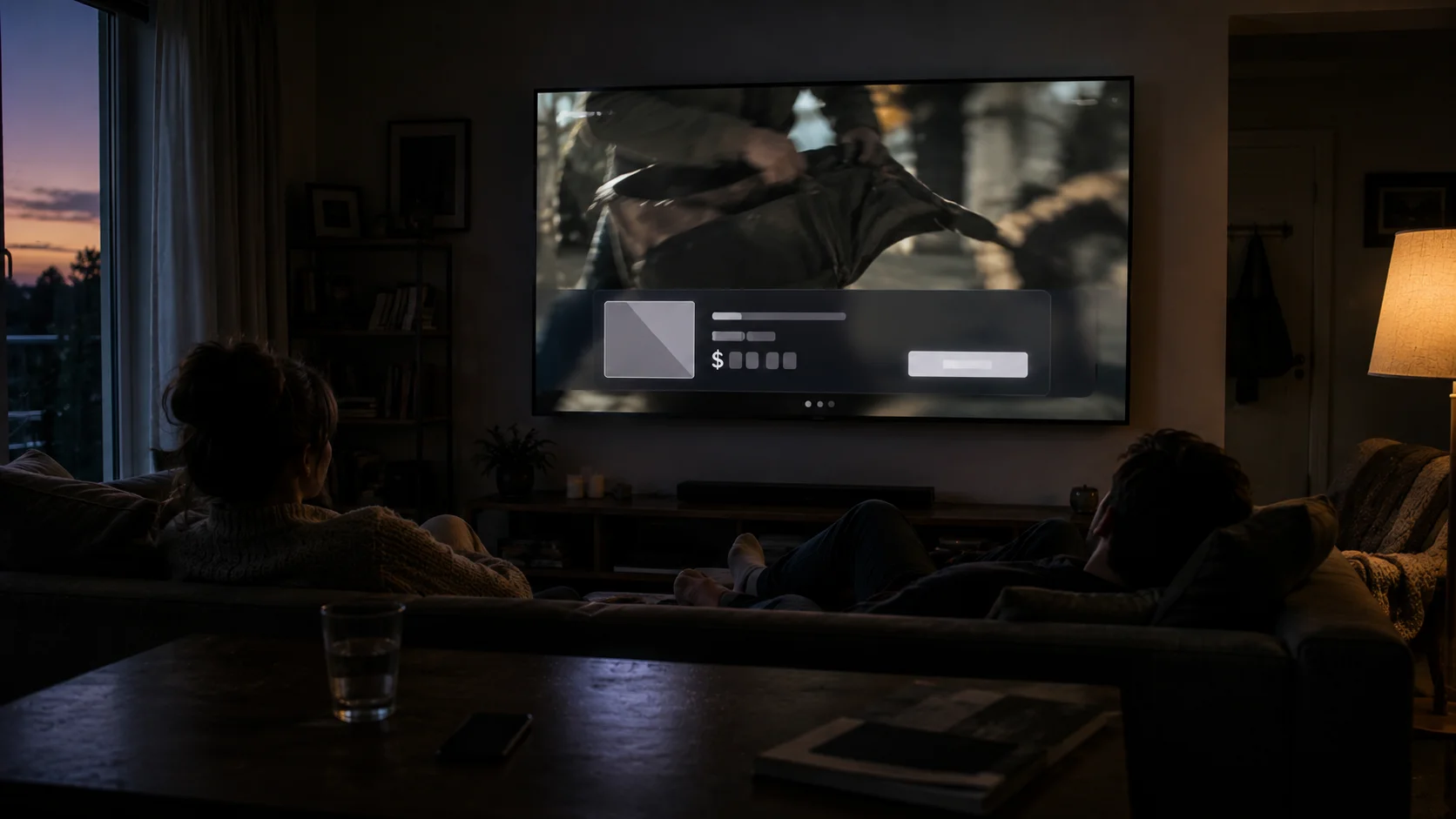
YouTube held Brandcast 2026 last week — its annual pitch to the advertising industry — and the product announcements were the most substantive the event has produced in years. The headline number: conversions from connected TV ads grew more than 200% year over year in Q1 2026. The headline product: Buy with Google Pay on CTV, which lets viewers complete a purchase directly from their television screen with two clicks.
Taken together, Brandcast 2026 is YouTube’s most direct statement yet that it is not a media platform that sells advertising. It is a commerce platform that happens to be the most-watched content service on television. The distinction matters because it reframes who YouTube’s real competitors are — not just Netflix and Disney+, but Amazon Prime Video, Walmart Connect, and every retailer that is trying to build a direct path from content to purchase.
Three announcements from Brandcast deserve analysis beyond the press release summaries: the CTV checkout product, the AI Custom Sponsorships tool, and the creator show slate that is pulling YouTube’s content strategy toward something that looks considerably more like traditional media than the platform’s founders envisioned.
Buy with Google Pay: The TV Remote as Checkout
The CTV checkout product is the most commercially significant announcement from Brandcast, and it is worth understanding what it actually does before evaluating what it means.
A viewer watching YouTube on their television sees a product advertised in a video. Historically, the path from that exposure to a purchase requires multiple steps: note the product, pick up a phone or laptop, search for it, navigate to a retailer, complete checkout. Each step is a drop-off point. The purchase conversion rate for CTV advertising has historically been low because the friction is high — the screen you are buying from is not the screen you are watching.
Buy with Google Pay eliminates the majority of that friction. A viewer who sees a product they want can complete the purchase on-screen with two clicks, using payment information already stored in their Google account. The television remote becomes the checkout device. YouTube reports that conversions from CTV ads grew 200% year over year in Q1 2026 — and that growth is happening before the frictionless checkout product is widely deployed. The trajectory when checkout friction is fully removed is the number advertisers will be running models on.
The comparison to Amazon is instructive and intended. Amazon has built the most effective digital commerce ecosystem in history partly because it has eliminated purchase friction — one-click ordering, Prime delivery guarantees, and an interface that is optimised for discovery-to-purchase. YouTube is now competing on the television screen for the same behaviour pattern: a consumer who is passively browsing content encounters something they want and acts on it immediately, without leaving the environment they are in.
The categories most directly affected are consumer packaged goods, fashion, home goods, and electronics — exactly the categories that already dominate television advertising budgets. An advertiser who has been running brand awareness campaigns on connected TV with no measurable purchase attribution now has a direct conversion signal. That changes the economics of their TV buy in ways that will accelerate budget allocation to YouTube.
AI Custom Sponsorships: Scale Without Selection
The second major announcement is AI Custom Sponsorships — a product that dynamically builds thematic content packages at scale, matching brand moments to creator content without requiring the manual selection process that has historically limited how many brands could participate in YouTube sponsorship deals.
The traditional YouTube sponsorship model requires a brand to identify specific creators, negotiate terms, approve content, and manage compliance across individual relationships. That process is feasible for large brands with dedicated influencer marketing teams and for creator relationships at the top of the market. It does not scale to the mid-market brand that wants sponsorship presence across 500 relevant channels rather than 5 flagship creators.
AI Custom Sponsorships changes that by letting the algorithm do the matching. A brand defines its desired moment — “outdoor adventure,” “home cooking,” “personal finance for millennials” — and the system surfaces videos across the creator ecosystem that fit that theme, packages them into a coherent sponsorship unit, and deploys the brand’s presence across that package without individual creator negotiations for each placement.
The creator relationship still exists — creators opted into the program, pricing is algorithmic within bands, and brand safety filters ensure categories and content types the brand has excluded are respected. What changes is the operational overhead. A mid-market brand can now access YouTube sponsorship inventory at a scale that was previously only available to the largest buyers.
This is a direct competitive move against the influencer marketing platforms — AspireIQ, CreatorIQ, Grin — that have built businesses around managing creator-brand matching at scale. YouTube is internalising that function, capturing the margin, and providing advertisers with a simpler path to the same outcome. The influencer marketing platform business model has a structural problem if the inventory owner starts doing the matching itself.
The Creator Show Slate: YouTube Becomes a Studio
The content announcement at Brandcast was, in some ways, the most strategically significant — not because the individual shows are necessarily transformative, but because the direction it signals is a departure from YouTube’s historical identity.
YouTube announced exclusive creator-led shows that will function as premium advertising environments: Kareem Rahma’s “Keep the Meter Running,” Alex Cooper’s Met Gala docuseries “Before the Steps,” series from Dude Perfect, Trevor Noah, and Quen Blackwell. These are not user-generated content in the traditional YouTube sense — they are professionally produced, branded entertainment specifically designed to attract premium advertising dollars.
YouTube is positioning these shows as Emmy-contending content — and teasingly referenced a potential connection to the 2029 Oscars. The competitive set is explicitly Netflix, HBO, and the prestige streaming services. YouTube’s argument to advertisers is that they can buy against creator-led content that reaches the YouTube scale audience — over 2 billion logged-in monthly users — with production values that support premium brand adjacency.
The tension in this strategy is real. YouTube’s competitive advantage over Netflix is that it is free, creator-driven, and globally distributed. The more YouTube invests in produced, exclusive content, the more it looks like a lower-budget version of what Netflix does rather than a fundamentally different kind of platform. The creator show slate needs to be good enough to attract premium advertisers without being expensive enough to undermine the unit economics that make YouTube profitable.
The creator shows serve a secondary function: they anchor creator loyalty at the top of the market. Alex Cooper, who commands one of the highest-value podcast advertising rates in the industry through her “Call Her Daddy” network, bringing an exclusive docuseries to YouTube is a signal to other major creators that YouTube can provide the kind of premium production support and advertiser access that justifies exclusivity. Creator retention at the top of the market has commercial implications that extend beyond the individual shows.
Multimodal Video Creation: AI Closes the Production Gap
The fourth major announcement — Multimodal Video Creation — addresses a constraint that has historically limited smaller advertisers’ ability to compete on YouTube: video production cost and complexity.
The tool uses Google’s latest AI models, including Gemini and Veo, to move from creative brief to final video production with a small number of prompts. A brand can describe the ad it wants — product, audience, tone, visual style — and receive production-ready video output without a production team, agency, or studio.
This is not a replacement for high-production-value brand advertising from major advertisers. A car manufacturer launching a new model will still commission a cinematic spot with a director, a shoot, and post-production. What Multimodal Video Creation replaces is the 85% of video advertising that is produced for performance purposes — testing creative variants, localising campaigns, filling lower-funnel inventory with product-specific content that drives direct response rather than brand building.
The commercial implication is that the addressable market for YouTube video advertising expands. Businesses that could not justify the cost of video production can now produce video ads. Businesses that could only afford a small number of creative tests can now run dozens simultaneously and let performance data determine which ones deserve budget. The CPM efficiency of video advertising improves because the creative supply increases — more advertisers bidding for more inventory, with production no longer being the bottleneck.
Affiliate Partnerships Boost and the Creator Commerce Layer
The final significant product announcement is Affiliate Partnerships Boost, which allows brands to amplify organic creator content that already includes their products. If a creator has filmed a video that features a brand’s product — without a paid sponsorship — the brand can now pay to boost that video’s reach within YouTube’s ad system, turning organic creator enthusiasm into a distribution vehicle.
This closes a gap that has existed in creator marketing for years. A brand that monitors creator content knows which creators genuinely use and recommend its products, but historically had no way to convert that organic endorsement into a paid distribution arrangement without initiating a full sponsorship negotiation. Affiliate Boost turns the organic content into a click-to-amplify commercial asset.
For creators, this creates a new passive revenue stream. A creator who mentions a product without a paid deal can now earn affiliate revenue if the brand chooses to boost that content. The incentive this creates — if creators know that genuine product mentions may generate affiliate income — is both a positive signal (more authentic product mentions) and a potential complication (the distinction between genuine recommendation and commercially motivated mention becomes less clear).
What Brandcast 2026 Means for Advertisers
The aggregate picture from Brandcast 2026 is that YouTube is removing every excuse an advertiser might have for not spending more of their budget on the platform. Video production too expensive? Multimodal Video Creation solves it. CTV reach without purchase attribution? Buy with Google Pay solves it. Sponsorship at scale too operationally complex? AI Custom Sponsorships solves it. Premium brand adjacency content not available? The creator show slate provides it.
The counterargument that advertisers will make is measurement and brand safety. YouTube has made significant progress on both — the AI-powered content suitability controls are substantially more granular than three years ago, and the attribution modelling for CTV has improved with the Buy with Google Pay data layer. But brand safety concerns about YouTube have not disappeared, and the platform’s content moderation at scale remains imperfect.
Google Marketing Live on May 20 — two days from now — will provide additional context on how these products integrate with Google Search advertising and the Performance Max campaign structure that has become the dominant buying model for Google’s large advertisers. The CTV checkout product, in particular, will need to demonstrate how it fits into a cross-channel measurement framework that includes Search, Display, and YouTube together.
For advertisers who have been allocating cautiously to YouTube CTV — acknowledging the reach but struggling to justify it against the measurability of Search — Brandcast 2026 gives them the tools to answer the measurement question. Whether they use them is now a strategy choice, not an infrastructure limitation.
The Slightly Unsettling Friendliness Of Television That Wants To Sell You Things
There is something quietly strange about a television set that has been reconfigured into a checkout terminal, and the strangeness deserves naming even if the consumer outcome is convenient. Television, for the seventy-five years of its mass-market life, has been the medium where you could not buy anything directly. The friction was a feature. The buying happened later, in a store or online, after the desire had time to settle into either a real intention or a passing impulse.
The new CTV-checkout architecture removes the settling window. The desire and the purchase happen inside the same minute. For some categories of purchase — a sponsored kitchen tool, an obviously useful subscription — this is fine and arguably an improvement. For other categories — anything the buyer would have reconsidered in the morning — this is a structural shift in consumer behaviour that the marketing-industry press is not quite reckoning with. The shift looks like convenience. The aggregate effect on consumer financial behaviour will be similar to what app-store one-click purchases did over their first five years: small individual decisions, large cumulative result.
The brands jumping into Brandcast’s checkout layer should be honest with themselves about which side of the line their product sits on. The convenient side is great. The impulse side will eventually produce consumer backlash, and the brands most exposed to it are the ones whose entire CTV strategy depends on the lower-friction purchase that the buyer would not have completed an hour later. Take the convenience. Watch the boundary.
FAQ
What is Buy with Google Pay on CTV?
A two-click purchase completion tool that lets viewers buy products advertised on YouTube TV directly from their television screen, using payment information stored in their Google account. CTV conversion rates grew 200% YoY in Q1 2026 before this product launched widely.
What are AI Custom Sponsorships?
An AI-powered product that dynamically builds thematic content packages by matching brand moments to creator content at scale, without requiring individual creator negotiations for each placement. Designed for mid-market brands that want sponsorship presence across hundreds of channels rather than a handful.
What creator shows did YouTube announce at Brandcast?
Kareem Rahma’s “Keep the Meter Running,” Alex Cooper’s Met Gala docuseries “Before the Steps,” and series from Dude Perfect, Trevor Noah, and Quen Blackwell. YouTube positioned these as Emmy-contending premium content environments for brand advertisers.
What is Multimodal Video Creation?
An AI video production tool using Google’s Gemini and Veo models that allows advertisers to produce video ads from a brief with minimal manual production work. Designed to lower the video production barrier for small and mid-market advertisers.
What is Affiliate Partnerships Boost?
A product that allows brands to pay to amplify organic creator content that features their products, turning unpaid product mentions into boosted distribution assets with affiliate revenue for the creator.
How does Brandcast 2026 compare to previous years?
It is the most product-dense Brandcast event in recent memory, with multiple new ad formats, a purchase completion product, an AI-powered creation tool, and a premium content slate. The through-line is YouTube positioning itself as a commerce platform, not just a media platform.
Sources
- YouTube Blog — YouTube Brandcast 2026: Highlights & New Tools for Brands
- Adweek — YouTube Goes All-In on Creator Shows at Its Brandcast Event
- ALM Corp — YouTube Brandcast 2026: New Ad Features and CTV Checkout
- Social Media Today — YouTube announces ad updates at 2026 Brandcast Event
- Campaign US — Everything announced at YouTube Brandcast 2026