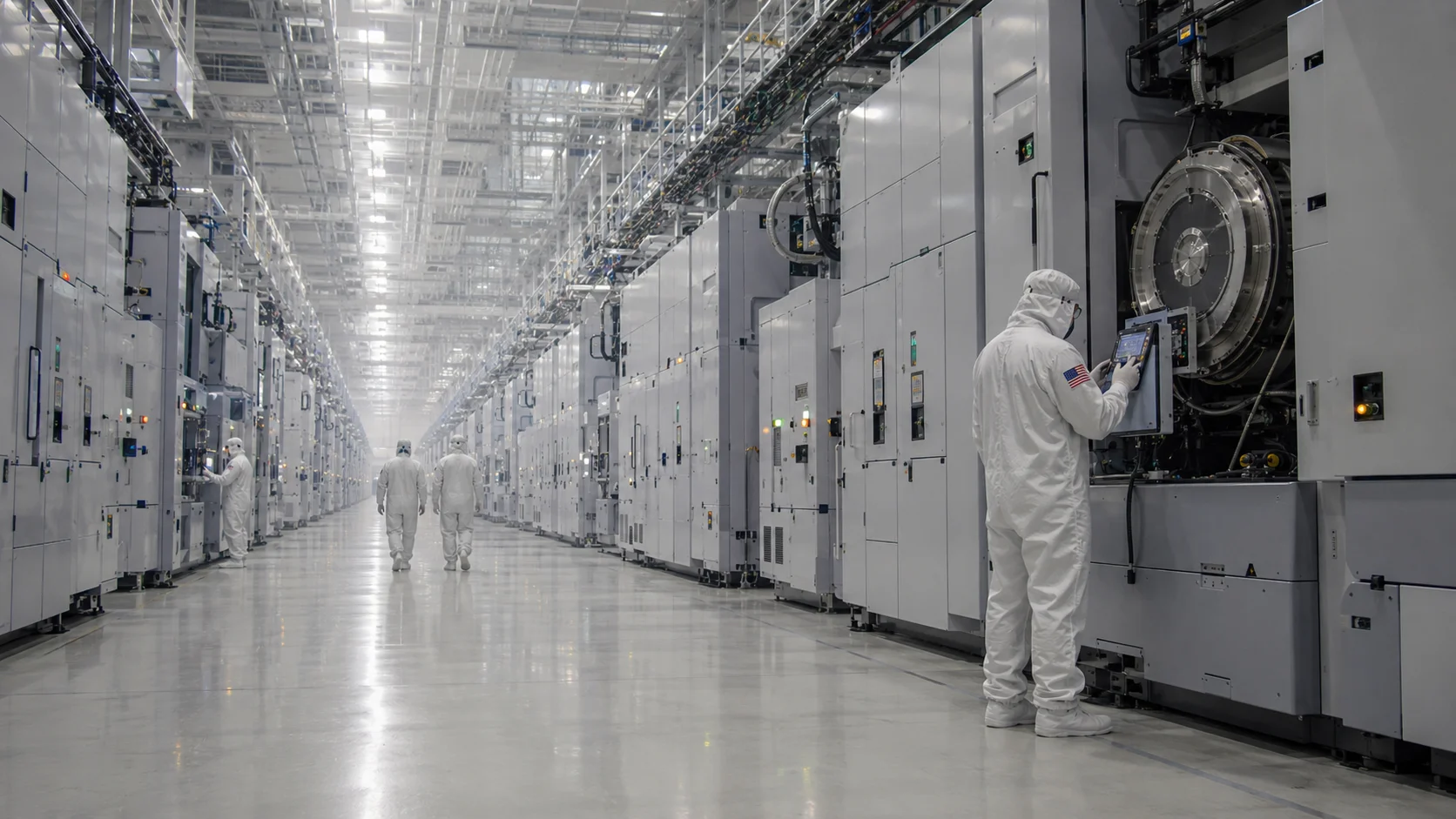
In March 2026, Elon Musk announced Terafab — a joint semiconductor fabrication venture between Tesla, SpaceX, and xAI — with a stated goal of producing more than one terawatt of AI compute capacity per year. In April, Intel joined as the foundry partner, bringing its 18A process node — the most advanced semiconductor manufacturing technology produced entirely within the United States. In May, SpaceX filed paperwork estimating the project’s total investment at up to $119 billion.
To put that number in context: TSMC’s entire capital expenditure program for 2025 was approximately $38 billion. Intel’s multi-year recovery plan for its foundry business involves approximately $100 billion in investment across multiple sites and multiple years. A single Terafab facility in Austin, Texas — one project, one company group — targeting $119 billion in total investment is a number that has no precedent in the history of the semiconductor industry.
Whether Terafab delivers on its stated ambitions is a question that will take years to answer. What is worth examining now is what the project actually is, why it exists, and what success looks like for the entities involved.
The Architecture of the Bet
Terafab is not a traditional chip fab. It is a vertically integrated compute infrastructure project that starts at the silicon fabrication layer and extends to the AI systems that run on the resulting chips.
The chips Terafab is designed to produce are Tesla’s AI5 processors — the next-generation silicon behind Tesla’s Full Self-Driving system, the Cybercab robotaxi platform, and the Optimus humanoid robot series. These are not general-purpose AI accelerators competing in the data center market against Nvidia. They are purpose-built chips for a specific set of applications that Tesla and SpaceX control end-to-end.
SpaceX’s acquisition of xAI in February 2026 — creating a combined entity valued at approximately $1.25 trillion — is the context that makes Terafab comprehensible. Musk’s stated intention is that 80% of Terafab’s compute output will be directed toward space-based AI infrastructure: a constellation of orbital satellites internally designated AI Sat Mini, designed to provide AI compute capacity from orbit. The remaining 20% is for ground-based applications across Tesla, SpaceX, and xAI’s operations.
The orbital AI constellation is the part of Terafab’s stated purpose that mainstream analysis has struggled with. It sounds like science fiction. But SpaceX is the world’s dominant launch provider, with the ability to deploy satellite constellations at a cost and cadence no other entity can match. If AI compute from orbit is technically feasible — and the physics of space-based computing have been studied extensively — SpaceX is the only organisation on the planet that could actually build and operate it at scale. Musk is attempting to vertically integrate from chip fabrication to satellite deployment to orbital AI compute. The ambition is real even if the timeline is aggressive.
Intel’s Role and the 18A Process Node
Intel joining Terafab as the foundry partner is the development that transforms the project from a press release into a credible manufacturing plan. Tesla and SpaceX know how to design chips — Tesla’s FSD chips have been produced at TSMC — but neither company knows how to fabricate them. Intel does.
Intel’s 18A process node is technically significant. It features gate-all-around transistor architecture — a fundamental improvement over the FinFET architecture that has been the industry standard — combined with backside power delivery and advanced 3D stacking capabilities via Intel’s EMIB and Foveros technologies. At 1.8 nanometre class, 18A is competitive with TSMC’s N2 and Samsung’s 2nm nodes in the global technology race.
What makes Intel’s involvement geopolitically significant is that 18A is manufactured entirely within the United States. Every Nvidia H100 and H200 that powers the AI industry today is fabricated by TSMC in Taiwan. Every AMD MI300X. Every Google TPU. The concentration of advanced semiconductor manufacturing on a small island with a complex geopolitical relationship with China is the strategic vulnerability that the CHIPS Act was designed to address and that Terafab directly confronts.
If Terafab produces AI5 chips on Intel’s 18A process at scale, it creates a meaningful quantity of advanced AI silicon that does not depend on Taiwan for fabrication. For Tesla’s autonomous vehicle program and SpaceX’s satellite constellation, supply chain security is not an abstract concern — it is a precondition for the kind of long-duration, large-scale deployment that both programs require.
The $119 Billion Number and What It Actually Covers
The $119 billion figure from SpaceX’s filings covers all phases of the Terafab project — from the initial prototype fab in Austin to full production capacity. The initial investment is approximately $55 billion, with the total scaling to $119 billion as production ramps.
Breaking down where that capital goes illuminates the scope. A single advanced semiconductor fab — the kind that produces chips at 2nm-class nodes — costs $20–30 billion to build and equip with the ASML EUV lithography tools and associated equipment required for advanced process nodes. A fab at the scale Terafab is targeting requires multiple production lines, extensive clean room infrastructure, supporting utilities, and the workforce to operate it.
The $119 billion also reflects the nature of semiconductor manufacturing as a capital-intensive, long-duration investment. Fabs are not built and immediately profitable — they require years of yield ramp, process development, and manufacturing learning curve before they operate at the efficiency levels that justify the capital. Intel’s existing foundry investments are not yet profitable in part because it is in the early stages of that learning curve on its advanced process nodes.
The funding structure for Terafab is not fully public. Tesla, SpaceX, and xAI have different balance sheet profiles and different access to capital. The project is likely to involve a combination of equity from the parent companies, government incentives under the CHIPS Act framework, and potentially debt financing against future chip supply commitments. The $119 billion total investment number is almost certainly not a single capital commitment — it is the projected cumulative investment across a multi-year build and ramp program.
Why Musk Is Doing This Instead of Using TSMC
Tesla’s FSD chips are currently produced by TSMC. Samsung has also been a supplier for Tesla silicon. The question of why Musk is spending up to $119 billion to build his own fab rather than continuing to use the world’s most advanced contract manufacturer requires a specific answer.
The answer has three components. First, supply chain independence. TSMC charges premium prices for advanced node capacity, has limited availability at the leading edge, and is subject to geopolitical risk that is difficult to hedge contractually. A company with the supply chain exposure of Tesla — which is deploying tens of millions of autonomous vehicle chips — cannot accept the concentration risk of single-source advanced manufacturing indefinitely.
Second, customisation depth. TSMC produces chips to customer specifications but the process node is standardised across customers. A company with a proprietary fab can co-develop the process node specifically for its chip architecture — optimising at the materials and process level for the exact performance characteristics its applications require. This is what Apple has done, in collaboration with TSMC but with increasing co-design depth, to produce the industry’s most power-efficient mobile chips.
Third, and most speculatively, the orbital compute thesis. If Terafab’s primary purpose is to produce chips for space-based AI infrastructure, TSMC is simply not the right partner. The security requirements, the supply chain visibility requirements, and the volume profile for an orbital AI constellation are unlike anything in TSMC’s standard customer base. A purpose-built fab under Musk’s control is the only production model that supports that application at scale.
The Risks Are Proportional to the Ambition
Terafab carries execution risks that are proportional to its scale and ambition. The semiconductor industry has a long history of large, expensive fabs that underperformed their projections — Intel’s own Fab 42 in Arizona was announced in 2011, broke ground in 2013, and did not reach volume production for over a decade.
Intel’s 18A process, while technically impressive, is entering commercial production at a moment when Intel’s foundry business is still in recovery. Intel Foundry’s existing customers — Microsoft and AWS have been announced as 18A customers — are qualifying the process but have not yet moved to volume production. Terafab’s AI5 chip would be among the first 18A volume production commitments at scale. If the process has yield issues at volume, Terafab’s timeline slips and the economics become more challenging.
The workforce challenge is substantial. Advanced semiconductor fabs require highly specialised engineers — process engineers, equipment engineers, yield engineers — who are in short supply globally. Building out the human capital for a new fab in Austin, competing with established fabs in Taiwan, South Korea, and Arizona for the same talent pool, is a constraint that capital cannot fully resolve.
The orbital AI constellation — 80% of Terafab’s stated output — is the most speculative component. Space-based computing is technically possible but has not been demonstrated at the scale Musk is targeting. The thermal management challenges, the radiation hardening requirements, and the communication latency of orbital compute are all solvable engineering problems, but they are unsolved at the scale Terafab implies. If the orbital compute thesis does not materialise, Terafab’s utilisation model looks very different from what the initial filings describe.
What Success Looks Like
The realistic near-term success scenario for Terafab is narrower than the $119 billion headline suggests. Small-batch AI5 chip output from the Austin prototype facility in 2026 — which is the stated initial timeline — would represent genuine progress. Volume production in 2027 would validate the manufacturing thesis. A functioning supply of AI5 chips for Cybercab and Optimus at a cost and availability that beats TSMC alternatives would prove the economic case.
The broader orbital AI constellation is a longer-duration bet. Five years from now, if SpaceX has launched the first AI Sat Mini constellation and Terafab chips are operating in orbit, the project will be seen as one of the most consequential infrastructure investments in the history of technology. If the orbital component stalls and Terafab operates as a relatively conventional chip fab supplying Tesla’s automotive and robotics operations, it will still have been a significant domestic semiconductor investment — just not the transformative one the filings describe.
The $119 billion number will look different depending on which scenario materialises. It is either the foundation of a vertically integrated AI infrastructure empire spanning silicon to orbit, or it is an expensive but strategically sound insurance policy against Taiwan Strait risk for the company that has bet its automotive future on autonomous driving. Both are coherent outcomes. The distance between them is the distance between Musk’s orbital AI vision and the engineering reality of the next five years.
The Power Question Hiding Inside The Terafab Bet
The right Helmer-style question to ask about a $119 billion vertical-integration bet is: which of the seven powers is Musk attempting to acquire that he does not already have? The honest answer is most likely “process power” — the cumulative know-how of running a leading-edge fab, which TSMC currently dominates and which neither xAI nor Tesla can replicate by spending money alone. The Terafab structure is essentially a bet that this know-how can be partially imported via the Intel 18A node and the talent that comes with it.
The historical base rate on this kind of vertical-integration bet is unforgiving. Companies that attempted to acquire process power by purchasing or contracting with an incumbent fab have, more often than not, discovered that the process power was distributed across thousands of operational decisions made by engineers who were not part of the transaction. The know-how does not transfer cleanly. Apple’s silicon program took a decade and required acquiring P.A. Semi plus building an internal team. Google’s TPU program took similar time and similar org-building. Neither was a $119 billion single-stroke bet.
Musk’s structural advantage, if any, is that the urgency of the AI buildout compresses the timeline he is willing to accept for the bet to compound. The structural disadvantage is that the compression makes the historical pattern more, not less, likely to bind. The next four years will produce one of three outcomes — Terafab works, it partially works at large cost, or it fails and gets restructured into something smaller. The probability mass is roughly evenly distributed across those three, which is enough uncertainty that anyone reading the announcement as confirmed strategy is overconfident relative to the base rate.
FAQ
What is Terafab?
A joint semiconductor fabrication venture between Tesla, SpaceX, xAI, and Intel, targeting production of over one terawatt of AI compute capacity per year. Located in Austin, Texas, near Tesla’s Gigafactory. Total investment estimated at up to $119 billion across all phases.
What chips will Terafab produce?
Primarily Tesla’s AI5 processor — the chip powering Full Self-Driving, the Cybercab robotaxi, and the Optimus humanoid robot. 80% of compute output is stated to be directed toward a space-based AI satellite constellation.
Why is Intel involved?
Intel is the foundry partner, providing its 18A process node — the most advanced semiconductor manufacturing technology produced entirely within the United States. Tesla and SpaceX can design chips but do not have fabrication expertise. Intel provides the manufacturing capability.
Why not just use TSMC?
Supply chain independence from Taiwan, the ability to co-develop process nodes for Tesla’s specific applications, and the unique requirements of the orbital compute thesis all point toward a proprietary fab. TSMC is not optimised for a customer whose primary product use case is satellites.
Is the $119 billion committed?
No. It is the estimated total investment across all phases of the project. The actual capital will be deployed incrementally as each phase is validated. The initial investment is approximately $55 billion.
What is the timeline?
Small-batch AI5 chip output from the Austin prototype facility in 2026; volume production targeted for 2027. The orbital AI constellation is a longer-duration component with no public timeline commitment.
Sources
- CNBC — Elon Musk’s Terafab chip factory in Texas could cost up to $119 billion
- TechCrunch — Intel signs on to Elon Musk’s Terafab chips project
- The Next Web — Intel joins Musk’s Terafab as foundry partner in $25B chip megaproject
- EE Times — Intel Enters Pact With Tesla and SpaceX for Terafab
- TechCrunch — SpaceX may spend up to $119B on ‘Terafab’ chip factory in Texas