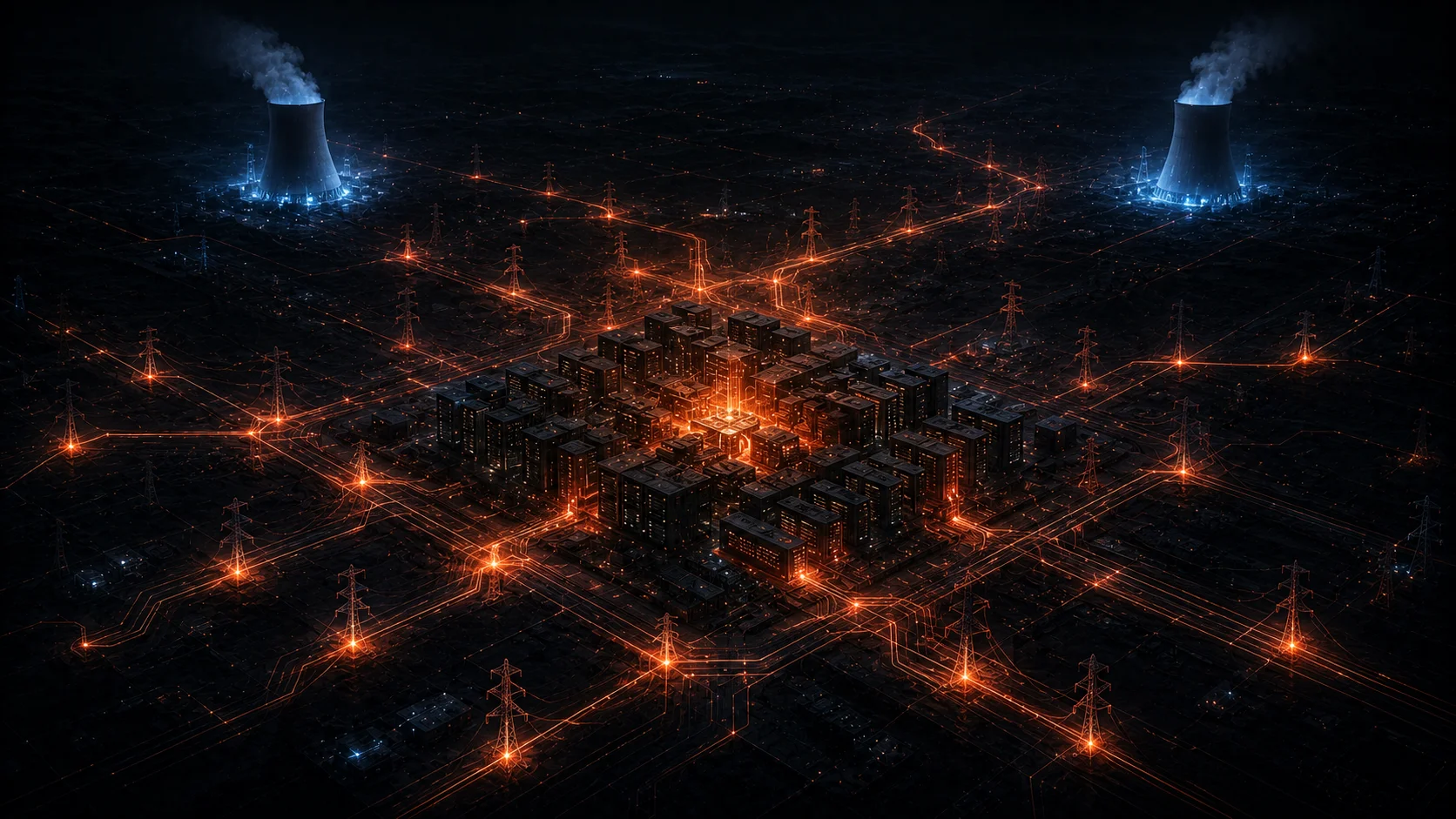
AI’s Power Constraint: Why Data Centers Are Reviving Nuclear and What the Energy Bottleneck Costs the Industry
The binding constraint on AI infrastructure buildout in 2026 is not capital — Amazon, Microsoft, and Google have committed $250 billion in combined cloud infrastructure spending for the year. It is not GPUs — Nvidia’s Blackwell production is ramping and AMD’s MI350 supply is expanding. The constraint is electricity: reliable, affordable, large-scale power delivered to data center campuses in jurisdictions where zoning approvals, grid connections, and water permits can be secured on a timeline that aligns with AI infrastructure demand.
US data center electricity consumption is projected to reach 580 TWh in 2026 — approximately 12% of total US electricity generation — up from 200 TWh in 2020. The six-year doubling-plus trajectory has outrun the expansion capacity of every major grid operator, and the AI workload concentration that is driving the growth is only beginning. The consequence is a capital reallocation into energy infrastructure that has no precedent in the technology industry’s history.
Nuclear’s Structural Advantage for AI Workloads
AI inference and training workloads impose a specific power profile that favours baseload generation: constant, high-wattage draw with near-zero tolerance for interruption. A GPU cluster running inference cannot be throttled when solar generation dips at 4pm or wind generation drops on a calm day. It requires the same 40-80 megawatts of power delivery at 2am as at 2pm, regardless of renewable energy’s variable generation profile.
Nuclear power is the only zero-carbon generation source that matches this profile: constant output, unaffected by weather, dispatchable on demand, and scalable to the multi-gigawatt capacity that a hyperscaler’s full data center campus requires. This structural alignment between nuclear generation characteristics and AI workload requirements is why technology companies — rather than utilities or industrial manufacturers — have become the most aggressive investors in US nuclear development.
Microsoft was first at scale: its 20-year agreement with Constellation Energy to restart Three Mile Island Unit 1 (rebranded Crane Clean Energy Center) for approximately 835 megawatts of capacity represents the largest private nuclear power purchase agreement in US history. The deal, announced in September 2024 and operational in early 2026, supplies a portion of Microsoft’s East Coast data center campus power requirements.
Google followed with agreements to purchase power from Kairos Power’s small modular reactor (SMR) program — 500 megawatts of contracted capacity from reactors expected to come online between 2030 and 2035. The long lead time is the characteristic constraint of nuclear: even with regulatory acceleration and technology advancement, new nuclear capacity requires 5-10 years from planning to generation. The deals being signed today are power for AI workloads that do not yet exist.
Amazon’s equivalent commitment came through its acquisition of the Talen Energy nuclear power plant in Pennsylvania, providing 960 megawatts of dedicated power for Amazon Web Services’ data centers in the region. The acquisition structure — rather than a PPA — reflects Amazon’s assessment that owning the generation asset provides more cost certainty and supply security over a 20+ year data center investment horizon than relying on market pricing for nuclear power.
The Grid Connection Bottleneck
For AI infrastructure that cannot wait for new nuclear capacity, the immediate constraint is transmission grid interconnection. US transmission utilities process interconnection requests on a first-come, first-served queue that had a backlog of approximately 2,700 gigawatts of new capacity applications as of early 2026 — representing more than double the current total installed US generation capacity. Data center projects requesting grid connections are competing with renewable energy projects, industrial facilities, and residential developments for the same transmission capacity.
Average grid interconnection timelines have extended from approximately 2.9 years in 2015 to 5.1 years in 2025. For data center operators who can plan 18-36 month construction timelines but cannot bring online buildings with no power supply, the grid interconnection queue is a structural bottleneck that capital cannot directly solve — it requires regulatory reform, transmission infrastructure investment, and coordination across utilities, state regulators, and federal authorities.
The response has been to move data center development to jurisdictions with shorter interconnection queues, lower electricity prices, and political appetite for expedited permitting. Virginia, the dominant US data center market through 2022, has effectively closed to new large-scale development due to grid saturation — a reversal that was unthinkable five years ago. Data center investment has shifted toward: Texas (deregulated ERCOT grid with shorter queues), the Pacific Northwest (hydroelectric power with stable pricing), and international jurisdictions including Iceland (geothermal power) and Scandinavia (hydroelectric).
Small Modular Reactors: Promise and Timeline
The technology sector’s enthusiasm for small modular reactors reflects a genuine alignment of needs: SMRs can theoretically be deployed closer to data center campuses (eliminating transmission distance), manufactured in standardised factory units (reducing construction costs and timelines), and operated with smaller minimum viable size than conventional large-scale nuclear plants (enabling incremental capacity additions as AI workloads grow).
The timeline reality is more challenging. Kairos Power, TerraPower, X-energy, and NuScale are the leading US SMR developers. Of these, NuScale was furthest advanced until its 2023 project cancellation in Utah, attributable to construction cost overruns that inflated the projected electricity price from $58/MWh to $89/MWh — at which point the project became uncompetitive against grid alternatives.
The NuScale cancellation is the canonical caution against over-reliance on SMR timelines for near-term energy planning. First-of-a-kind nuclear projects routinely exceed construction cost estimates; the “factory-manufactured” cost reduction thesis for SMRs requires production volumes that do not yet exist. The SMR capacity Google has contracted from Kairos Power is scheduled for 2030-2035 precisely because the technology development and manufacturing ramp require that timeline — there is no shortcut to first-of-a-kind nuclear deployment.
Renewable Plus Storage: The Nearer-Term Solution
For AI infrastructure coming online in 2026-2028 — after permitting approval but before new nuclear generation is available — the practical power solution is large-scale renewable energy paired with battery storage, supplemented by natural gas peaker plants for reliability backstop.
The unit economics of this combination have improved dramatically. Utility-scale solar LCOE (levelised cost of electricity) has fallen below $25/MWh in sun-rich US markets. Four-hour battery storage costs have declined approximately 75% since 2020. The solar-plus-storage LCOE for a system designed to deliver 85% of a data center’s power requirements now competes with natural gas generation in many US markets and is cheaper than any nuclear option by current cost benchmarks.
The limitation is not cost but duration. Four-hour battery storage handles short-term renewable intermittency effectively; it does not handle multi-day weather events (low sun and low wind for 72+ hours) that data center AI inference cannot pause for. Until longer-duration storage technologies — iron-air batteries, flow batteries, compressed hydrogen — reach commercial scale, renewable-plus-storage requires gas backstop for the tail risk of extended low-generation periods. This carbon dependency is why nuclear, with its constant output, remains the preferred long-term solution despite its cost and timeline disadvantages.
What This Means for AI Capex Economics
The power bottleneck imposes a cost structure that is increasingly visible in hyperscaler financial results. The $700 billion AI capex commitment from the Magnificent Seven in 2026 allocates a meaningfully larger proportion toward energy infrastructure than in any prior technology buildout cycle — at Google and Microsoft, the 2025 disclosures indicate that approximately 25-30% of data center construction capex now reflects power infrastructure (substations, generators, transmission upgrades), up from approximately 12-15% in 2019.
The energy-intensive economics of AI training and inference create a direct relationship between electricity prices and AI model economics that the industry is only beginning to manage systematically. A large language model training run that consumes 50 gigawatt-hours of electricity has a power cost of $2.5-4 million at $50-80/MWh commercial rates — a significant line item against a total training budget that might be $50-100 million. Inference, which runs continuously at scale, has power cost exposure that compounds with every unit of AI adoption.
The companies that can secure long-term power purchase agreements at locked prices — Microsoft’s Three Mile Island deal at reportedly $100/MWh fixed for 20 years, Amazon’s nuclear campus at comparable long-term certainty — are building a structural cost advantage over competitors who rely on spot or short-term power markets. In a world where AI inference is a commodity service where price competition matters, the cost of the electrons that run the models is a durable competitive variable. The energy infrastructure investment race that the hyperscalers are running is a long-term cost-position competition disguised as a sustainability commitment.
The Human Systems That Nuclear Energy Revival Actually Requires
DonNorman’s design principle: systems fail at the human interface, not the technical one. The nuclear energy revival that AI data centres are driving is described in terms of gigawatts and construction timelines. What it actually requires is a reconstruction of human systems — the engineers who know how to build and operate nuclear plants, the regulatory reviewers who can process permits at a pace consistent with the investment schedule, the communities adjacent to proposed sites who have been told for 40 years that nuclear is dangerous. None of those human systems are designed for the speed the data centre buildout needs.
The NRC permitting timeline for a new large-scale reactor has historically run ten to fifteen years from application to operation. The advanced reactor designs being proposed for data centre colocation — small modular reactors from Kairos Power, X-Energy, and Oklo — are designed to be faster, cheaper, and more sitable. They are also designs that the NRC has never reviewed at scale. The agency has a staff size and a review process calibrated to infrequent applications of known technology. When the application rate increases and the technology is new, the human system is the bottleneck, not the engineering.
The workforce problem is more acute than the permitting problem because it has a longer lead time. A nuclear engineer with the operational experience to run a small modular reactor takes ten to fifteen years to produce from undergraduate entry to full operational competence. The US nuclear fleet has been operating on a declining workforce for thirty years — plants that closed in the 1990s and 2000s took their experienced operators with them. The data centre buildout is proposing to accelerate nuclear capacity at a moment when the human capital base is near its minimum.
Three Mile Island and Fukushima were not failures of reactor physics. They were failures of the human-machine interface — operators making decisions based on ambiguous instrument readings, under cognitive load, in environments not designed for error recovery. Small modular reactors reduce the complexity of the physical system. They do not automatically reduce the complexity of the human system operating them. DonNorman would argue that the design work required here is not the reactor design; it is the operator-interface design, the shift-handover protocol design, the alarm-management system design. Those are the artefacts that prevent incidents.
The enterprise AI workloads scaling across tens of thousands of agentic deployments represent the demand end of this equation — each workflow running continuously requires the kind of consistent, on-demand power that gas peakers cannot reliably provide and that renewables with current storage cannot guarantee. The nuclear revival is a response to a real constraint. Whether the human systems required to execute it can be rebuilt at the speed the data centre industry needs is the design problem that deserves as much attention as the reactor specifications.
The tell for whether the industry is taking the human-systems problem seriously: are the companies investing in SMRs also investing in operator training pipelines, NRC staffing advocacy, and community engagement programmes at proposed sites? The technical bet and the human-systems bet have to be made simultaneously. Making only the technical bet is how you get a reactor design that is ready before the people needed to run it are.