OpenAI introduced advertising into ChatGPT on February 9 of this year with a cost-per-thousand impressions model, a $200,000 to $250,000 minimum spend, and early advertisers that included Target, Ford, Adobe, and Expedia. The launch CPM was $60 — a premium rate that reflected the novelty of the placement and the demographic quality of ChatGPT’s user base.
Within ten weeks, that $60 CPM had eroded to approximately $25. The collapse was fast enough that OpenAI has now pivoted to a cost-per-click model, charging $3 to $5 per click, with the minimum spend cut from $250,000 to $50,000. The product hit $100 million in annualized revenue within the first two months of launch. OpenAI is projecting $2.5 billion in advertising revenue for full-year 2026, scaling to $11 billion by 2027 and $100 billion by 2030.
Those numbers, the pricing evolution, and what ChatGPT’s ad product actually is tell you something specific about where the advertising industry is going — and how fast the traditional Google/Meta duopoly is being pressured from an unexpected direction.
Why the CPM Collapsed So Fast
A $60 CPM is a premium rate — above what most digital channels charge for non-video placements and comparable to premium podcast and streaming inventory. The premium was justified at launch by the argument that ChatGPT users are highly educated, high-income, and actively seeking answers rather than passively scrolling. Intent-based advertising has always commanded higher rates than ambient display.
The rate eroded for predictable reasons. More advertisers entered the market, increasing the supply of bids. OpenAI expanded available ad inventory as it rolled out ads to more conversation types and user segments. The novelty premium faded as buyers gained data on actual performance and adjusted their bids accordingly.
The CPM-to-CPC pivot reflects OpenAI’s response to that erosion. CPC is a performance-linked model that charges advertisers only when a user actively clicks through to their destination — a model that is more defensible as a premium product because it ties cost directly to a user action rather than an impression. For advertisers who were paying $60 CPM with uncertain click-through rates, a $3–5 CPC model with measurable outcomes is potentially more attractive.
The math: if a $60 CPM placement generates a 0.1% click-through rate — typical for display — you are paying $60 per 1,000 impressions for 1 click, or $60 per click. At $3–5 per click on a CPC model, advertisers pay a fraction of that. The CPC model is cheaper for advertisers and more competitive for OpenAI to sell. The CPM premium was only sustainable when there was no performance benchmark to compare it against.
What ChatGPT Ads Actually Are
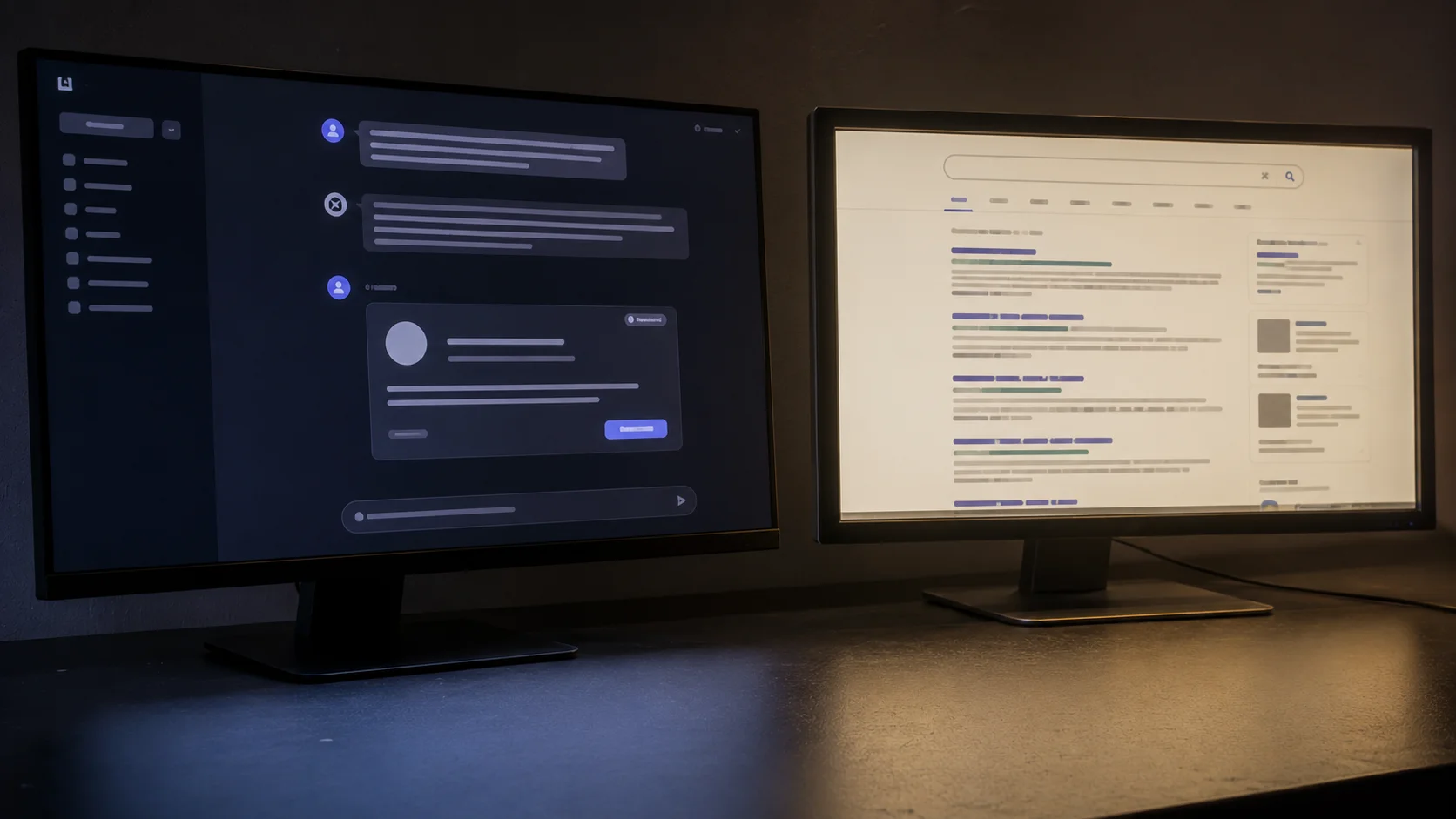
Understanding what OpenAI is selling requires understanding that ChatGPT ads are not display ads. They are not banners, interstitials, or sidebar placements. They are contextually integrated product recommendations that surface inside conversational responses — when a user asks ChatGPT a question that has commercial relevance, an advertiser’s product may appear as part of the response, clearly labeled as sponsored.
The format has no direct equivalent in traditional digital advertising. The closest analogy is a sponsored result in a search engine, but the integration is more seamless — a ChatGPT response to “what laptop should I buy for video editing” might include an organically presented recommendation followed by a sponsored alternative with a “Sponsored” label, rather than a separate unit visually segregated from the content.
This creates both the opportunity and the risk. The opportunity: conversational advertising that appears in the context of a genuine user question has higher relevance and lower friction than display. The risk: if users perceive the sponsored content as compromising the quality or impartiality of ChatGPT’s answers, trust in the product as an information source degrades — and trust is the primary asset that makes ChatGPT valuable enough to advertise against in the first place.
OpenAI’s ad labeling and placement design is therefore not just a compliance question — it is an existential product question. The line between “sponsored recommendation within a helpful response” and “ChatGPT is now a paid-placement engine” is one that user perception will draw for them, regardless of how OpenAI labels the units.
The $2.5 Billion Target and What It Requires
$2.5 billion in advertising revenue in 2026 is an aggressive target for a product that launched in February. It requires approximately $208 million per month in ad revenue for the remainder of the year — significantly above the $100 million ARR run rate achieved in the first two months.
The scaling path is identifiable. ChatGPT has approximately 700 million weekly active users as of early 2026. The portion of those users whose conversations have commercial relevance — the addressable inventory — is a subset, but a large one. As OpenAI expands the categories of conversations where ads appear, the inventory grows. As more advertisers enter the market with budgets, the price competition for that inventory stabilizes and eventually increases.
The minimum spend reduction from $250,000 to $50,000 is the key lever for the near term. At $250,000, only large advertisers with established digital media budgets could participate. At $50,000, the mid-market — the agencies managing brands with $500,000–$5 million total digital budgets — can trial ChatGPT ads without making it a significant proportion of their spend. Opening the market to mid-market advertisers multiplies the number of participating buyers by a factor that the $100M ARR run rate did not include.
The $11 billion by 2027 projection implies a 4x year-over-year growth. That is achievable if the mid-market expansion works and if the CPC model produces measurable performance results that advertisers reinvest. It requires ChatGPT’s user growth to continue and requires that the ad product does not damage user retention — neither of which is guaranteed.
Custom Audience Targeting: The Data Play
OpenAI is rolling out custom audience targeting capabilities that allow advertisers to upload hashed or raw customer identifiers — emails, phone numbers — for targeting and suppression. This is customer match targeting, equivalent to what Google Ads, Meta, and the major ad platforms have offered for years. Its introduction to ChatGPT advertising is significant because it transforms ChatGPT from a contextual-only ad environment into a first-party data-capable platform.
What this enables: a retailer can upload its email list and show ads to existing customers in ChatGPT conversations, or suppress existing customers and show ads only to new prospects. A subscription service can match its subscriber list to ChatGPT users and run win-back campaigns to lapsed members. A financial services company can segment by account type and show different offers to different segments.
The infrastructure required to do this safely — hashing algorithms, privacy-preserving matching, secure data handling — is standard in the industry and not technically novel. What is novel is OpenAI having it. A company that launched advertising three months ago is already offering the targeting sophistication that took Google and Meta years to build. This is the speed at which the ad market is being rebuilt around AI platforms.
The implications for existing platforms are direct. Every dollar of advertiser budget that moves into ChatGPT is a dollar that comes from somewhere — and the most likely source is Google Search and, to a lesser degree, Meta. The advertisers who were most interested in intent-based search advertising are exactly the advertisers most likely to trial ChatGPT ads. Google Marketing Live on May 20 — three days from now — takes place in this context. Whatever Google announces about its AI search advertising product will be interpreted partly as a response to OpenAI’s momentum.
Where ChatGPT Ads Fit in the Funnel
The advertising industry’s standard funnel framework — awareness at the top, consideration in the middle, conversion at the bottom — maps imperfectly onto ChatGPT’s ad product, and the imperfect mapping is the opportunity.
Traditional search advertising captures demand that already exists — a user who searches “best CRM software” is already in the consideration or purchase phase. Google Search ads are powerful precisely because they intercept users at the moment of expressed intent. ChatGPT ads intercept users earlier in a different kind of intent — the exploratory, research-oriented conversation that precedes the comparison search.
A user asking ChatGPT “how do I improve my team’s project management” is not yet searching for specific products. They are defining their problem. An ad that surfaces a relevant software recommendation at that moment — before the user has formed a preference or begun comparison shopping — is a top-of-funnel placement with middle-funnel intent signals. That is a placement that does not exist in traditional search, and its value to advertisers depends on whether it can measurably influence the subsequent purchase journey.
The CPC model makes this measurable. If ChatGPT ads at $3–5 per click produce downstream conversions at rates comparable to intent-based search, the product justifies its pricing tier. If clicks from ChatGPT conversations convert at lower rates than search clicks — because the user intent is more exploratory — advertisers will adjust their bids downward, and the market will find a clearing price that reflects the actual value of the placement.
Criteo, Shengshu, and the Advertising AI Stack
OpenAI’s ChatGPT ad product is the largest single development in AI advertising, but it is not happening in isolation. The broader advertising technology landscape is reorganizing around AI at multiple layers simultaneously.
Criteo has expanded its integration with OpenAI to enable self-service advertising within ChatGPT, connecting conversational AI to cross-channel commerce strategy for brands and agencies. Criteo’s product surfaces product recommendations during discovery-driven conversations — a layer of retail advertising infrastructure built on top of OpenAI’s platform.
Shengshu Technology released Vidu Claw, a tool that creates video advertisements from a single text description. The output is not the cinematic-quality video that human creative teams produce, but it is fast and cheap enough to be viable for performance advertisers who need to test dozens of creative variants simultaneously. Ad creative is being commoditized in the same way that ad targeting was commoditized a decade ago.
The combination of AI-generated creative (Shengshu/Vidu), AI-native placement (OpenAI/ChatGPT), and AI-optimized buying (every major DSP is now running AI-based bidding) means that AI is no longer a feature in the advertising stack — it is the stack. Agencies that have not restructured around this reality are already operating on borrowed time.
What This Means for Google
Google’s advertising business generated $238 billion in revenue in 2025 — the vast majority of which came from Search. The $60 CPM that OpenAI launched with, the $25 that it eroded to, and the $3–5 CPC it is now charging are all well below Google’s effective CPCs in competitive categories. Software and finance keywords on Google routinely cost $30–80 per click in competitive markets.
The immediate competitive threat is not displacement — it is share-of-wallet at the margin. Advertisers with finite budgets who trial ChatGPT at $50,000 minimum spend are not pulling $50,000 from Google simultaneously in most cases. They are finding incremental budget from brand or awareness spend to trial a new channel. The first-order effect is additive to total digital spend, not substitutive.
The second-order effect, over 12–24 months, is more significant. If ChatGPT ads demonstrably perform — if the $3–5 CPC produces conversions — advertisers will shift allocation. Not all of it, and not quickly, but enough to create a new line item in media plans that was not there before. Google’s response to that scenario is the AI Overviews integration and whatever it announces at Marketing Live on May 20. The incumbent is aware of the threat. Whether its response is fast enough to contain the share loss is the defining question of the next two years in digital advertising.
Why The ChatGPT Ad CPM Was Always Going To Collapse
The collapse of the ChatGPT ad CPM from $60 to its current level looks, to the conventional advertising-industry reader, like a pricing failure. It is not. It is what happens when a product priced on attention assumptions enters an environment that does not produce the kind of attention the assumptions required.
The pricing logic of $60 CPM came from the social-media advertising era, where the attention being purchased was passive scrolling attention with weak intent signals and high tolerance for irrelevant placement. ChatGPT is a different category of attention entirely. The user is in a high-intent task-completion state — they are asking the assistant for something specific, with clear context, and they have weak tolerance for irrelevant placement because every ad has the cognitive cost of derailing the task they are trying to complete. The advertising the user can tolerate in this context is much narrower than the advertising the user can tolerate while scrolling Instagram, and the narrowness compresses the CPM the market is willing to pay.
The behavioural economics of this is interesting because it inverts the conventional pricing logic. Higher-intent attention is normally worth more, not less. The reason the CPM collapsed anyway is that the marketers most willing to pay for high-intent attention — search-aligned advertisers — already buy through Google at prices ChatGPT cannot beat. The buyers left for ChatGPT ads are the lower-intent buyers, and the lower-intent buyers will not pay $60. The pricing will continue to fall toward a level that reflects the actual intent layer the surface produces, which is probably somewhere in the $8-$15 CPM range. The $2.5B target is then a volume question, not a CPM question. The original $60 was a category error that anyone who had studied the behavioural texture of assistant-style queries would have caught before launch.
FAQ
When did OpenAI launch ChatGPT advertising?
February 9, 2026, with a CPM model and early advertisers including Target, Ford, Adobe, and Expedia.
What happened to the $60 CPM?
It eroded to approximately $25 within ten weeks as more advertisers entered and inventory expanded. OpenAI then pivoted to a cost-per-click model at $3–5 per click.
What is the minimum spend to advertise on ChatGPT?
$50,000, reduced from the original $200,000–$250,000 at launch.
How much advertising revenue is OpenAI projecting?
$2.5 billion for full-year 2026, scaling to $11 billion by 2027 and $100 billion by 2030.
What does a ChatGPT ad look like?
A contextually integrated product recommendation within a conversational response, labeled as sponsored. Not a banner or display unit — it appears within the text of a ChatGPT answer when the conversation has commercial relevance.
Does ChatGPT advertising compete directly with Google?
Not head-to-head yet, but directionally yes. ChatGPT ads intercept users during exploratory, research-oriented conversations — earlier in the funnel than Google Search ads, which capture expressed purchase intent. The competitive pressure is real but is currently operating at the margin of advertiser budgets.
What is custom audience targeting in ChatGPT ads?
Advertisers can upload hashed email or phone lists to match against ChatGPT users for targeting or suppression — the same “customer match” capability that Google and Meta have offered for years, now available in ChatGPT’s ad platform.
Sources
- The Next Web — OpenAI shifts ChatGPT ads to cost-per-click as $60 CPM erodes
- PYMNTS — OpenAI Begins Offering Cost-Per-Click Ad Campaigns on ChatGPT
- Medium / AI Studio — ChatGPT Just Started Charging $3–$5 Per Click for Ads
- ALM Corp — Digital Marketing News May 1–10, 2026
- NY Ave — May 2026: What’s Happening in Digital Marketing