Oracle Cloud Infrastructure Is Taking AI Revenue From AWS, Azure, and Google
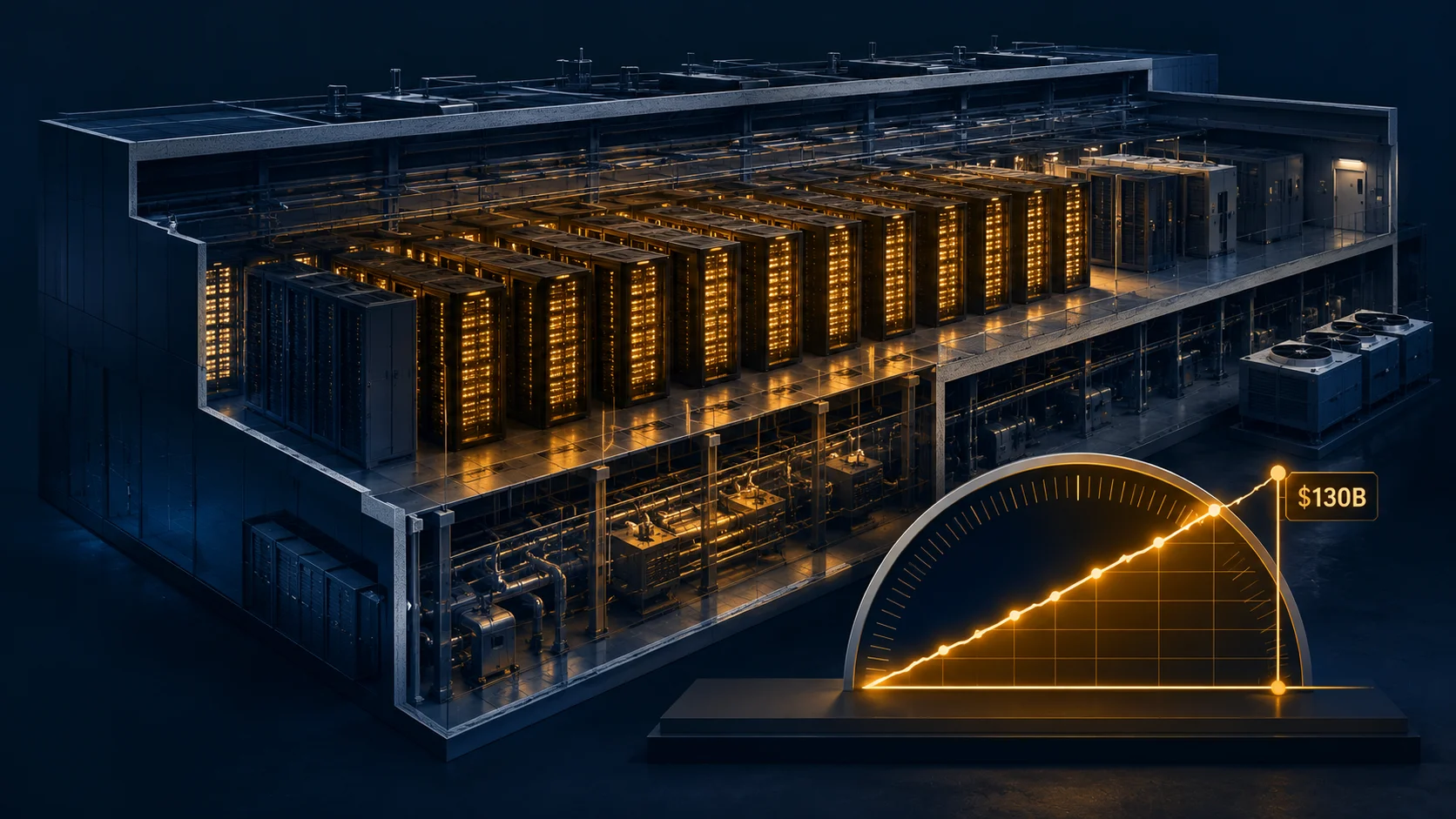
Oracle reported $14.3 billion in total revenue for fiscal Q4 2026 (ending May 31, 2026) — up 15 percent year over year — with cloud infrastructure revenue growing 53 percent annually to reach a $25 billion annualized run-rate and remaining performance obligations (contracted-but-not-yet-recognized future revenue) crossing $130 billion for the first time in the company’s history. Oracle’s investor relations disclosures show AI GPU cluster demand filling Oracle Cloud Infrastructure capacity faster than Oracle can build it — with management confirming on the Q4 earnings call that every GPU cluster Oracle has provisioned in 2026 has been sold before it came online, and that the constraint on Oracle’s cloud revenue growth is now data center construction pace and power provisioning capacity, not customer demand. A $130 billion backlog growing faster than a $25 billion annualized revenue run-rate is the most direct available measure that Oracle Cloud Infrastructure has shifted from a secondary cloud option to a primary AI compute destination for enterprises that cannot secure equivalent GPU cluster availability from AWS, Azure, or Google Cloud on comparable timelines.
Oracle’s position in the cloud market as recently as 2023 was that of a credible but tertiary player in a market structured around three incumbents. Gartner’s cloud infrastructure market share tracking shows AWS commanding roughly 30 percent of global cloud infrastructure revenue, Microsoft Azure at approximately 22 percent, and Google Cloud at 11 percent, with Oracle OCI below 5 percent and characterized primarily by customers running Oracle databases who found OCI the lowest-friction option for adjacent workloads. What changed between 2023 and 2026 was not primarily Oracle’s product quality — OCI had been technically competitive for years — but the arrival of a demand category, AI GPU compute, where the three incumbents were simultaneously supply-constrained and where Oracle had made early infrastructure commitments that gave it provisioned capacity at exactly the moment enterprise demand for that capacity reached its highest point. Oracle’s NVIDIA H100 GPU cluster buildout, accelerated through 2023-2024 ahead of broader AI demand confirmation, positioned the company to fill the availability gap that AWS and Azure left open during their own GPU capacity expansion programs. The capital commitments that Amazon, Microsoft, and Google made to AI infrastructure in 2026 have expanded the total market significantly, but they have not eliminated the gap Oracle exploited — enterprise customers who secured OCI GPU clusters in Q4 2023 and Q1 2024 are now under multi-year committed-spend contracts, and their contracted revenue is in Oracle’s $130 billion backlog.
What the $130 Billion Backlog Actually Signals
Remaining performance obligations represent contracted future revenue the customer has committed to purchase but Oracle has not yet recognized. A $130 billion RPO is not a guarantee of $130 billion in next-year revenue — Oracle will recognize roughly $25-30 billion of it in FY2027 — but it is a guarantee of customer commitment. Multi-year cloud contracts are directional infrastructure decisions: enterprises signing 3- to 5-year OCI committed-spend agreements have selected Oracle as a primary vendor, not a backup. The switching cost of migrating AI workloads off OCI — re-architecting pipelines, migrating data, retraining operations teams, renegotiating NVIDIA licensing and support terms — is high enough that contract renewal is the default behavior unless Oracle gives a customer a specific reason to leave. A $130 billion backlog growing by $20-25 billion per quarter is, structurally, a measurement of how many enterprise AI workload decisions have been made in Oracle’s favor and how durable those decisions are through the medium term.
The Oracle-Microsoft infrastructure interconnect partnership, active since 2024 and expanded to additional regions through 2025-2026, is the clearest market-structure signal in the AI infrastructure race. Under the partnership, enterprises can deploy workloads that span OCI and Azure through a unified management interface, with compute charges billed through whichever provider’s infrastructure runs the workload. The arrangement is commercially unusual because it acknowledges explicitly that Microsoft Azure alone cannot satisfy the AI GPU cluster demand of its enterprise customer base — and that routing overflow demand to Oracle is preferable to losing those customers to AWS or Google. For Oracle, the partnership provides Azure’s distribution reach and enterprise customer relationships at no direct sales cost. Microsoft’s AI revenue gap relative to its capex commitment reflects the same supply constraint Oracle has benefited from — Azure has been spending aggressively on AI infrastructure and still cannot satisfy all the GPU cluster demand from its installed enterprise base. The interconnect partnership resolves that tension while it persists, and Oracle’s contracted backlog captures the revenue from that resolution window regardless of what the hyperscaler capacity picture looks like when the contracts expire.
How Oracle Won AI Compute Without Playing the Hyperscaler Game
Oracle’s competitive advantages in 2026 are specific rather than broad. In AI GPU compute availability — particularly for NVIDIA H100 and H200 clusters where AWS and Azure had allocation queues measured in quarters during peak demand — OCI’s wait times have been materially shorter at comparable demand peaks, and OCI’s per-GPU pricing has been consistently at or below the hyperscaler rate cards for equivalent instance types. In Oracle database workloads, OCI is the natural home because running Oracle databases on AWS or Azure introduces licensing and support complications that OCI avoids by design. In dedicated single-tenant AI infrastructure for regulated industries — healthcare organizations with HIPAA requirements, financial institutions with data sovereignty constraints, federal contractors with FedRAMP obligations — OCI’s willingness to provision isolated customer-dedicated GPU clusters at pricing that matches the hyperscaler equivalents has differentiated Oracle in enterprise competitive evaluations where multi-tenant compute is disqualifying. Where OCI trails materially: managed services breadth (AWS has approximately 220 distinct managed services, OCI roughly 150), developer tooling ecosystem, geographic data center coverage outside North America and Western Europe, and the startup-to-enterprise pipeline that AWS and Azure have built through startup credit programs over fifteen years. The $700 billion AI infrastructure commitment from the Magnificent Seven in 2026 will eventually close the GPU availability gap that gave Oracle its market entry window — the question is whether Oracle can use the contracted backlog period to embed OCI more deeply in enterprise database and application estates before the availability advantage normalizes.
Why Enterprise AI Buyers Are Signing Multi-Year OCI Contracts
Enterprise infrastructure decisions in 2026 are being made under conditions that favor Oracle’s specific strengths: GPU cluster availability is the highest-priority variable for AI workload infrastructure selection, pricing transparency matters more than ecosystem breadth for workloads where the compute requirement is defined before the infrastructure is selected, and multi-year committed-spend economics reward the vendor that can guarantee delivery timeline over the vendor with the largest service catalogue. Reuters technology coverage through Q2 2026 characterizes Oracle’s cloud position as a specialist that has successfully exploited the AI compute bottleneck without becoming a full-stack hyperscaler competitor — a viable long-term position if AI infrastructure spending remains concentrated at the top of the enterprise budget stack. The strategic risk Oracle faces is the 2027 timeline: Gartner projects that hyperscaler GPU capacity reaches parity with enterprise demand by late 2027, at which point Oracle’s availability advantage normalizes and pricing becomes the primary competitive variable. Oracle’s answer to that risk is the depth-of-integration strategy — embedding OCI into enterprise database operations, analytics workflows, and application estates through APEX, Autonomous Database, and Oracle Analytics Cloud integrations that run materially better on OCI than on competing infrastructure. Whether that depth-of-integration moat is sufficient to retain backlog customers when their multi-year contracts expire is the key question Oracle’s FY2029 revenue will answer. For FY2027 and FY2028, the contracted backlog makes the answer clear: the AI compute window has already been converted into durable forward revenue regardless of what the competitive infrastructure market does in the interim.
How Oracle Wins AI Infrastructure Without Competing in the Model Layer
Aggregation theory — the framework Ben Thompson has applied most consistently to understanding platform power — distinguishes between platforms that control access to users and platforms that control access to supply. Google aggregates user attention and uses that control to set the terms of the advertising market. Netflix aggregates content rights and uses that control to negotiate with studios. Oracle’s position in enterprise AI is neither of those things. Oracle controls access to GPU compute at a price point and contract structure that enterprises buying multi-year AI infrastructure commitments find more predictable than the hyperscaler alternatives — and it has no competing AI model product that creates the channel conflict that makes AWS, Azure, and Google Cloud structurally uncomfortable for enterprises that want neutral infrastructure.
The $130 billion contract backlog that OCI has accumulated is not primarily a signal about Oracle’s model capabilities. It is a signal about enterprise procurement decisions made by companies that need GPU capacity and are specifically avoiding concentrating that dependency in the same vendor from whom they buy their foundational AI services. A pharmaceutical company using Microsoft’s Copilot and Azure OpenAI for internal productivity tooling has a rational reason to prefer Oracle or another provider for its GPU training infrastructure: it does not want Microsoft to have both the client-facing AI model relationship and the underlying compute contract. The structural separation between model vendor and infrastructure vendor has commercial value to the enterprise even when the infrastructure vendor’s technology is not meaningfully differentiated from the hyperscaler equivalent.
Oracle’s $130 billion backlog reflects this procurement logic at scale. The enterprises signing 3-5 year OCI contracts are not doing so because OCI’s performance benchmarks consistently outperform AWS or Azure. They are doing so because Oracle occupies the “neutral compute” position in the AI infrastructure market — a position that AWS, Azure, and Google Cloud structurally cannot occupy because each of them is also selling the frontier AI models that enterprise AI buyers are using as their primary application layer. Oracle’s competitive moat in enterprise AI is not technical leadership. It is the absence of a model business — which looks like a weakness from a product innovation standpoint and functions as a trust advantage in the enterprise procurement conversations that are producing the $130 billion backlog.
What the Enterprise Procurement Chain Behind Oracle’s $130 Billion AI Backlog Actually Looks Like
A $130 billion contract backlog is a number that needs to be followed through the organizations that signed those contracts. Enterprise AI infrastructure commitments of this size do not emerge from a CTO’s preference for a particular vendor’s GPU throughput metrics. They emerge from procurement processes that involve budget committees, vendor risk assessments, legal review of multi-year commitment structures, board-level capital allocation approvals, and finance team analysis of vendor diversification mandates. The people who matter in a $130 billion GPU compute commitment decision are not the ones quoted in Oracle’s investor presentations. They are the procurement officers, the CFOs, and the board risk committees who authorized the capital.
Oracle’s neutral compute positioning resonates in enterprise procurement because the procurement officers have a specific mandate concern: dependency concentration risk when their infrastructure vendor also competes with their AI model vendor. AWS, Azure, and Google Cloud are all pursuing enterprise AI application revenues that compete with enterprise-built and third-party AI applications. An enterprise that signs a five-year GPU compute commitment with AWS is signing with an entity that may be competing with its own AI application layer in eighteen months. The procurement chain recognizes that risk because recognizing it is the procurement chain’s job. Oracle’s $130 billion backlog reflects, in significant part, that risk committee consensus — not just Oracle’s technical superiority.
What an investigative inquiry would want to know is the composition of that backlog. How much is driven by genuine compute-cost efficiency versus vendor diversification mandates? How much is concentration from a small number of very large customers versus broad enterprise distribution? What are the exit clauses, and what do they reveal about how committed these customers actually are? A $130 billion number with three customers and flexible exits means something structurally different from a $130 billion number with forty customers on strict multi-year terms. Oracle has not disclosed the backlog composition at that level of detail. The vendor narrative is that demand is strong and structural. The follow-the-money question is who signed, why, and what they have the right to do if the rationale changes.