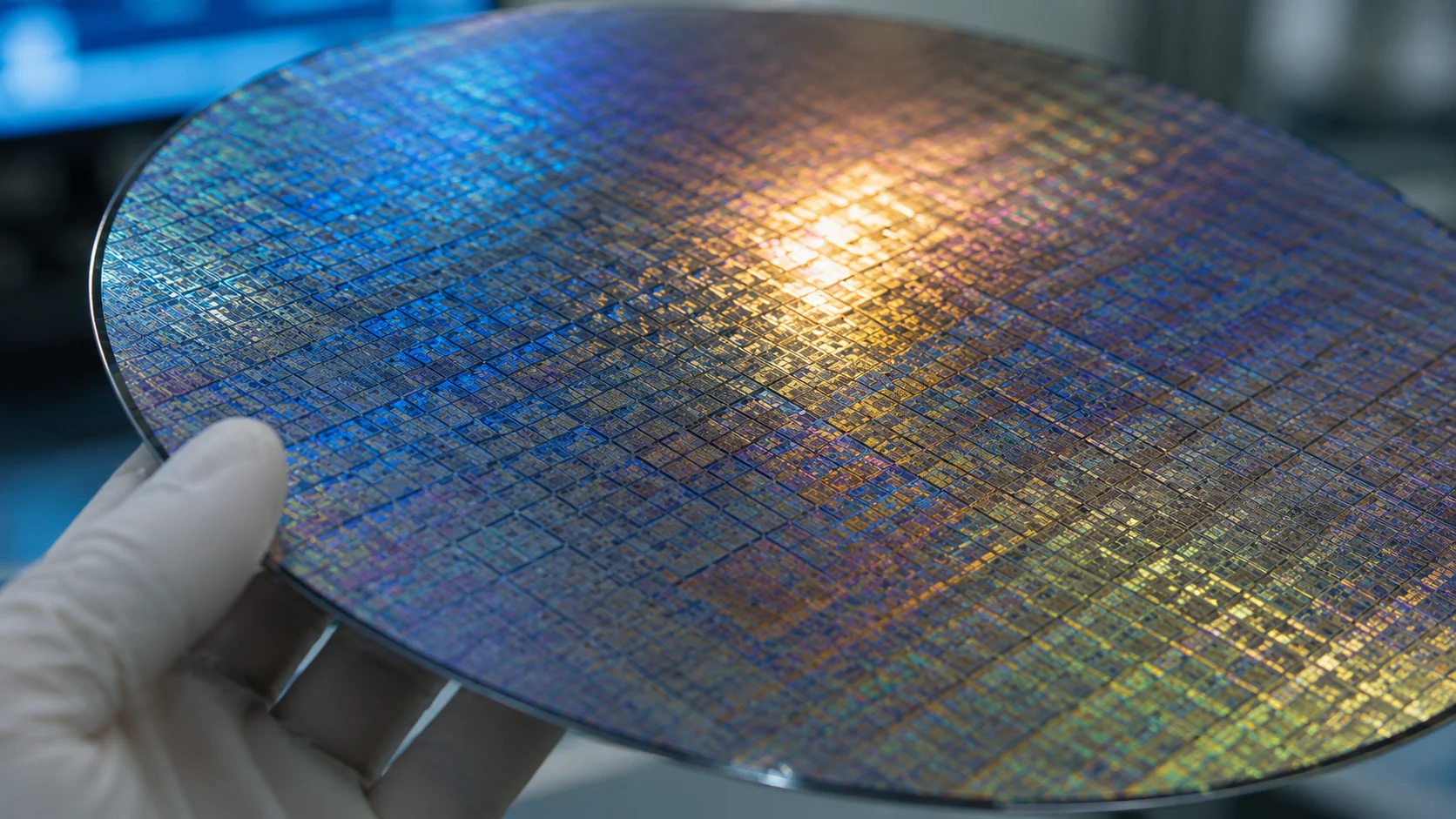
Global semiconductor sales reached $298.5 billion in Q1 2026 — up 25% from the previous quarter — and the Semiconductor Industry Association says the full-year total is on track to exceed $1 trillion for the first time in history. Memory chips are the defining story: spending is forecast to jump from $216 billion last year to $633 billion in 2026, driven by AI inference infrastructure requirements. Amazon’s AI chip backlog alone sits at $225 billion — the spending side of the Magnificent Seven’s $700 billion 2026 AI capex commitment, and the foundry capacity needed to absorb it is the same constraint reshaping Intel’s onshoring talks with Apple. The Philadelphia Semiconductor Index is up 66% year-to-date. And a Goldman Sachs analyst is publicly warning the sector resembles 1999 — with a 25-30% correction risk embedded in current valuations. The question is whether the $1 trillion milestone marks a genuine structural shift in the semiconductor industry’s size, or whether Wall Street has simply front-run a demand cycle that hasn’t fully arrived yet.
The Numbers Behind the $1 Trillion Forecast
The $298.5 billion Q1 2026 figure from the Semiconductor Industry Association is the most concrete evidence that the $1 trillion full-year forecast isn’t just analyst optimism. Tom’s Hardware reported the SIA data showing a 25% quarter-over-quarter increase — a pace that, if sustained, would push full-year revenue well above the $1 trillion threshold even accounting for typical second-half seasonality.
The composition of that growth matters. Memory — DRAM and NAND flash — is driving the acceleration. Gartner’s latest forecast puts memory chip spending at $633 billion for 2026, up from $216 billion in 2025 — nearly a 3x increase in a single year. The driver is AI inference infrastructure: the model serving clusters that hyperscalers are building require enormous amounts of high-bandwidth memory (HBM) attached to each GPU, and HBM is the fastest-growing and highest-margin segment of the memory market.
Micron has been the most visible beneficiary. The company’s stock is up over 750% in the past year, which reflects both genuine HBM demand and the market’s willingness to price in multi-year infrastructure build requirements. AMD’s CEO noted that “agents are really driving tremendous demand in the overall AI adoption cycle” — confirmation that the demand signal comes from AI agent deployment infrastructure, not just training workloads.
Amazon’s $225 Billion AI Chip Backlog
Amazon’s disclosure of a $225 billion AI chip backlog is the single most striking data point in the current semiconductor cycle. Motley Fool reported that Amazon’s custom chip business — primarily Trainium 2 and Inferentia chips designed for AI training and inference — is growing at triple-digit year-over-year percentages, with a current annual revenue run rate above $20 billion and nearly 40% quarter-over-quarter growth in Q1.
The $225 billion backlog has two implications. First, it confirms that the hyperscaler custom chip programs — Amazon Trainium, Google TPUs, Meta’s MTIA — are scaling far faster than Wall Street was modeling a year ago. Second, it suggests that the custom silicon investment is not displacing Nvidia GPU demand but supplementing it: the total compute requirements for AI agent deployment are large enough that hyperscalers are buying every chip they can produce, whether Nvidia H100s, their own custom ASICs, or AMD MI300X accelerators.
For Nvidia’s upcoming May 20 earnings report, this context is important. The custom chip backlog at Amazon doesn’t mean Nvidia is losing share — it means the overall addressable market for AI compute is larger than the Nvidia-centric view of the semiconductor cycle suggested. That’s bullish for the entire semiconductor supply chain, including memory, networking silicon, and power management chips.
The “Changing of the Guard” in AI Chips
While Nvidia has dominated the AI chip narrative since 2023, CNBC reported that Wall Street is increasingly moving to Intel, AMD, and Micron as the AI chip trade rotates. Goldman Sachs and Bernstein both upgraded AMD to buy ratings in May, citing CPU tailwinds as AI agents require more general-purpose compute alongside GPU acceleration.
The narrative shift reflects something real about AI workload composition. Training large models is GPU-dominated and Nvidia-centric. But inference — serving those models to users and agents at scale — has a different compute profile. Inference workloads run on a mix of GPUs, CPUs, and custom ASICs depending on latency and throughput requirements, and AMD’s Instinct accelerators and Intel’s Gaudi 3 are competitive in inference at a meaningfully lower price point than Nvidia’s H100/H200 stack.
The inference market shift is already visible in design wins — AMD’s MI300X has taken meaningful market share in inference-optimized data centers, and Intel’s Gaudi 3 is the choice for cost-sensitive inference deployments where Nvidia’s premium isn’t justified. As the AI infrastructure market matures from “build training clusters” to “scale inference economically,” the competitive dynamics favor a broader set of chip vendors than the training-era market did.
The Valuation Warning Nobody Wants to Hear
Set against the demand data is an analyst warning that the Philadelphia Semiconductor Index — up 66% year-to-date — is pricing in a perfection scenario that history suggests is dangerous. The specific comparison is to 1999: a period when genuine technological transformation (the internet) intersected with speculative excess to create a valuation overhang that took years to unwind.
The analyst case for caution runs as follows. Semiconductor cycles are inherently cyclical — demand surges create supply investment, supply investment creates overcapacity, overcapacity creates pricing pressure and margin compression. The $725 billion in hyperscaler AI capex committed for 2026 represents a massive pull-forward in chip demand. When that infrastructure is built, the incremental demand signal weakens — and stocks priced for perpetual growth derate sharply.
The 25-30% correction risk estimate for the PHLX isn’t a prediction that AI infrastructure demand is fake. It’s a prediction that stocks up 66% YTD are priced for a scenario where nothing goes wrong: no macro slowdown, no trade restriction escalation affecting TSMC, no Nvidia supply shortfall, no custom silicon displacing GPU demand faster than expected. Any one of those variables moving adversely is enough to trigger the kind of valuation reset the 1999 comparison implies.
TSMC and the Concentration Risk
The $1 trillion semiconductor forecast depends heavily on TSMC’s ability to produce leading-edge chips at scale. TSMC manufactures over 90% of the world’s most advanced semiconductors — the chips that power Nvidia’s H100s, AMD’s Instinct accelerators, Apple’s M-series, and Amazon’s Trainium. This concentration creates a single-point fragility that the semiconductor trade is pricing through, rather than pricing in.
The Taiwan geopolitical risk isn’t new information, but it becomes materially more relevant as the stakes of the semiconductor cycle increase. A $1 trillion industry with 90%+ of advanced production at a single fab cluster in Taiwan creates a supply security vulnerability that no amount of CHIPS Act investment in U.S. domestic fabs has yet resolved. TSMC’s Arizona fab is operating, but advanced node production at U.S. scale is years away from providing meaningful supply redundancy.
For investors pricing the semiconductor supercycle, TSMC concentration risk is the asymmetric downside that doesn’t appear in the earnings models but sits behind every bullish forecast. The demand is real; the question is whether the supply infrastructure can consistently deliver it from a geography that multiple governments consider a strategic risk.
Crypto and Web3 Mining Implications
A $1 trillion semiconductor industry has specific implications for the crypto mining and on-chain compute ecosystem. The HBM supply crunch that’s driving Micron’s stock up 750% is the same supply chain that affects the availability and pricing of consumer and enterprise GPUs — the hardware that runs Ethereum validator nodes, ZK proof generation, and decentralized compute networks.
As HBM allocation prioritizes hyperscaler AI clusters, the availability of high-performance memory for non-AI applications tightens. This creates a secondary market dynamic for mining and decentralized compute: operators running Bittensor (TAO), io.net, and Akash Network infrastructure are competing for GPU hardware against the largest companies in the world, which are buying in hundred-thousand-unit quantities with multi-year contracts.
ZK proof computation — the compute-intensive cryptographic foundation of Ethereum Layer 2 scaling — is directly affected by the inference chip market. zkSync, StarkNet, and Polygon zkEVM all run proof generation on GPU clusters that are subject to the same supply and pricing dynamics as AI inference hardware. A semiconductor supercycle that concentrates the best chips at hyperscalers isn’t neutral for ZK infrastructure — it raises the hardware cost of decentralized proof generation relative to centralized alternatives.
The flip side is that the custom ASIC trend — Amazon Trainium, Google TPUs — accelerates the development of application-specific proof generation hardware. As ZK proof workloads scale, dedicated ZK ASICs become economically viable. Several teams are already building ZK-specific accelerators, and the semiconductor supercycle is making the investment case for that specialization stronger, not weaker.
The Mental Model Worth Carrying Into A $1 Trillion Industry
The right frame for any forecast that hits a trillion-dollar industry milestone is to ask which part of the forecast is mechanical and which part is reflexive. The mechanical part is the demand math — orders, capacity, lead times, the parts you can verify with primary sources. The reflexive part is the price-and-narrative loop, where strong demand drives high valuations, high valuations drive more capacity announcements, capacity announcements drive more narrative, and narrative pulls in capital that flatters the demand math.
The current semiconductor cycle has both layers running. The mechanical layer is genuinely strong — Amazon’s $225 billion backlog is not a narrative. The reflexive layer is also running, which is why valuation warnings keep appearing in the same coverage as bullish demand forecasts. Both are correct simultaneously, which is what makes the cycle hard to read.
The mental model worth carrying is to separately track the mechanical and reflexive signals rather than collapsing them into a single bullish or bearish call. Strong demand + stretched valuations is not a contradiction. It is the standard texture of every late-cycle commodity boom, and the question is not whether both are true (they are) but which one breaks first when stress arrives. The mechanical layer usually compresses last and recovers fastest. The reflexive layer usually breaks first and recovers slowest. Anyone planning capacity or capital deployment against this cycle should be planning against the reflexive break, not the mechanical one.
FAQ
Why are global semiconductor sales on track to hit $1 trillion in 2026?
The primary driver is AI infrastructure investment. The Magnificent Seven and other hyperscalers have committed approximately $725 billion in capital expenditure for 2026, a significant portion of which goes to semiconductor procurement — GPUs, custom AI chips, high-bandwidth memory, and networking silicon. Q1 2026 semiconductor sales of $298.5 billion already represent a 25% quarter-over-quarter increase, and memory chip spending alone is forecast to jump from $216 billion in 2025 to $633 billion in 2026 — nearly a 3x increase driven by HBM requirements for AI model serving. The combination of AI training, inference, and the broader digital infrastructure build creates demand across virtually every semiconductor category simultaneously.
What is Amazon’s $225 billion AI chip backlog?
Amazon’s AI chip backlog refers to committed future orders for its custom AI chips — primarily Trainium 2 training chips and Inferentia inference chips — developed through Amazon Web Services. The $225 billion figure represents the value of forward orders and deployment commitments from AWS customers who have pre-committed to AI compute capacity. Amazon’s custom chip business is growing at triple-digit year-over-year rates with an annual revenue run rate above $20 billion. The backlog is significant because it confirms that custom silicon programs are scaling faster than Wall Street models anticipated — and that total AI compute demand is large enough to support both Nvidia GPU procurement and hyperscaler custom chip deployment simultaneously.
Is the Philadelphia Semiconductor Index overvalued at up 66% YTD?
A Goldman Sachs analyst has publicly compared the current semiconductor index valuation to 1999 and warned of a 25-30% correction risk. The concern isn’t that AI demand is fake — it’s that stocks up 66% YTD are priced for perfect execution: sustained demand, no supply disruptions, no macro headwinds, no faster-than-expected displacement of GPU demand by custom silicon. Semiconductor cycles are historically cyclical, and a demand surge of this magnitude typically creates supply investment that eventually produces overcapacity and margin compression. Whether 2026 marks the peak of the current cycle or a midpoint in a multi-year supercycle is the central debate in semiconductor investing.
What does the memory chip shortage mean for AI infrastructure?
High-bandwidth memory (HBM) — the specialized memory attached to AI accelerator chips — is in severe supply constraint. Each Nvidia H100 GPU requires approximately 80GB of HBM3e memory, and data center clusters running thousands of GPUs require enormous HBM allocation. Gartner’s forecast of $633 billion in 2026 memory chip spending, up from $216 billion, reflects the compounding of HBM demand with standard DRAM and NAND requirements from the broader AI infrastructure build. Micron, SK Hynix, and Samsung are the primary HBM suppliers, and their production capacity is fully committed through 2026 and into 2027 — meaning any demand shortfall in AI infrastructure could create inventory build and price pressure in the memory market.
How does the semiconductor supercycle affect crypto and Web3 infrastructure?
The semiconductor supercycle has three main effects on crypto and Web3. First, GPU supply prioritization for hyperscaler AI clusters tightens availability and raises costs for decentralized compute networks (Bittensor, io.net, Akash) and mining operations that depend on the same hardware. Second, ZK proof generation — the compute foundation of Ethereum L2 scaling — runs on GPU infrastructure subject to the same supply dynamics, raising the cost of decentralized proof generation relative to centralized alternatives. Third, the custom ASIC trend accelerating through the AI cycle is creating the economic conditions for ZK-specific accelerator chips, which would dramatically reduce the cost of proof generation at scale and benefit the entire Ethereum Layer 2 ecosystem.
Sources
- Tom’s Hardware — SIA Q1 2026 semiconductor sales data and $1 trillion forecast
- Motley Fool — Amazon’s $225 billion AI chip backlog analysis
- CNBC — “Changing of the guard” in AI chips: Intel, AMD, Micron surge
- Deloitte — 2026 Semiconductor Industry Outlook
- Yahoo Finance — Tech stocks: chip surge on AI boom
- 24/7 Wall St. — AI semiconductor valuations and correction risk analysis