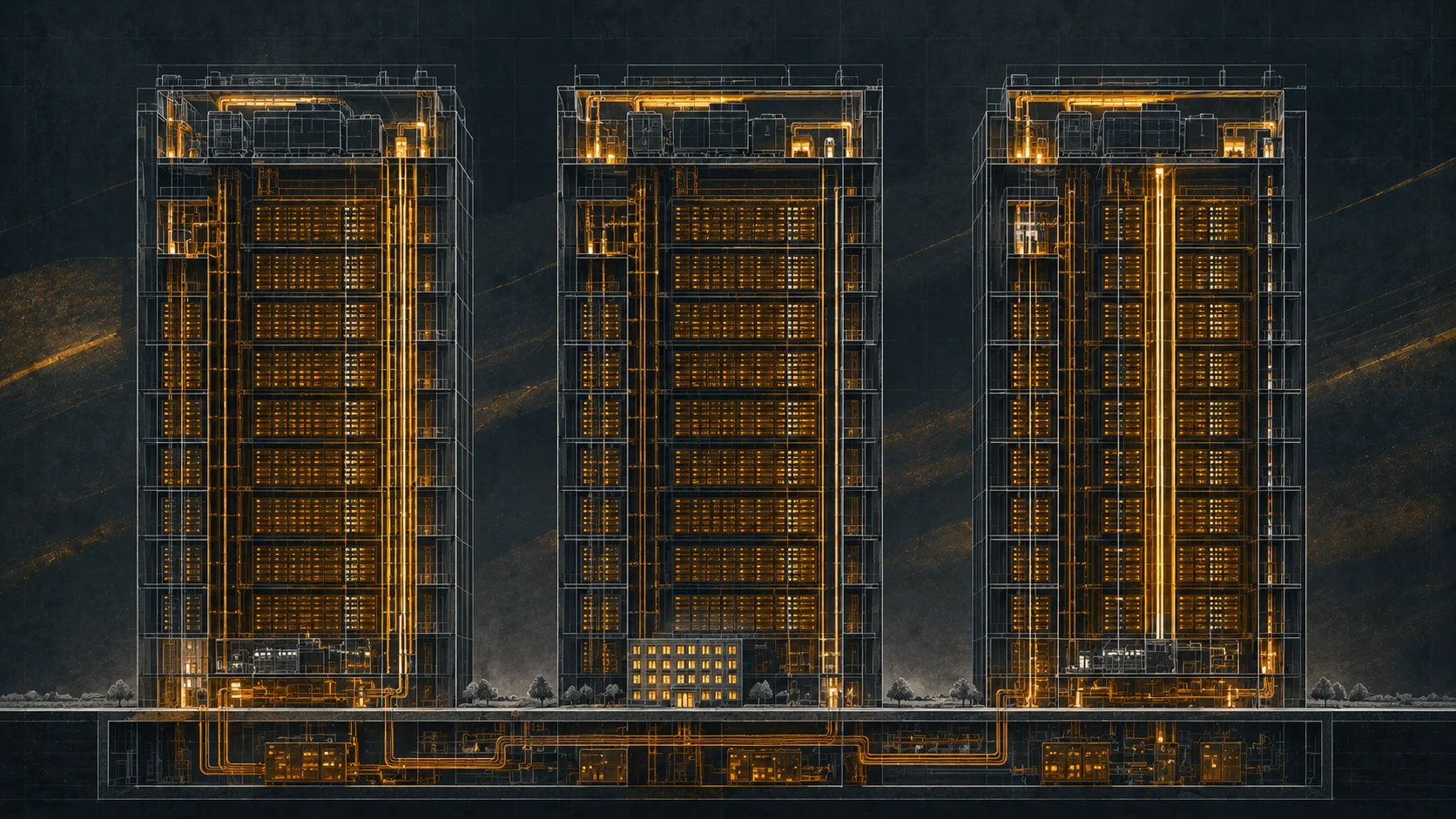
The Largest Infrastructure Bet in Commercial History
The combined capital expenditure commitments of the three dominant hyperscale cloud providers in fiscal 2026 represent the largest peacetime infrastructure investment by commercial entities in recorded history. Amazon Web Services has guided to over $100 billion in CapEx for the fiscal year. Microsoft committed to $80 billion in data center investments in its fiscal year, which ends in June 2026. Google’s Q1 2026 capital expenditure alone was $17.2 billion, annualizing to approximately $70 billion. The combined number — roughly $250 billion in a single year, from three companies, directed primarily at the compute infrastructure needed to train and serve AI models — exceeds the annual infrastructure investment of most national governments.
The scale creates a context problem for anyone trying to evaluate it: there is no historical precedent for this level of private sector infrastructure investment in a single technology category over a single year. The nearest analogs are the telecom buildout of the 1990s, the early internet backbone construction, and the electricity grid expansion of the mid-20th century — each of which represented multi-year, multi-decade commitments that produced infrastructure bottlenecks, significant overcapacity in some segments, and ultimately transformative economic value. The question the hyperscaler CapEx raises is not whether the AI infrastructure is being built — it clearly is — but whether the economics of the applications that will run on it justify the investment being made on the timelines the hyperscalers are committing to.
What the Money Is Buying
The $250 billion in annual CapEx is purchasing several distinct categories of infrastructure. The largest component is GPU servers — specifically Nvidia Blackwell GPUs at roughly $30,000-40,000 per unit, deployed in clusters of thousands for AI training workloads and in smaller configurations for inference serving. Each hyperscaler is building GPU capacity that serves both internal AI development (training the models they use for their own products) and external AI-as-a-service customers (providing GPU compute on demand through cloud APIs). Nvidia’s $75.2 billion in Q1 Data Center revenue is the single-company financial expression of this procurement wave.
The second component is data center construction — the physical buildings, power distribution, cooling systems, and networking infrastructure that houses the GPU servers. AI workloads are substantially more power-intensive than traditional cloud workloads: a rack of Blackwell GPUs consumes 20-30 kilowatts of power, versus 5-10 kilowatts for a comparable rack of CPU servers. The data center footprint required to deploy AI compute at hyperscale is larger and more power-hungry than the footprint of traditional cloud infrastructure, which is driving construction timelines, electricity procurement strategies, and in several cases, direct power generation investments by the hyperscalers.
The third component is networking — the high-speed interconnects between GPUs, between servers, and between data centers that determine training efficiency for large models. GPU compute is only as useful as the bandwidth available to move data between GPUs during training, and the networking investments the hyperscalers are making — custom silicon, proprietary interconnect fabrics, fiber infrastructure between data centers — are as important as the GPU investments themselves for training performance at the scales required for frontier models.
The Demand-Side Validation Required
The financial logic of the $250 billion bet is straightforward: if AI applications generate enough enterprise value to drive cloud revenue growth that exceeds the cost of the infrastructure supporting it, the investment is rational. The hyperscalers are each projecting that AI-driven cloud revenue will grow at rates that justify the CapEx commitments, and the early evidence is consistent with that projection. Microsoft’s Azure revenue growth has accelerated alongside its Copilot AI product adoption. AWS’s AI services have become the fastest-growing segment of Amazon’s cloud business. Google Cloud’s AI products are driving customer acquisition and expansion. The demand-side data, through Q1 2026, supports the investment thesis.
The risk scenario is one in which enterprise AI adoption, while real, proceeds more slowly than the hyperscalers’ planning models assumed. If the transition from “we are piloting AI” to “AI is embedded in our production workflows and we are scaling it” takes three years rather than one, the revenue that justifies the CapEx is deferred. Deferred revenue against committed capital expenditure means lower returns on the investment in the near term and the possibility of overcapacity in specific GPU generations if the next generation’s capabilities make current-generation infrastructure less competitive before current-generation demand has fully materialized.
The Power Constraint That Nobody Solved
The power requirement for the AI infrastructure buildout has emerged as the binding constraint that the industry underestimated. The data centers required to house the compute that Amazon, Microsoft, and Google are procuring need power at a scale that the electrical grid in most locations cannot immediately provide. This constraint is producing a set of behaviors that would have seemed unusual in any other infrastructure buildout context: hyperscalers are building their own power generation capacity (Microsoft and Google both have nuclear power agreements, Amazon has acquired wind and solar capacity), entering into long-term power purchase agreements that lock up available renewable capacity in priority markets, and in some cases selecting data center locations based primarily on available power rather than network latency or proximity to customers.
The power constraint is the factor most likely to cause the $250 billion CapEx commitment to miss its theoretical potential. If the GPU servers are purchased but the power and cooling infrastructure to operate them at full utilization cannot be constructed fast enough, the effective compute capacity available is lower than the hardware investment suggests. The hyperscalers’ data center construction timelines — 18-36 months from site selection to full operation for large facilities — mean that the compute capacity being planned today will come online in 2027-2028. The timing mismatch between GPU procurement and data center readiness is one reason why hyperscaler CapEx numbers don’t translate directly into immediately available compute capacity.
The Returns Question
The fundamental returns question for the $250 billion AI infrastructure bet is one that won’t be answerable with confidence until 2028-2030. The AI applications being built on this infrastructure need to generate economic value — in productivity improvement, in revenue generation, in cost reduction — that justifies the capital costs of the infrastructure at reasonable discount rates. The enterprise AI adoption data through early 2026 is encouraging but not conclusive: KPMG deploying Claude to 276,000 employees, Goldman Sachs and JPMorgan integrating AI into investment banking workflows, and thousands of enterprise AI deployments suggest that the demand exists. Whether it exists at the scale and pace required to justify the infrastructure investment is the question that the next three years of enterprise adoption data will answer.
The hyperscalers have made the bet. The infrastructure is being built. The $250 billion is committed or committing. Whether it was the right bet at the right time and scale is a question that will be answered by the enterprise applications that run on it, and by whether those applications generate the economic value that the investment requires. The largest infrastructure bet in commercial history is in progress. We’ll know whether it paid off by the end of the decade.
The Clarity $250 Billion Demands
William Zinsser’s central argument in “On Writing Well” is that clutter is the disease of American writing, and that every word should be doing work. The same principle applies to capital allocation. Every dollar should be doing work. And the $250 billion that Amazon, Microsoft, and Google are committing to AI infrastructure in 2026 is, at minimum, a test of whether the people spending it can explain — in clear, unhedged sentences — what they expect it to return.
The clutter version appears in most earnings calls: “We continue to see strong signals of customer demand across our AI portfolio and remain committed to investing at the levels necessary to capture the secular growth opportunity in cloud and AI infrastructure.” That sentence says nothing. It contains no predicate that could be proven wrong.
The numbers say something. Amazon is spending $100 billion. Microsoft is spending $80 billion. Google is spending $70 billion. Together they are building more data center capacity and buying more GPU servers than any commercial enterprise has committed to in a single year in history. The return on that investment depends entirely on whether enterprise customers use the compute they’re being offered at a price above the cost of providing it. That hasn’t been proven yet.
The GPU server buildout is real. The data center construction is real. Nvidia’s $75.2 billion in data center revenue in Q1 FY2027 alone confirms that the hardware spending is genuine, not a paper commitment. But hardware deployment and economic return are different measurements. The hyperscalers are building ahead of demonstrated demand — which is correct strategy if demand materializes and catastrophic capital misallocation if it doesn’t.
Zinsser would apply a simple editing rule: if you can’t write a clean sentence explaining what you expect to get back, you may not have thought it through clearly enough. The sentence the hyperscalers need to be able to write is something like: “We believe enterprise AI workloads will consume X exaflops of compute by Y year, generating Z in revenue at a W percent margin, producing a return above our cost of capital in N years.” Any version of that sentence is worth scrutinizing. The consistent absence of that sentence is the most important disclosure in every AI infrastructure earnings call this year.
The largest infrastructure bet in commercial history has been made. The clutter will clear when the returns either justify it or don’t. Until then, read every investor day presentation the same way you’d edit a first draft: cut the adjectives, find the verb, and ask what the sentence actually commits to.