FIGR_HELOC$1.04▲ 0.37%WBT$56.54▲ 2.83%RAIN$0.0147▲ 2.99%XRP$1.10▲ 3.40%ETH$1,875.59▲ 5.14%BNB$579.18▲ 1.57%WTI$79.75▲ 0.52%ZEC$552.79▲ 9.50%LEO$9.80▲ 2.76%USDS$0.9998▲ 0.00%XLM$0.1832▲ 2.44%NATGAS$2.92▲ 0.52%DOGE$0.0741▲ 2.91%BRENT$85.48▲ 0.89%BTC$64,734.00▲ 3.30%SOL$78.02▲ 3.98%XAU$4,040.30▼ 0.51%HYPE$66.79▲ 5.45%TRX$0.3264▲ 0.55%XAG$58.81▲ 0.06%FIGR_HELOC$1.04▲ 0.37%WBT$56.54▲ 2.83%RAIN$0.0147▲ 2.99%XRP$1.10▲ 3.40%ETH$1,875.59▲ 5.14%BNB$579.18▲ 1.57%WTI$79.75▲ 0.52%ZEC$552.79▲ 9.50%LEO$9.80▲ 2.76%USDS$0.9998▲ 0.00%XLM$0.1832▲ 2.44%NATGAS$2.92▲ 0.52%DOGE$0.0741▲ 2.91%BRENT$85.48▲ 0.89%BTC$64,734.00▲ 3.30%SOL$78.02▲ 3.98%XAU$4,040.30▼ 0.51%HYPE$66.79▲ 5.45%TRX$0.3264▲ 0.55%XAG$58.81▲ 0.06%
Prices as of 04:57 UTC

Author: Tyler Raze

  • Lucasfilm Is Already Killing the Sequel Trilogy. It Should Finish the Job — Then Step Back and Let Something New Win.

    Lucasfilm Is Already Killing the Sequel Trilogy. It Should Finish the Job — Then Step Back and Let Something New Win.

    Lucasfilm Is Already Killing the Sequel Trilogy. It Should Finish the Job — Then Step Back and Let Something New Win.

    Lucasfilm sequel trilogy — Star Wars retcon and reset

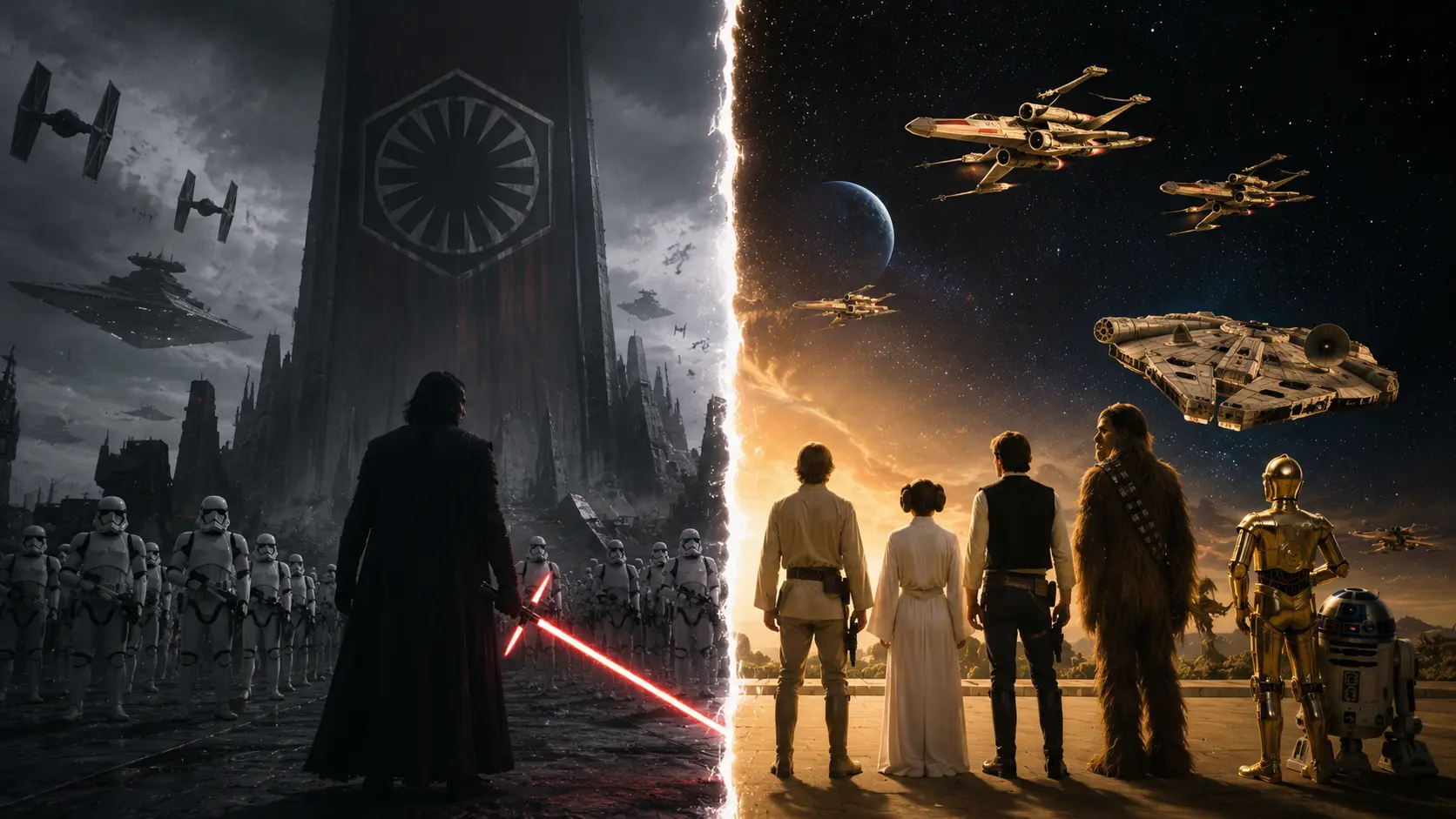
    Kathleen Kennedy left Lucasfilm in January 2026 after nearly fourteen years as president, and the company she handed to Dave Filoni and Lynwen Brennan is already doing something it won’t say out loud: dismantling the sequel trilogy’s place at the centre of Star Wars canon. In the comics, a Han Solo miniseries quietly patched a plot hole in The Force Awakens that the film’s own creators never addressed. In the theme parks, Galaxy’s Edge at Disneyland was restructured from April 29, 2026 to bring in Luke Skywalker, Leia, Han Solo, and Darth Vader — characters who had been deliberately excluded from the land since 2019 because it was locked in the sequel-era First Order timeline. The Rey Skywalker film that was announced, given a release date, cycled through three writers, and then quietly had its December 2026 slot handed to Ice Age 6 is now widely understood to be dead. The Mandalorian — the streaming series that was the best thing to come out of the Disney era — has been cancelled, its conclusion moved to a theatrical film.

    What’s happening is obvious. What’s missing is the honest acknowledgment of what it means, and the decisive creative choice that would actually complete the reset rather than leaving the franchise in a permanent state of half-retcon. Our position is straightforward: Lucasfilm should finish what it has started, formally sideline the sequel trilogy as a creative dead end, and then do something harder — step back, breathe, and allow the cultural space that Star Wars has occupied for nearly fifty years to open up for something genuinely new.

    That second part is the argument most people aren’t making. The debate so far is about what to do with the sequel trilogy. The more interesting question is what the entertainment industry does with the cultural real estate that a legacy franchise has colonised for half a century, once the franchise finally admits it has run its course.

    What the Sequel Trilogy Actually Was

    The numbers on the sequel trilogy are worth stating cleanly because they contain the contradiction that explains everything. The Force Awakens grossed $2.07 billion worldwide. The Last Jedi grossed $1.33 billion. The Rise of Skywalker grossed $1.07 billion. Combined, the trilogy is the highest-grossing Star Wars trilogy ever made in nominal terms, clearing $4.4 billion. By the only metric that Hollywood typically uses to evaluate franchise decisions, the sequel trilogy was a success.

    It was not a success. The box office is the wrong measurement.

    The correct measurement is what the trilogy did to the audience that had been loyal to Star Wars for decades, and what it did to the creative universe. The Last Jedi arrived with a 91% critical score on Rotten Tomatoes and a 41% audience score — a split that is not a disagreement about quality but evidence of a fundamental breakdown between what the film was trying to do and what the audience needed it to do. Director Rian Johnson made a genuinely bold film that killed off the mystery box villain established in The Force Awakens, sidelined Luke Skywalker in ways that many longtime fans experienced as a character betrayal, and set up a third film that had no coherent path to follow from what he left.

    J.J. Abrams’s response in The Rise of Skywalker was to spend $275 million — $600 million including marketing — largely undoing the previous film. “Somehow, Palpatine returned.” Rey’s parentage was reversed from what The Last Jedi had established. The result was a film with a 51% critical score and an 86% audience score — the inverse of The Last Jedi’s split — because audiences were rewarding it for not being The Last Jedi rather than for being good. Three films, three directors, no unified plan, each entry partly a reaction against the previous one. The result was $4.4 billion and a franchise that emerged from the trilogy worse positioned than it entered it.

    Kennedy acknowledged the absence of a unified plan in her exit interview. The Marvel Cinematic Universe analogy — which Disney executives used to sell the sequel trilogy acquisition — required a Kevin Feige equivalent who held the creative map for the entire franchise and built each film as a chapter rather than a standalone. Star Wars never had that. The sequel trilogy was three separate filmmakers pointing in different directions, connected only by recurring characters and the fact that they all spent a lot of money.

    The Case for a Clean Break

    The argument for formally acknowledging that the sequel trilogy was a creative failure and sidelining it from the active canon has three parts: what it would do for the franchise, what it would do for the audience, and what it would allow to happen next.

    For the franchise, the half-retcon Lucasfilm is currently executing is worse than either option it’s avoiding. Galaxy’s Edge adding original trilogy characters while nominally keeping the sequel timeline intact means the theme park is telling two contradictory stories simultaneously, which satisfies neither the people who loved the sequel era nor the people who never accepted it. Starfighter, the Ryan Gosling film arriving May 2027, is set five years after The Rise of Skywalker but features entirely new characters — which means it inherits the sequel trilogy’s continuity without any of its characters, carrying the baggage without the benefit. A clean acknowledgment that the sequel trilogy is being treated as a non-canonical branch — not deleted from existence, but moved out of the primary lineage — allows every future film to breathe without constantly navigating around the debris.

    For the audience, what the half-retcon denies is closure. The fans who felt the sequel trilogy betrayed the original trilogy characters — and specifically, who felt that Luke Skywalker’s arc in The Last Jedi was an injustice to a character they had spent forty years with — don’t want the sequels erased from memory. They want the franchise to formally acknowledge that the direction was wrong and that a different direction is being chosen deliberately. The difference between a quiet repositioning and an honest creative reset is the difference between a company hoping no one notices it changing course and a company treating its audience as adults. Mark Hamill himself — Luke Skywalker — said in April 2026 he “can’t think of better hands” than Filoni’s for the franchise. That endorsement carries weight precisely because Hamill was publicly uncomfortable with what the sequel trilogy did to his character. His confidence in the new direction is implicit confirmation that the old direction needed changing.

    Dave Filoni’s entire creative history is the counter-argument to everything the sequel trilogy represented. He learned storytelling from George Lucas directly on The Clone Wars. His current project — Maul: Shadow Lord, which premiered April 6, 2026 and holds a 98% critic score in its first season — is built on plans Lucas had discussed with him for years and never got to execute. Filoni’s ascension to Lucasfilm president is the institutional version of what the Galaxy’s Edge restructuring is doing in the theme parks: the Lucas-era creative DNA being restored, deliberately, by the people who were closest to it. A clean break from the sequel era formalises what Filoni’s appointment already means in practice.

    What the Data Says About Franchise Fatigue

    The Andor argument is the one that matters most for understanding what good Star Wars looks like and why the sequel era was structurally unable to produce it.

    Andor Season 2 generated 7.4 billion minutes of viewing across its run in 2025, peaked at 931 million minutes in a single week to become the number one streaming show overall, and its final five episodes all received above 9.5 user ratings on IMDB — a standard that no other television series has achieved across multiple consecutive episodes. The show is set in the prequel era, features no sequel trilogy characters, and is built around themes of political resistance and moral complexity that have nothing to do with the Force as a mystical object. It succeeded not despite being Star Wars but because it trusted the audience enough to treat the Star Wars setting as a backdrop for genuine storytelling rather than a delivery mechanism for nostalgia callbacks.

    The Acolyte, by contrast, peaked at 1.5 million views on its release day and lost viewers week over week until it was cancelled. Skeleton Crew failed to crack the top ten new originals. Variety’s 2024 Luminate Film and TV Report formally named Star Wars franchise fatigue as a measurable trend. The pattern is clear: Star Wars content that treats the IP as a content factory produces declining returns; Star Wars content that treats the IP as a setting for ambitious storytelling produces the best results the franchise has generated in years. The sequel trilogy was the content factory model at its most expensive. Andor was the antidote.

    The Mandalorian and Grogu theatrical film arrives May 22, 2026 — the franchise’s first theatrical release in seven years. Tracking currently puts its Memorial Day four-day opening between $80 million and $100 million — potentially the lowest Star Wars theatrical opening on record, below even Solo: A Star Wars Story’s $103 million in 2018. That number, if it holds, is what seven years of franchise mismanagement and streaming oversaturation does to theatrical appetite. The film may be excellent. The audience trust it has to overcome is a structural problem, not a quality problem.

    After the Retcon: The Case for Stepping Back

    This is the argument that goes further than most commentary on this topic is willing to go.

    Star Wars has occupied a specific position in popular culture since 1977 — it has been the default science fiction mythology for multiple generations of audiences, the reference point against which all other space operas are implicitly measured. That position has costs that are easy to overlook when the franchise is working and impossible to ignore when it isn’t. The sequel trilogy failed partly because of poor creative planning, but it also failed because the expectations placed on any Star Wars film are now so enormous, so loaded with decades of fan investment and cultural weight, that the creative space available inside those expectations is shrinking. Every new Star Wars story has to be simultaneously new enough to be interesting, reverential enough not to offend existing fans, and commercially accessible enough to justify nine-figure budgets. That is a near-impossible brief, and the sequel trilogy’s failure is partly evidence that no creative team can routinely meet it.

    The honest answer to that problem is not a better creative team — though Filoni is clearly better positioned than Kennedy’s theatrical slate. The honest answer is a genuine rest period. Not cancellation. Not abandonment. A deliberate decision to let the IP breathe for five to seven years at theatrical scale — at a moment when streaming consolidation is reshaping who controls legacy IP altogether, to let streaming content do the quiet work of rebuilding trust the way Andor has, and to use that time to allow the cultural space Star Wars has dominated to open up to something new.

    That something new does not exist yet, which is part of the argument. The reason no post-Star Wars science fiction mythology has emerged to claim the cultural space is partly that Star Wars never fully vacated it. The franchise’s continuous output — theatrical trilogies, streaming series, games, theme park expansions, merchandise — has maintained a presence in the cultural conversation large enough to crowd out the kind of slow-burn audience development that a new IP requires to build the same depth of fan investment. Dune is the closest thing to a genuine successor that has emerged in decades, and it has managed to do so precisely because its two Villeneuve films were given time and space to breathe without being squeezed by constant Star Wars content in adjacent lanes.

    James Bond is the useful comparison here. The Daniel Craig era — which TechRadar has explicitly compared to the Star Wars sequel era, noting that Bond took the creative risks the sequels avoided — ended with No Time to Die in 2021 and the franchise has been silent since. That silence is not failure. It is the Eon Productions equivalent of what Lucasfilm should be doing: taking enough time between Bond eras to ensure that the next version means something rather than arriving as a content obligation. The Bond silence is creating the cultural appetite that will make the next Bond actor’s debut feel like an event rather than a product release cycle.

    Star Wars has not been silent since 1977. It has not given audiences the opportunity to miss it. That is the underlying condition that the sequel trilogy exploited and exhausted, and it is the condition that no amount of creative talent can fix without a genuine pause.

    What Good Looks Like After the Reset

    The Filoni era already knows what it wants to be. Maul: Shadow Lord is building on Lucas’s original plans. Ahsoka Season 2 is in post-production. The Mandalorian and Grogu film represents the conclusion of the streaming-to-theatrical pipeline that Filoni and Favreau built. Starfighter, with Ryan Gosling and a cast that includes Matt Smith, Mia Goth, Amy Adams, and Aaron Pierre, is the first genuinely fresh theatrical take — new characters, new era, no sequel-era baggage — and it arrives May 2027 with a director (Shawn Levy) who understands how to make blockbusters with emotional stakes rather than franchise obligations.

    The content that works — Andor, The Mandalorian, Maul: Shadow Lord — shares a specific characteristic: it treats the Star Wars universe as a setting rather than a product, and the people making it care about the stories they are telling more than about the franchise maintenance obligations they are fulfilling. That is the Filoni inheritance. The sequel trilogy represents the opposite: enormous budgets directed toward franchise maintenance at the expense of story, producing films that are simultaneously safe and unsatisfying.

    Kill the sequel era formally. Let Filoni’s vision run its course across streaming. Give Starfighter the chance to establish a genuinely new theatrical Star Wars identity. And then — after whatever that produces — consider whether the most generous thing Lucasfilm can do for both its audience and the broader culture is to leave the galaxy far, far away alone long enough for something genuinely new to emerge in its wake.

    The franchise that means the most to the most people is the one that earned that meaning slowly, over years, through stories that treated their audience as participants rather than consumers. Star Wars did that once. It can be the model for how it’s done again — by a different IP, in a different register, for a generation that deserves its own mythology rather than a perpetual sequel to someone else’s.

    Three Conversations About Star Wars That Tell You What Lucasfilm Already Knows

    I have had three conversations recently that, taken together, suggest Lucasfilm has internalised the sequel-trilogy problem more honestly than the marketing language admits. The first was with a long-time franchise screenwriter who said, off the record, that the room conversations about how to “address” the sequels had shifted from “rehabilitate” to “absorb” to “minimise” over an eighteen-month window. The vocabulary change is the data.

    The second was with a theme-park designer involved in the Galaxy’s Edge expansion who described how the in-park content guidelines had quietly changed — the parts of the park that lean on sequel-trilogy characters get less new content investment than the parts anchored in the prequels and originals. Theme parks are an unusually honest signal because the investment decisions get made eighteen months ahead of the public-facing announcements and the dollars are not concealable.

    The third was with someone who works in licensing, who explained that the toy and apparel mix has been quietly rebalancing toward original-trilogy IP for the better part of two years. Licensing follows demand, and the demand has spoken.

    None of these people are speaking for the company. Each one is a small piece of evidence that the company has already made the decision the public coverage is only now considering. The “clean break” argument is not the analyst’s; it is the analyst noticing what Lucasfilm has been doing operationally without announcing. The next public statement will probably arrive shaped as something other than a clean break, because the language matters to fans in a way the operational reality does not. Both can be true.

    Frequently Asked Questions

    Is Lucasfilm actually retconning the sequel trilogy?
    Lucasfilm has not formally announced a retcon, but multiple simultaneous actions point in that direction. A Han Solo Marvel Comics miniseries retroactively addressed a Force Awakens plot hole. Galaxy’s Edge at Disneyland was restructured in April 2026 to add original trilogy characters after seven years of being locked in the sequel-era First Order setting. The Rey Skywalker film is widely considered dead. The Mandalorian TV series has been cancelled, its conclusion moved to a theatrical film. Screen Rant and Inside the Magic have both characterised these moves as an official de-centring of the sequel trilogy from the franchise’s primary identity, even without a formal announcement.

    What happened to Kathleen Kennedy and why did she leave?
    Kennedy stepped down as Lucasfilm president in January 2026 after nearly fourteen years in the role, which she had held since Disney’s $4 billion acquisition of Lucasfilm in 2012. She had been discussing succession with Disney’s Bob Iger and Alan Bergman for two years. Dave Filoni (President and Chief Creative Officer) and Lynwen Brennan (Co-President, business) replaced her. Kennedy remains a producer on The Mandalorian and Grogu and Starfighter. Her tenure oversaw three theatrical trilogies and the full Disney+ streaming rollout — a commercially mixed record that ended with the franchise in a rebuilding phase.

    What did the sequel trilogy make at the box office?
    The Force Awakens (2015) grossed $2.07 billion worldwide. The Last Jedi (2017) grossed $1.33 billion. The Rise of Skywalker (2019) grossed $1.07 billion. Combined total: over $4.4 billion — the highest-grossing Star Wars trilogy in nominal terms. Despite the commercial performance, the trilogy is widely regarded as a creative failure due to the absence of a unified creative plan, three directors pointing in conflicting directions, and the critical/audience score split that peaked with The Last Jedi (91% critics / 41% audience on Rotten Tomatoes).

    Who is Dave Filoni and why does his leadership matter?
    Dave Filoni is the new President and Chief Creative Officer of Lucasfilm, and the most significant creative appointment the franchise has made since George Lucas himself. Filoni joined Lucasfilm to work directly under Lucas on The Clone Wars — the animated series that Lucas considered his most complete expression of the Star Wars mythology. Filoni has confirmed he is adapting and honouring Lucas’s original creative plans for characters like Maul and Ahsoka. Mark Hamill has described Filoni as the right person for the role, noting that “George was a mentor to Dave, so he knows George’s sensibility.” Filoni’s ascension represents the Lucas-era creative DNA being formally restored to institutional control.

    What should come after Star Wars?
    That is the right question, and the honest answer is that it doesn’t exist yet — in part because Star Wars has been too continuously present in the cultural conversation to allow a successor mythology to develop. Dune (Villeneuve’s two-film adaptation) is the closest thing to a post-Star Wars science fiction mythology to have emerged, and it achieved that position by being given time and space. The argument for a genuine Star Wars rest period at theatrical scale is not that the franchise should disappear, but that perpetual output is crowding out the cultural space in which the next generation’s mythology could develop. Star Wars did something extraordinary by earning that space over decades. The most generous thing it can do now is leave room for something new to earn it too.

    Sources

  • 93% of Web3 Games Failed. Shrapnel Just Found the One Market That Could Prove the Model Still Works.

    93% of Web3 Games Failed. Shrapnel Just Found the One Market That Could Prove the Model Still Works.

    Shrapnel GalaChain China Web3 gaming launch

    93% of Web3 Games Failed. Shrapnel Just Found the One Market That Could Prove the Model Still Works.

    On April 30, 2026, Shrapnel — a moddable first-person extraction shooter developed by Neon Machine — became the first Western Web3 game to launch in China with fully compliant digital asset trading. The game runs on GalaChain, the Layer 1 blockchain built by Gala Games, which has now become the first Western blockchain to bridge into China’s Trusted Copyright Chain (TCC), the government-certified framework that grants digital assets official legal recognition under Chinese law.

    This is not a minor milestone. China’s online gaming market generates $49 billion in annual revenue and has nearly 700 million active players. It is also a market that has been functionally closed to Western blockchain infrastructure since 2021, when China banned cryptocurrency trading and mining. The TCC integration doesn’t circumvent that ban — it works within it, using a state-sanctioned blockchain framework that allows peer-to-peer RMB trading of in-game assets without touching the banned cryptocurrency rails. That distinction is the entire architecture of the deal.

    The backdrop makes this more significant, not less. A Caladan report published April 23, 2026 found that 93% of GameFi and Web3 gaming projects are now effectively dead — the sector burned through $12–15 billion in investment, gaming tokens are down roughly 95% from 2022 peaks, and even Axie Infinity, the flagship play-to-earn title, has crashed from 2.7 million daily active users at peak to approximately 5,500. Shrapnel’s China launch is the first credible evidence that a surviving Web3 game found a structural path forward, rather than just outlasting the collapse.


    What the TCC Integration Actually Did

    The Trusted Copyright Chain is China’s government-backed digital asset framework — not a cryptocurrency network, but a state-sanctioned ledger system that grants licensed digital assets official legal recognition under Chinese intellectual property law. The distinction matters because it is precisely what allows the Shrapnel / GalaChain integration to operate where banned cryptocurrency infrastructure cannot.

    GalaChain serves as the bridge between Shrapnel’s global game economy and China’s TCC. Chinese players can buy, sell, and trade Shrapnel weapon skins and in-game items for RMB, peer-to-peer, inside a fully compliant marketplace. The cross-border bridge maintains one unified game economy across the Chinese and global versions of the game — players on both sides trade the same assets, in different currency denominations, on infrastructure that is legally distinct but technically continuous.

    Over 400,000 NFTs have already been migrated to GalaChain ahead of the China launch. The SHRAP token handles in-game asset representation; the GALA token handles transaction fees including cross-chain transfers between the global and Chinese versions. The government compliance was not retrofitted — the TCC integration was targeted for Q1 2026 public launch and was part of the Neon Machine / Gala Games partnership structure established in the $19.5 million funding round led by Gala Games in August 2025, with participation from Griffin Gaming Partners and Polychain Capital.

    What GalaChain achieved — becoming the first foreign blockchain to earn TCC status — required demonstrating to Chinese regulators that the system operates within the government’s digital asset framework rather than around it. That approval process is not replicable quickly. The regulatory bridge between GalaChain and the TCC now exists as infrastructure that other Gala Games titles can use, creating a platform advantage for GalaChain within the Chinese market that has no immediate parallel among Western blockchain networks.


    The 93% Failure Rate in Context

    The Caladan data requires careful reading because the headline figure — 93% of Web3 gaming projects effectively dead — is accurate but incomplete as a description of what actually happened and why.

    Web3 gaming attracted $12–15 billion in investment between 2020 and 2023 on the premise that play-to-earn economics would convert gamers into crypto users by paying them to play. The model failed for a reason that was predictable from the start: it relied on continuous new capital inflow to pay existing players, which is the structural definition of an unsustainable reward scheme. When new capital stopped coming in — which it did when broader crypto markets corrected in 2022 — the play-to-earn economics collapsed everywhere simultaneously. Gaming tokens fell 95% from peak. Daily active wallets on gaming protocols fell from 7 million in January 2025 to 4.66 million by Q3 2025, a 33% decline in a single year.

    More revealing than the failure rate is the adoption data that preceded it. A Coda Labs survey cited in the Caladan report found that only 12% of gamers had ever tried a crypto game even at peak mania. The market never existed at the scale the investment assumed. Gaming’s share of all Web3 venture investment collapsed from 62.5% in 2022 to single digits by 2025.

    What Shrapnel represents is a different model that doesn’t depend on play-to-earn to justify blockchain integration. The game is an extraction shooter — a genre with a proven commercial structure (think Escape from Tarkov, Hunt: Showdown) where item scarcity and player-driven economies have natural demand independent of token rewards. The in-game assets have value because they are scarce, tradeable, and useful in gameplay. The blockchain enables that trading without being the reason players show up. This is the distinction between Web3 gaming that works and Web3 gaming that didn’t.


    Why China Is the Right Market for This Model

    The choice of China as the launch market for Shrapnel’s compliant digital asset trading is not incidental. China has two characteristics that make it specifically suited to the extraction shooter + tradeable assets model that Shrapnel is running.

    First, China’s gaming culture has always had a stronger relationship with item trading and secondary markets than Western markets. Virtual item economies — weapons, skins, cosmetics — have operated in Chinese gaming for decades, with third-party trading platforms generating significant revenue alongside the games themselves. Chinese players understand and accept that in-game items have real monetary value. The conceptual leap from “buy this skin” to “own and trade this verified digital asset” is substantially shorter in China than in Western markets where NFT associations with speculative mania still carry baggage.

    Second, the TCC framework gives Shrapnel’s in-game assets a legal property right status that no Western NFT marketplace can currently offer Chinese players. A TCC-registered asset has official legal recognition under Chinese IP law, which means disputes about ownership are adjudicable and the asset can be treated as property rather than as a token that might be retroactively classified as a financial instrument. For a player considering whether to spend real money on tradeable game items, that legal clarity is a meaningful purchase condition.

    The $49 billion annual revenue figure for China’s gaming market is the scale context — but the more relevant number is the 700 million active players in a market where no Western Web3 game has previously been able to operate with compliant asset trading. Shrapnel is not competing against all of China’s gaming revenue. It is establishing that the regulatory infrastructure to access a portion of that market now exists for Western blockchain games, which is a different and more defensible claim.


    What This Means for GalaChain and the Broader Web3 Gaming Stack

    The strategic value of the TCC integration for Gala Games extends well beyond Shrapnel. GalaChain is now the only Western Layer 1 blockchain with a live, government-approved bridge into China’s digital asset framework. Every other title in the Gala Games catalogue — and potentially third-party titles that build on GalaChain — can access the same China compliance infrastructure that Shrapnel just established.

    This is a platform moat that was built through regulatory approval rather than technical innovation. The technical components — cross-chain bridges, NFT migration infrastructure, peer-to-peer trading — are all implementable by other networks given time and investment. The TCC approval is not replicable without going through a Chinese government certification process that took Gala Games years to complete. Any competing Web3 gaming blockchain that wants China access now has to start that process from scratch.

    The GALA token’s role as the fee layer for cross-chain transfers — including China-global transfers — creates direct transaction demand that scales with Chinese player activity on GalaChain-powered games. Every RMB-denominated trade of a Shrapnel skin generates a cross-chain fee paid in GALA. At 700 million potential players in the addressable market, even fractional penetration creates meaningful on-chain volume. This is yield from genuine utility rather than token incentive programs — the model that most GameFi tokens never achieved.

    The funding structure also reveals confidence in the China thesis before the launch. Griffin Gaming Partners is not a crypto-native fund — it is a gaming-specialist investor that backed Scopely, Roblox, and several other major gaming companies before they went public or were acquired. Griffin’s participation in the Neon Machine round alongside Polychain Capital (crypto-native) and Gala Games (strategic) suggests the China market thesis was persuasive to investors who evaluate gaming companies on gaming fundamentals, not crypto narratives.


    The Survival Template for Post-Collapse Web3 Gaming

    The Caladan report and the Shrapnel China launch are usefully read together because they describe the same industry from two different directions. The 93% failure rate is the consequence of building financial instruments and calling them games. The Shrapnel model is what happens when you build a game with a financial infrastructure layer rather than a financial instrument with a game attached.

    Three elements of the Shrapnel model are worth isolating as the survival template for Web3 gaming post-collapse.

    The first is genre selection. Extraction shooters have intrinsic item scarcity — you risk your gear when you enter a map, you lose it if you die, and you keep it if you extract. That mechanic creates genuine demand for tradeable items without requiring token rewards to generate interest. The blockchain is a better trading infrastructure for items that players already want to trade, not a mechanism to create demand that wouldn’t exist otherwise.

    The second is regulatory alignment rather than regulatory avoidance. The history of Web3 gaming is largely a history of launching in jurisdictions that hadn’t yet decided to ban the activity, then scrambling when bans arrived. Shrapnel’s China strategy is the opposite — it sought and obtained government certification before launch, making the regulatory framework an asset rather than a liability.

    The third is separating the game from the token economy. Shrapnel is playable without engaging with the SHRAP token or the asset trading system. The game generates revenue through traditional channels — early access sales, cosmetic sales, platform fees — while the on-chain trading layer adds a premium tier for players who want it. This insulates the game from token market volatility in a way that pure play-to-earn titles cannot manage.

    None of this guarantees Shrapnel’s commercial success. Extraction shooters are a notoriously competitive genre and the game has not published player numbers for the China early access. But the structural model it represents — a game-first, blockchain-infrastructure-second design that achieved government-compliant access to the world’s largest gaming market — is the most credible post-collapse Web3 gaming framework demonstrated so far.


    Discipline The Web3 Gaming Survivors Have And The Failures Did Not

    Here is the part most Web3 gaming postmortems skip. The 93% failure rate is not evidence that the model is broken. It is evidence that most studios that took the model on did not have the operational discipline to ship a real game on top of a token. The same failure rate would show up in any category where capital arrived faster than the operational capability to deploy it. Web3 gaming had a capital problem dressed as a model problem.

    Shrapnel’s TCC integration looks different because the studio behind it ran the discipline. They built the game first. They negotiated the regional distribution before they shipped the token. They sequenced the operational requirements correctly, did the unglamorous compliance work for the China market, and did not let the token mechanics replace the work the game itself had to do. None of that is exciting. All of it is the difference between a studio that ships and a studio that announces.

    Discipline equals freedom. The studios that learned this — the few left after the 93% washout — are the ones whose next game will compound on the operational track record they already built. The studios that confused fundraising with execution will run the same playbook in a different category and produce the same failure rate. Anyone evaluating Web3 gaming projects should run the discipline check first: did this team ship something hard before they raised, or did the raise come before the shipping? The answer determines the next year. The same diagnostic applied to the broader $15B failure cohort would have screened out most of them at funding stage.

    Frequently Asked Questions

    What is Shrapnel and who made it?
    Shrapnel is a moddable first-person extraction shooter developed by Neon Machine, a studio founded by former Halo and Call of Duty developers. The game runs on GalaChain, the Layer 1 blockchain built by Gala Games, and launched China Early Access on April 30, 2026. Neon Machine raised $19.5 million in August 2025 led by Gala Games, with participation from Griffin Gaming Partners and Polychain Capital. The game uses the SHRAP token for in-game asset representation and GALA for transaction fee payment.

    What is China’s Trusted Copyright Chain (TCC)?
    The Trusted Copyright Chain is China’s government-certified blockchain framework that grants digital assets official legal recognition under Chinese intellectual property law. TCC-registered digital assets have legal property status in China — they can be owned, traded, and disputed through Chinese courts. GalaChain has become the first Western blockchain to receive TCC certification, enabling Shrapnel to operate a fully compliant digital asset marketplace in China where peer-to-peer RMB trading of in-game items is legally recognised.

    What happened to Web3 gaming — why did 93% of projects fail?
    A Caladan report published April 23, 2026 found that 93% of GameFi and Web3 gaming projects are now effectively dead after the sector burned through $12–15 billion in investment. The root cause was structural: play-to-earn models paid existing players with funds from new entrants — an economically unsustainable model that collapsed when new capital inflows slowed after the 2022 crypto market correction. Axie Infinity fell from 2.7 million daily active users to approximately 5,500. Gaming’s share of Web3 venture investment collapsed from 62.5% in 2022 to single digits by 2025. Only 12% of gamers had ever tried a crypto game even at peak adoption.

    How does GalaChain bridge between China’s TCC and the global Shrapnel economy?
    GalaChain functions as the technical and regulatory bridge between Shrapnel’s global token economy and China’s TCC framework. Chinese players trade in-game assets for RMB within the TCC system; global players trade in GALA and SHRAP. The cross-chain bridge maintains one unified game economy — the same assets exist on both sides, with cross-chain transfers incurring GALA fees. Over 400,000 NFTs were migrated to GalaChain ahead of the China launch to prepare the unified asset base.

    What does Shrapnel’s China launch mean for other Web3 games?
    GalaChain is now the only Western blockchain with government-approved TCC access, creating a platform advantage that other networks cannot replicate quickly — the TCC approval required years of regulatory engagement that any competitor must restart from scratch. Other Gala Games titles can access the same China compliance infrastructure that Shrapnel established, meaning the regulatory bridge built for one game becomes a platform asset for the entire GalaChain ecosystem. For the broader Web3 gaming industry, Shrapnel’s launch is the first demonstration that regulatory-compliant market access — not token incentive programs — may be the viable path forward.


    Sustaining and Disruptive Web3 Gaming Are Not the Same Strategic Problem

    Clayton Christensen’s disruption framework draws a sharp line between two kinds of innovation that look similar from the outside but operate by entirely different strategic logic. A sustaining innovation makes a good product better for the customers who already buy it. A disruptive innovation enters from a different angle — typically cheaper, simpler, or aimed at non-consumers — and eventually reshapes the market from below. Confusing the two is one of the most reliable routes to strategic failure, because each kind of innovation requires a different resource allocation, different success metrics, and a different tolerance for near-term loss.

    Shrapnel’s TCC integration is a sustaining innovation. It makes a AAA-quality game better for the gamers who already play AAA-quality games — better asset ownership, better cross-title portability, better monetisation mechanics for the serious player. This is genuinely valuable, but it does not reach the non-consumer. The person who does not currently play AAA shooters is not going to start because Shrapnel added blockchain asset tracking. The market for Shrapnel is the existing PC gaming market, and the battle is for wallet share within that existing market.

    GalaChain’s China distribution model is a disruptive innovation candidate. It targets a different customer base (mobile-first, lower per-session cost tolerance, different cultural relationship to gaming IP), offers a different value proposition (accessible entry, social earning mechanics, IP that is not competing with Activision), and operates at a different price point. If Christensen’s pattern holds, this model does not need to win against Shrapnel — it needs to win against nothing, which is the market of non-consumers of premium Web3 gaming who might nonetheless engage with a casual mobile title that happens to have token economics. The disruption threat, when it comes, does not come from below the AAA market. It comes from the side of the market that AAA game studios do not currently see as their addressable audience.

    Sources

    What the Web3 Gaming Survivors Did That the Failures Did Not

    The 93% failure rate in Web3 gaming produces two different stories depending on which end of the distribution you’re looking at. The failure narrative focuses on what went wrong in the aggregate: token-first design, speculative player bases with no genuine game interest, play-to-earn economics that collapsed as soon as new player inflow slowed. That story is accurate and has been written extensively. The story that is less written is the survival narrative — what specific decisions the 7% that are still operating made that were different from the 93% that are not. Shrapnel’s China integration via GalaChain is one of the more specific examples of a survival decision, because it reveals a logic that is identifiable in retrospect and that was not obvious when it was made.

    Neil Strauss’s narrative method — which he applied to rock bands, pickup artists, and survivalists before the genre existed — is to find the specific moment of discipline that separated the person who made it from the person who didn’t. In Shrapnel’s case, that moment was the decision to find a market that actually wants what the game delivers, rather than modifying what the game delivers to match the market that was already paying attention to Web3 gaming. The existing Web3 gaming audience in 2023-2024 was disproportionately token-speculative: players whose primary interest was yield from in-game assets, not the gameplay itself. Shrapnel is a high-fidelity competitive extraction shooter — it is not designed for players who are primarily there for token economics. Finding that the game had genuine appeal in China’s mobile-first, IP-driven competitive gaming market was not a pivot. It was a discovery that the right audience was not the first audience that arrived.

    GalaChain’s role in the survival equation is the infrastructure finding that accompanies the market finding: the reason Shrapnel can operate at commercial scale in a market that requires high-throughput transaction processing is that GalaChain was built for gaming transaction volumes rather than for financial smart contracts. Ethereum mainnet’s throughput would make the in-game asset settlement that the China market expects technically infeasible at the game’s transaction volume. The infrastructure-market fit is as important as the game-market fit. What the Web3 gaming survivors share is not a single template — they have found different markets, different blockchain substrates, and different monetisation architectures. What they share is having found an audience whose primary reason for playing the game is the game, not the yield. That specific clarity, maintained through a period when the dominant genre message was “players are investors,” is what the survival narrative is actually about.

  • Xbox Just Fell 33%. Two Quarters In a Row. Microsoft Needs to Decide What It Actually Is.

    Xbox Just Fell 33%. Two Quarters In a Row. Microsoft Needs to Decide What It Actually Is.

    Xbox Just Fell 33%. Two Quarters In a Row. Microsoft Needs to Decide What It Actually Is.

    Xbox Just Fell 33%. Two Quarters In a Row. Microsoft Needs to Decide What It Actually Is.

    Microsoft reported Xbox hardware revenue down 33% year-over-year in Q3 FY2026. Gaming revenue fell 7%. Total gaming revenue came in $380 million below the same quarter last year. The quarter before that, hardware was down 32%.

    Two consecutive quarters of 30%+ hardware declines. That is not a cycle. That is not a current-generation maturity curve. That is not a temporary effect of price increases or reduced marketing. It is a verdict.

    Xbox is losing the hardware generation. The question Microsoft needs to answer — clearly, publicly, and soon — is whether it is a console company that is struggling, or a gaming software and services company that has been carrying an expensive hardware division it can no longer justify. Those are very different strategies, and pretending the answer is somewhere in the middle is exactly how companies spend billions deferring the obvious.

    The Numbers That Don’t Leave Room for Spin

    Xbox hardware revenue fell 33% in Q3 FY2026. The same metric fell 32% in Q2 FY2026. The combined two-quarter hardware revenue decline represents hundreds of millions of dollars in lost revenue against a business that was already the third-place console platform globally.

    Total gaming revenue was down 7% year-over-year, representing a $380 million shortfall against the prior year quarter. Xbox content and services revenue — which includes Game Pass subscriptions, digital game sales, and first-party titles — fell 5%. This matters because it shows the decline is not limited to hardware. The software and services layer, which Microsoft has consistently pointed to as the future of its gaming strategy, is also contracting.

    The contributing factors are well documented. Microsoft raised Xbox console prices in most major markets in May 2025 and raised them again in the US in October 2025. Two price increases in less than six months, on hardware that was already the more expensive option versus Sony’s PlayStation 5 at comparable tiers, predictably compressed consumer demand. Marketing investment was simultaneously reduced. The combination of higher prices and lower visibility is a formula for accelerated market share loss.

    Competition from Sony and Nintendo intensified during this period. Sony’s PlayStation 5 continued its installed base growth. Nintendo’s successor hardware has driven renewed consumer interest in that platform. Xbox entered this environment with a hardware lineup that hasn’t been refreshed in the current generation, a game release cadence that disappointed relative to expectations set by the Activision Blizzard acquisition, and a new CEO who inherited a business already in structural decline.

    Asha Sharma Inherited a Problem Phil Spencer Created

    Phil Spencer retired in February 2026 after nearly a decade as the face of Xbox. His legacy is genuinely complicated. He rescued the Xbox brand from the Xbox One disaster, established Game Pass as a credible subscription model, and engineered the largest acquisition in gaming history with the $68.7 billion purchase of Activision Blizzard.

    He also presided over a hardware strategy that never solved the fundamental challenge: Xbox has never had a console generation where it outsold PlayStation in any major global market. The gap has been partially disguised by reframing Xbox as a platform rather than a console — “play anywhere,” PC Game Pass, cloud gaming, Xbox app on Samsung TVs. These are real products that real people use. But they are not a substitute for hardware market share, which determines installed base, which determines the size of the audience for first-party titles and the leverage in platform economics.

    Asha Sharma, who took over as Xbox CEO in February, has begun repositioning with a different tone. She has lowered Game Pass prices in some tiers, ended certain marketing campaigns that weren’t converting, and signalled a return to exclusives — acknowledging implicitly that the “games everywhere, on everything” strategy has not produced the installed base growth it was supposed to generate.

    These are sensible corrective moves. They are also moves being made from a position of weakness, two quarters into 30%+ hardware declines, against a Sony that is executing its hardware roadmap with relative consistency and a Nintendo that just launched a new platform cycle.

    The Activision Bet Hasn’t Paid Off in Hardware

    The core strategic logic of the Activision Blizzard acquisition — beyond the obvious content library value — was that Call of Duty, Diablo, World of Warcraft, and Candy Crush would become system-sellers that drove console adoption and Game Pass subscriptions simultaneously. Three years after the deal closed, that thesis has not produced the hardware results it was supposed to.

    Call of Duty remains one of the best-selling franchises in gaming. Microsoft has kept it on PlayStation, both because the acquisition approval required it and because the revenue from PlayStation sales is substantial. That decision is commercially rational. It is also a tacit acknowledgment that Xbox-exclusive Call of Duty was never a realistic option, which removes the most compelling potential hardware differentiator the acquisition offered.

    The Activision catalogue has strengthened Game Pass and driven subscriber value. It has not moved hardware units in a way that shows up in the quarterly data. Two consecutive 30%+ hardware declines since the acquisition’s full integration into Xbox strategy suggest the content library alone is insufficient to close the hardware gap against a PlayStation ecosystem that has a larger installed base and more consistent first-party execution.

    The Strategic Choice Microsoft Is Avoiding

    There are two honest strategic positions available to Microsoft in gaming.

    The first is to compete seriously in hardware. This means a next-generation Xbox announcement with a clear launch window, aggressive pricing designed to regain installed base share, a committed exclusive title pipeline for the first 18 months of the new platform, and marketing investment at the scale the PlayStation launch cycle receives. It means treating hardware as the foundation rather than one optional access point among many. It is expensive, risky, and requires sustained commitment through a full console generation.

    The second is to acknowledge that Microsoft is a gaming software and services company that distributes through multiple platforms including PlayStation, Nintendo, PC, mobile, and cloud. This means treating Xbox hardware as a premium PC-adjacent device for the enthusiast market rather than a mass-market console, investing the freed capital into Game Pass content and cross-platform distribution, and competing on the software layer where Microsoft has genuine strengths. It is strategically coherent and commercially defensible. It also requires saying publicly that Xbox lost the console generation — which Microsoft has been unwilling to do.

    The current position — not fully committed to either strategy, spending on hardware without a clear next-generation plan, reducing marketing while raising prices, signalling exclusives without announcing a new platform — produces exactly the results showing up in the data: 33% hardware declines and 7% total gaming revenue contraction.

    The longer Microsoft occupies this middle ground, the more expensive the eventual choice becomes. Hardware development cycles are long. If a next-generation Xbox is going to compete in the next console generation, the engineering and manufacturing decisions are being made now, whether Microsoft is prepared to announce them or not. Delay doesn’t preserve optionality — it eliminates it.

    What This Means for Game Pass and the Services Model

    The 5% decline in Xbox content and services revenue is the more concerning data point for Microsoft’s stated strategic direction. Game Pass was supposed to be the hedge against hardware underperformance — a subscription model that monetized engagement across platforms regardless of which hardware a user owned.

    A services revenue decline while hardware is collapsing suggests one of two things: either Game Pass subscriber growth has stalled, or the average revenue per subscriber is declining due to the tier pricing changes Sharma has made. Either reading weakens the narrative that the services strategy insulates Microsoft from hardware volatility.

    Game Pass at its best is a genuine value proposition: a large library of games including day-one first-party releases for a fixed monthly fee. The problem is that the library depth depends on first-party release cadence, which has been inconsistent, and on third-party partnerships, which are under constant renegotiation as publishers assess whether Game Pass inclusion helps or hurts their per-unit economics. As AI-driven game development reduces production costs but increases the volume of titles competing for player attention, the value of curation within Game Pass becomes more important — and Microsoft’s track record on curation is mixed.

    The Crypto and Web3 Gaming Parallel

    Xbox’s decline is a useful test case for the persistent Web3 gaming thesis — that blockchain-based ownership, play-to-earn economies, and NFT asset interoperability will drive the next platform cycle. The Xbox data says something specific and uncomfortable about that thesis.

    Axie Infinity is the cleanest comparison. At its 2021 peak, Axie had over 2.7 million daily active users, a market cap above $10 billion, and media coverage calling it the future of gaming. The ownership and economic participation model was the entire platform differentiator. By 2023, daily active users had collapsed below 100,000 and the SLP earn token had lost more than 99% of its value. The structural failure was not technical — the blockchain ownership was real, the asset transfers worked as designed. The failure was that the economic model required constant new player inflow to sustain token value, and when growth stalled, there was no content depth, no community formed around genuine enjoyment, and no reason to stay. The platform differentiator couldn’t compensate for the absence of everything that makes a game worth playing.

    Microsoft made the equivalent bet with Activision: that a $68.7 billion content library would be a platform differentiator strong enough to close the hardware gap with PlayStation. It hasn’t. The library strengthened Game Pass, but it couldn’t substitute for the installed base, the exclusive release cadence, or the social network effects that keep PlayStation users on PlayStation. A structural advantage at the platform level does not automatically convert into consumer adoption decisions — in gaming, it never has.

    Web3 gaming projects still pitching their asset ownership layer as the primary reason players will switch platforms are running the same experiment Axie already ran to conclusion. The result is in the data.

    The Growth-Loop Diagnosis Underneath The Xbox Numbers

    Every console business is, in growth-loop terms, a marketplace where one side (players) sustains the other (developers). The loop has a specific shape: a console attracts players because of exclusive content, those players attract developers because the install base is there, those developers ship more exclusive content, that exclusive content attracts more players, and the cycle compounds for a decade.

    The Xbox loop, looking at the hardware numbers, has not been compounding for six years. The Activision acquisition was structured to fix this — bring the exclusive content in-house, restart the player-attraction side of the loop, restart the developer-attraction side as a downstream effect. The hardware data suggests the player-attraction side has not yet responded. That is not unusual for a recent acquisition; the integration timelines are long and the effect of new exclusives takes 18-24 months to compound. But it does mean the patient-capital phase is now, not later.

    What changes the trajectory is the same thing that changes any stalled growth loop: a specific exclusive that genuinely moves the console attach-rate, not just the games-sold number. That exclusive has not shipped yet. Whether it ships in 2026 or 2027 will largely determine whether the Activision bet works at the hardware layer. Microsoft’s broader monetisation cycle pressure compounds the urgency — the company cannot run a multi-year patient-capital phase on Xbox at the same time it is squeezing customers elsewhere without the optics catching up. The next two earnings cycles are when this becomes legible.

    Frequently Asked Questions

    How much did Xbox hardware revenue fall in Q3 2026?
    Xbox hardware revenue fell 33% year-over-year in Microsoft’s Q3 FY2026 earnings. This follows a 32% decline in Q2 FY2026, making it two consecutive quarters of 30%+ hardware revenue contraction. Total gaming revenue fell 7%, representing approximately $380 million below the same period in the prior year.

    Why is Xbox hardware declining so sharply?
    Contributing factors include two console price increases in 2025 (May and October), reduced marketing investment, intensifying competition from PlayStation and Nintendo, and the absence of a new hardware generation announcement. The current Xbox Series X and Series S hardware is aging in a market where consumer purchasing decisions are influenced by platform refresh cycles.

    Who is the new Xbox CEO?
    Asha Sharma became Xbox CEO in February 2026 following Phil Spencer’s retirement. She has begun repositioning the brand by lowering some Game Pass tier prices, restructuring marketing, and signalling a return to exclusives strategy. This is the second consecutive quarter of 30%+ declines she has inherited.

    Did the Activision Blizzard acquisition help Xbox?
    The acquisition strengthened Game Pass content depth and maintained Call of Duty revenues across platforms. However, it has not produced the hardware unit growth its strategic logic implied. Call of Duty remains available on PlayStation, removing its potential as an exclusive system-seller, and hardware declines have continued through the period of Activision integration.

    Is Microsoft going to release a new Xbox console?
    Microsoft has not announced a next-generation Xbox platform. The absence of an announcement while hardware declines accelerate is itself a strategic signal — either the timeline is further out than competitors, or Microsoft has not resolved its internal debate about whether to remain a hardware competitor at scale.

    Sources