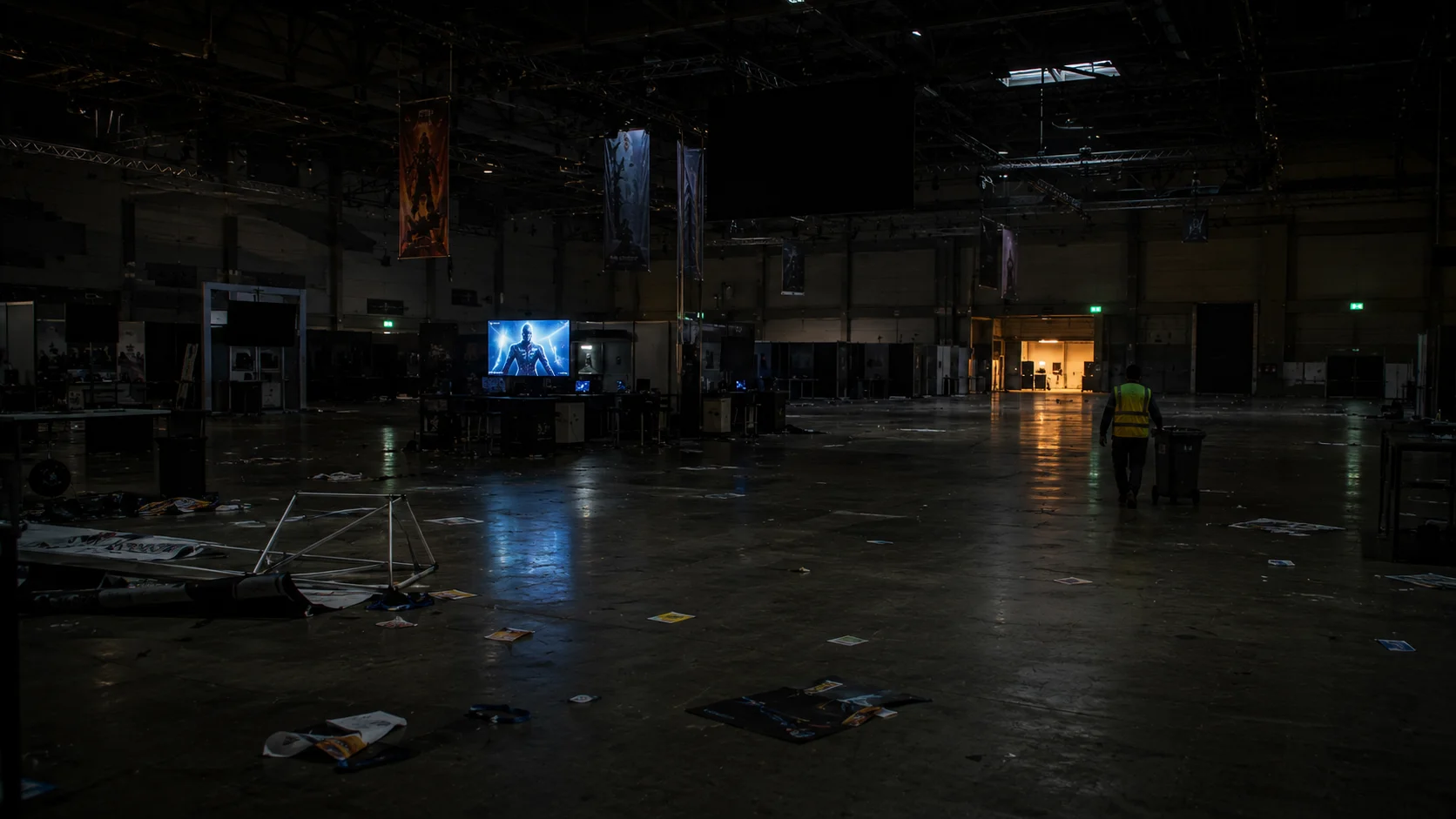
The numbers from Caladan’s April 2026 analysis are the kind that end arguments. More than 93% of Web3 gaming projects are now effectively dead — token prices down roughly 95% from their 2022 peaks, quarterly VC inflows collapsed from $1.6 billion to $18 million, and over 300 games shut down entirely. The industry burned through an estimated $15 billion over four years chasing a token-driven gaming future that mainstream players never wanted.
The easy explanation is that the market was a bubble. True, but insufficient. Plenty of technology sectors go through bubbles and emerge with viable companies on the other side. Web3 gaming’s failure was more specific and more instructive: studios raised capital at scale before building games that retained players past week one. The product problem was not discovered because there was no pressure to discover it. When the capital ran out, there was nothing underneath.
What survives is worth examining as carefully as what failed. One game — Gunzilla’s Off the Grid — launched on Steam in July 2025 with optional NFT mechanics, a $100 million war chest, and a competent battle royale that players could evaluate on its own terms. The $GUN token launched on Solana separately from the gameplay, letting skeptics enjoy the game without touching crypto. That architecture — game first, blockchain optional — is the model that everyone now claims they always intended.
The Caladan Numbers in Detail
Caladan’s report, published April 23, 2026, drew from several years of GameFi investment and project data. The headline figure — 93% of Web3 gaming projects effectively dead — includes projects where token trading has ceased, development has stopped, and social channels have gone dark. The 7% still operating includes projects that have dramatically scaled back ambitions relative to their fundraising decks.
The financial wreckage is concentrated. Gaming attracted 62.5% of all Web3 venture investment in 2022. By 2025, its share had fallen to single digits, with capital rotating into AI infrastructure, real-world asset tokenization, and layer-2 scaling. Quarterly VC inflows dropped from $1.6 billion at the 2021–2022 peak to $18 million — a 99% decline. YGG, the flagship gaming guild token that was supposed to be the institutional backbone of a player-owned economy, now trades 99.6% below its November 2021 high.
Hamster Kombat — the viral Telegram tap-to-earn game that attracted hundreds of millions of registered users — lost 96% of its active user base within six months of launch. The pattern repeated across categories: massive marketing-driven user acquisition, brief engagement, rapid churn, and then collapse when the token incentives ran dry.
Even more damning was the baseline Caladan cited from a Coda Labs survey: at the height of the GameFi mania, only 12% of gamers had ever tried a crypto game. The industry had spent billions on supply — studio infrastructure, token launches, play-to-earn mechanics — without establishing that mainstream demand existed.
Why Studios Raised Before They Built
The structural failure of Web3 gaming runs deeper than bad token design. In 2021 and 2022, the capital environment rewarded studios for raising large rounds — which required producing credible white papers, influencer backing, and token presales — rather than for shipping games. A studio that raised $50 million on a playable demo could sustain operations for years without pressure to retain players. The token launch was the product in a meaningful number of cases.
This inverted the normal game development feedback loop. Traditional studios live or die by player retention metrics — daily active users, session length, 30-day return rates. Those numbers reveal within weeks whether a game has genuine appeal or is riding a launch spike. Web3 studios with large war chests and token-inflated user numbers could report positive metrics for months without confronting the reality that their retention curves looked identical to every previous failed title.
Axie Infinity is the canonical case. At its peak in 2021, Axie had over two million daily active users, mostly in Southeast Asia, using the play-to-earn model as a supplemental income source. When the Smooth Love Potion (SLP) token rewards dropped — first through inflation, then through the $625 million Ronin bridge hack in March 2022 — the financial case for playing evaporated. The game’s design had never built intrinsic entertainment value strong enough to retain players when the yield dried up. Users left en masse. The Ronin network is still operational, but Axie’s player count has never recovered to anything approaching its 2021 peak.
The On-Chain Token Architecture Problem
Beyond the strategic failures, the token mechanics themselves were almost universally broken. Most Web3 games launched dual-token models — a governance token and a utility or reward token — that created inflationary pressure from day one. Players earned utility tokens by playing, selling them for the governance token or stablecoins. New players had to buy in to earn, creating a Ponzi-adjacent dynamic where early players profited at the expense of later ones.
The Ronin chain (RON), built by Sky Mavis specifically for Axie Infinity, remains active and continues processing gaming transactions. But the broader lesson it provided — that a purpose-built gaming chain cannot substitute for a game worth playing — has been largely internalized by the studios that survived. The chains and infrastructure that endured were those with utility beyond a single game’s ecosystem.
Immutable X (IMX) on Ethereum’s layer-2 stack took a different approach: building a gaming-specific chain with gas-free NFT minting that could serve multiple titles rather than locking value into one studio’s token economy. That model proved more durable. IMX has active integrations with multiple game studios in 2026 and serves as settlement infrastructure for in-game asset trading across titles — a genuinely different value proposition from a single-game token.
The Gala Games (GALA) model — where governance token holders voted on which games received ecosystem support — also demonstrated that decentralized game governance creates its own dysfunction. Token holders voted in favor of titles that promised higher yields rather than better gameplay. The portfolio of games funded by Gala’s governance process reflects that distortion directly.
What Survived and Why
Off the Grid is the most-cited survival story from the 2024–2025 shake-out period, partly because it’s one of the few that actually launched a commercially visible title. Gunzilla put the game on Steam in July 2025, reaching traditional PC gaming audiences who have no crypto context — and who judge games by whether they are fun, not by whether the tokenomics are sound. The battle royale format, directed by filmmaker Neill Blomkamp, stands on its own as a playable title. The GUNZ chain on Solana and the $GUN token are optional layers that players can ignore entirely.
That separation — functional game, optional blockchain — is the architectural decision that Gunzilla got right. It is also the architecture that most GameFi studios explicitly rejected during the bull cycle, because a game that is fun without the token removes the forced participation that made token price appreciation possible.
Smaller studios with more focused scope have also found traction. Projects building competitive card games, strategy titles, and prediction-adjacent experiences where on-chain ownership of assets has genuine meaning — not just speculative value — are finding small but sticky player bases. The games that work treat blockchain as a distribution and ownership layer, not as the revenue model itself.
Where Capital Is Going Now
The 99% drop in gaming VC inflows does not mean capital has left gaming entirely — it means the capital went elsewhere. AI-driven game tooling, infrastructure for on-chain asset ownership across platforms, and gaming-adjacent prediction markets are all receiving attention from the same investors who backed GameFi in 2021. The thesis has narrowed rather than collapsed.
Stablecoin transaction volume within surviving Web3 titles is growing. USDC and USDT settlement for in-game asset trades provides a more stable floor than inflationary reward tokens, and players who are trading real-money game assets prefer predictable settlement to token price exposure. Analysts tracking the surviving GameFi cohort expect 2x to 3x growth in stablecoin transaction volume within top titles through 2026.
The Consensus 2026 conference, running May 6–7, had a reduced but present gaming track compared to the 2022 peak. CiDi Games published its roadmap for a Pi Network gaming layer in May 2026, aiming to use Pi’s 18 million verified users as a player base for casual gaming experiences. That ambition — building games for an existing verified-user base rather than building a user base to extract token value — represents a structural reversal from the failed GameFi model.
What the Next Cycle Gets Wrong If It Repeats This One
The Web3 gaming postmortem produces a clear diagnosis, but diagnoses are easier to agree on than to act on. The incentive that drove studios to raise first and build second has not disappeared — the crypto capital markets still reward narrative over product in early fundraising rounds. A studio with a compelling whitepaper and influencer backing can still close an eight-figure round without a shippable game.
The check on that incentive in traditional gaming is publisher gatekeeping and platform distribution requirements. Steam, PlayStation, and Xbox apply minimum quality standards before granting distribution access. Those standards forced studios to ship playable products. The crypto-native funding model bypassed that discipline entirely — token presales and DAO treasury allocations have no equivalent quality gate.
If the next Web3 gaming cycle repeats this pattern, the outcome will be the same. The question is whether the 7% of studios that survived the shake-out, combined with traditional studios like Gunzilla entering on their own terms, can establish a product-quality floor before speculative capital floods back in and repeats the dynamic.
The $15 billion the sector spent already bought a clear lesson. Using it is optional.
The Growth Loop Web3 Gaming Never Built
Looking at the Web3 gaming postmortem from a growth perspective, the structural failure is not the token model, the studio overhead, or even the timing. It is that the entire category tried to skip the part of game development where a growth loop has to be built and validated before scaling. Traditional studios know this rule because they have lived through enough launches: a game that does not have an organic word-of-mouth coefficient above some minimum threshold cannot be saved by paid acquisition. It can be partly bought, briefly, then it falls back to its natural rate.
Web3 gaming, in the 2021-2023 cycle, was a category attempting to substitute token mechanics for the growth loop entirely. The token replaced the referral incentive. The early-airdrop hunters replaced the early-organic audience. The play-to-earn dynamic replaced the play-because-it-is-fun retention curve. Each substitution made it possible to launch faster and to look bigger, and each substitution corrupted the signal that would have told the studio whether they had built a game people actually wanted to play.
The next cycle’s surviving studios will look like the studios that were always going to survive: small teams who built the loop first, validated it with no token attached, and added token mechanics only when the loop was strong enough to bear them. The capital that flows back into Web3 gaming should be looking for that pattern specifically. The capital that flows into “AI-powered crypto-native immersive worlds” is funding the same mistake in different language.
Frequently Asked Questions
How many Web3 games have failed and why?
Caladan’s April 2026 analysis found that more than 93% of Web3 gaming projects are now effectively dead — defined as token trading ceased, development halted, and community engagement gone. The root cause was structural: studios raised capital at scale through token presales and venture rounds before building games that retained players past launch week. The token launch was frequently the product, not the game behind it. When token prices fell and yield incentives dried up, players had no entertainment reason to stay. The industry spent an estimated $15 billion building supply without first establishing that mainstream gamers wanted what was being built — and only 12% of gamers had tried a crypto game even at the height of the mania.
What happened to Axie Infinity and why did it collapse?
Axie Infinity reached over two million daily active users in 2021, primarily in Southeast Asia where the play-to-earn model provided supplemental income. The collapse came from two directions: the dual-token economy inflated Smooth Love Potion (SLP) rewards to unsustainable levels, and the March 2022 Ronin bridge hack extracted $625 million from the network. Both events removed the financial incentive to play. Because Axie’s design had never built intrinsic entertainment value strong enough to retain players without yield, user counts crashed and have not recovered. The Ronin network continues operating, but Axie’s player base is a fraction of its 2021 peak.
Which Web3 games are still working in 2026?
Off the Grid by Gunzilla Games is the most commercially visible survivor — a battle royale title that launched on Steam in July 2025 with optional blockchain elements, directed by Neill Blomkamp. The $GUN token launched on Solana separately from the core gameplay, allowing players to participate without engaging with crypto. Games that treated blockchain as an ownership and settlement layer rather than as the revenue model itself fared better: titles using Immutable X (IMX) for gas-free in-game asset trading on Ethereum layer-2 represent a more durable architectural approach. Smaller competitive card games and strategy titles with genuine gameplay and on-chain asset ownership — rather than speculative token economies — also maintained small but stable player bases.
What on-chain infrastructure held up through the Web3 gaming crash?
Immutable X (IMX) on Ethereum’s layer-2 proved more durable than single-game chains because it serves multiple studios rather than locking value into one token economy. Gas-free NFT minting and cross-title asset settlement gave IMX genuine utility beyond any single game’s fate. The Ronin network (RON) built by Sky Mavis for Axie Infinity is still operational and has broadened to support additional gaming projects. Stablecoin settlement rails — primarily USDC — are growing within surviving titles as players trading real-money assets prefer predictable settlement to reward token price exposure. Single-game utility tokens with inflationary reward mechanics are the architecture type that failed most completely and most consistently.
Is it worth investing in Web3 gaming projects in 2026?
The risk profile has changed significantly after the shake-out. The surviving studios are generally those that proved product-market fit through gameplay quality rather than token incentives. The sector’s VC funding is down 99% from peak, which removes the speculative froth but also means fewer new projects are entering the space — reducing noise and making it easier to identify studios with genuine traction. Projects with game-first architectures, optional blockchain integration, mainstream distribution (Steam, console storefronts), and stablecoin-based in-game economies are meaningfully lower risk than the token-first models that collapsed. The warning sign to watch for in any new project: token presale before the game is publicly playable.
Sources
- CoinDesk: More than 90% of Web3 Games Failed After $15 Billion Boom (Caladan Report)
- Phemex: Caladan — 93% of Web3 Gaming Projects Are Defunct
- CryptoRank: Web3 Gaming Shakeout — 93% Dead as Funding Drops 99%
- Yahoo Finance: 93% of Web3 Gaming Projects Are Now Effectively Dead
- Gunzilla Games: Off the Grid Now Available on Steam
- Cryptopolitan: CiDi Games Pi Network Gaming Plans Ahead of Consensus 2026
- Incrypted: The Rise and Fall of Web3 Games