

In the fast-paced world of technology, misinterpretations can reveal deeper truths. Take a viral Reddit post from late 2024: a SaaS founder lamented losing a loyal customer who had paid $300 monthly for 18 months, only to cancel and build an internal alternative. The founder dismissed it as irrational – after all, the in-house version was “worse” and costlier to maintain. Yet the tech community exploded, framing it as proof that AI tools like ChatGPT were democratizing software creation, threatening jobs and entire business models (source)
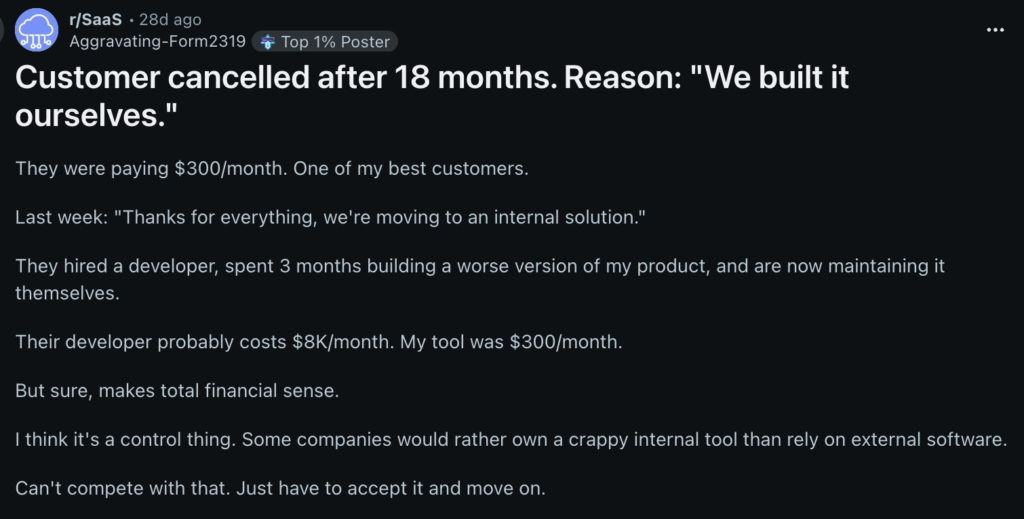
But here’s the twist: the post never mentioned AI. Not a single word about prompts, code generation, or weekend builds. Instead, it highlighted a fundamental disconnect, customers ditching products when they feel like burdensome rent rather than valuable tools. This Rorschach test of a story exposed how builders often project their fears onto user behavior, ignoring the real signals of dissatisfaction. The customer’s decision wasn’t about technological prowess; it was about reclaiming control and aligning costs with perceived value. In an era where subscription fatigue is rampant, users are increasingly questioning whether ongoing payments justify the hassle, especially when alternatives – even imperfect ones – offer ownership and customization.
This detachment isn’t unique to SaaS. In the crypto and DeFi space, it’s amplified, contributing to rampant user churn, security lapses, and billions in losses. As Web3 aims for mainstream adoption in 2026, developers must confront how their insular approaches are alienating users and what it means for the industry’s survival. The crypto sector, valued at over $3 trillion at its peak in 2025, saw user frustration manifest in ways that traditional tech could only dream of: instantaneous fund drains, abandoned wallets, and a revolving door of speculative participants who enter during bull runs and exit en masse during corrections.

The Misreading That Hit a Nerve
Developers pride themselves on precision: parsing code, debugging logs, anticipating edge cases. Yet thousands shared and debated this post as an AI harbinger, overlooking its core message about ownership economics. Why? It tapped into insecurities. With tech layoffs surpassing 245,000 globally in 2025, and AI accelerating output while compressing timelines, many saw existential threats everywhere (source). Studies show AI can slow experienced developers by 19% on complex tasks, yet perceptions of speedup persist, fueling hype over reality (source).
Echoes in Crypto: The DeFi Detachment Problem
This builder-user gap is even starker in DeFi, where complex protocols often prioritize technical elegance over usability. Jargon like “impermanent loss,” multi-step wallet approvals, and opaque smart contracts deter newcomers, leading to what experts call the “Web3 onboarding crisis” (source). Seed phrases – those 12-24 word strings – remain a major barrier, scaring off billions of potential users who fear irreversible losses (source).
Retention stats paint a grim picture: DeFi platforms see Day 30 retention as low as 65% for young users, with overall active wallets dropping despite market highs (source). Many protocols suffer from “developer-first” design, ignoring pain points like high gas fees or confusing interfaces. A 2025 report highlighted how DeFi UX “sucks” due to delays in confirmations and error messages that read like code dumps (source).
Worse, this disrespect manifests in outright exploitation. Rug pulls – where developers abandon projects after draining liquidity – exploded in scale in 2025, with losses nearing $6 billion across just seven major incidents, one accounting for 92% of the total (source). Hacks and vulnerabilities cost another $2.3 billion, eroding trust (source). Unlike SaaS, where churn is measurable at 4.9% annually for B2B (source), DeFi’s decentralized nature masks these metrics, but the result is the same: users flee to centralized alternatives or exit crypto altogether.
To illustrate, take the case of prominent DeFi platforms in 2025. Protocols like Aave and Uniswap saw TVL fluctuations tied to market sentiment, but user complaints centered on interface complexity. Newcomers often lose funds to slippage or failed transactions, with little recourse. This leads to a vicious cycle: low retention stifles network effects, reducing liquidity and increasing volatility. Moreover, the emphasis on “decentralization at all costs” ignores practical needs, such as intuitive mobile interfaces or seamless fiat on-ramps. As a result, while institutional players poured billions into tokenized assets, retail adoption lagged, with only 5% global crypto ownership by year’s end.
The End of Insulated Building
For years, tech’s growth-at-all-costs era shielded developers from accountability. From 2015 to 2022, easy funding meant shipping unused features without consequence. But with 127,000 U.S. tech layoffs in 2025 alone (source: note: global figure is 245,953, U.S. subset estimated), and AI shifting value to commercial acumen over pure coding, that luxury is gone. In crypto, post-FTX regulations and market maturation demand the same: builders who engage users directly.
Successful projects like Kaia (the Klaytn-Line merger) are tackling this by simplifying onboarding, but challenges persist (source). Morgan Stanley predicts AI will create more developer jobs by enabling complex apps, but only for those who prioritize strategy and user needs (source). Young developers, facing a 20% employment drop (source), must adapt or risk obsolescence.
In DeFi, this means moving beyond code-centric development. Projects like those integrating social logins or AI-assisted tutorials show promise, but adoption is slow. Developers should draw from traditional UX principles: A/B testing, user journeys, and iterative feedback. Ignoring these leads to “ghost protocols” – technically sound but user-empty.
Bridging the Gap: Steps Forward for Crypto Builders
To thrive, DeFi developers should treat user contact as core, not optional. Implement feedback loops via DAOs, user testing, and analytics. Simplify UX with account abstraction and social logins. Monitor churn signals – wallet dormancy, transaction drops – and address them proactively. For example, protocols could offer “trial modes” with simulated funds to build confidence before real commitments.
Education is key: Tutorials integrated into apps, rather than external docs, can reduce drop-offs. Collaborate with designers early, not as an afterthought. Finally, transparency builds trust – regular audits, clear roadmaps, and responsive support can turn detractors into advocates.
The Reddit story wasn’t about AI doomsday; it was a mirror reflecting detachment’s costs. In crypto, ignoring users isn’t just disrespectful – it’s existential. As 2026 approaches, builders who listen will build lasting protocols. Those who don’t? They’ll join the churn statistics.
For a deeper dive into the original Reddit saga and its lessons for DeFi, check our analysis: “40,000 Developers Misread a Churn Story. And That’s the Real Warning.”
Frequently Asked Questions (FAQs)
What is a rug pull in crypto, and how can I avoid it?
A rug pull occurs when developers promote a project, attract investments, then abandon it, draining liquidity and causing token values to plummet. In 2025, these scams cost nearly $6 billion. To avoid them, check for audited code, locked liquidity, and team doxxing. Use tools like RugDoc or TokenSniffer for analysis (source).
Why is DeFi onboarding so difficult?
Onboarding involves wallets, seed phrases, gas fees, and KYC in some cases, creating friction. Only 42% of new wallets remain active after six months. Solutions include account abstraction, which hides complexities (source).
How does AI affect developer jobs in crypto?
AI tools can automate routine coding, but studies show they slow complex tasks by 19%. Overall, AI is expected to create more jobs by enabling advanced apps, per Morgan Stanley (source).
What are typical churn rates in SaaS vs. DeFi?
SaaS B2B churn averages 4.9% annually, while DeFi Day 30 retention can be 65% for young users. DeFi’s higher churn stems from UX issues and volatility (source).
How can developers improve user respect in DeFi?
Prioritize UX testing, clear communication, and ethical practices. Engage communities via DAOs and feedback channels to build trust and reduce churn.
Is crypto adoption improving despite these issues?
Yes, unique DeFi users hit 27 million monthly in 2025, but retention lags. Projects like Kaia focus on simplifying access to drive growth (source).
A deeper breakdown of the original Reddit story — and what it reveals about developer culture — is available here:
The bigger point is simpler.
This wasn’t really an AI story. It was a mirror. And a lot of builders didn’t like what it showed.