When the Competitors Agree About the Competition
The AI industry has spent the past three years with a clear public narrative about who was ahead. OpenAI had GPT-4 first, deployed it at scale first, and established the product benchmarks that everyone else was measured against. The narrative shifted in 2025 when Anthropic’s Claude 3 Opus exceeded GPT-4 on several reasoning benchmarks, when Google’s Gemini Ultra achieved competitiveness at the frontier, and when DeepSeek demonstrated that cost-efficient training could produce results within striking distance of US lab outputs. But the public communications from the labs maintained a competitive hedging that stopped short of any of them acknowledging genuine parity.
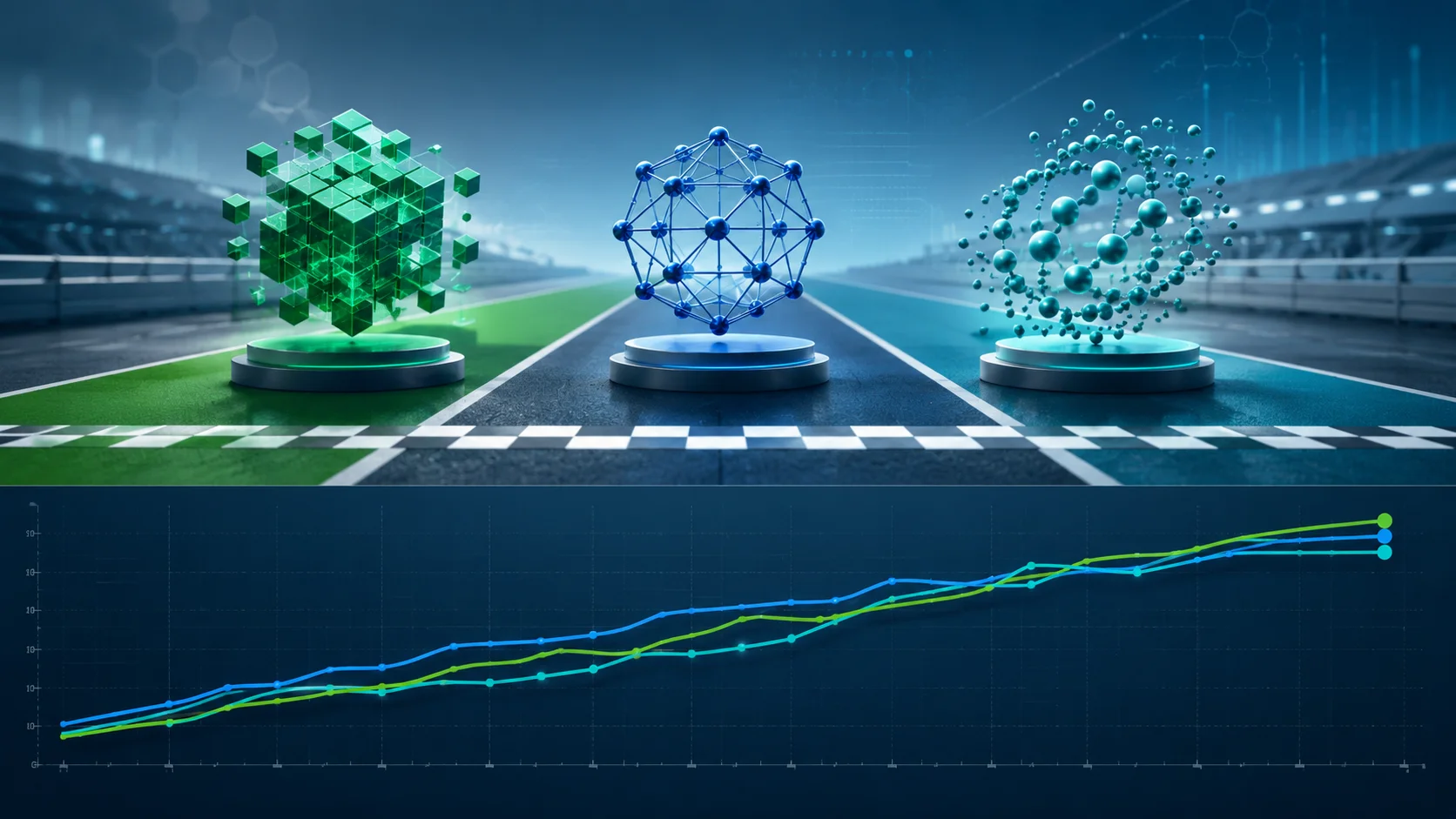
This week, multiple executives at Google, OpenAI, and Anthropic made statements in various venues — I/O presentations, interviews, conference appearances — that, when read together, describe the same competitive landscape: the frontier AI race is effectively neck-and-neck. “Companies making different tradeoffs around cost, speed and computing resources” with no single model or lab holding a commanding lead. It’s a framing that would have been unthinkable from OpenAI in 2023, when GPT-4’s margin over competitors was substantial and the company’s public posture reflected that advantage. In 2026, the same admission that no single player is clearly ahead is coming from all three simultaneously.
How Parity Happened
The convergence at the frontier is the result of several years of parallel investment, research sharing through published papers, and the fundamental dynamics of a field where the training recipes, architectural approaches, and scaling laws that produce frontier models are partially legible to any well-resourced lab that studies the outputs carefully. OpenAI’s early advantage was partly architectural (the transformer architecture that GPT-4 refined was a known quantity), partly scale (OpenAI had the compute and data access to train at the frontier first), and partly product (ChatGPT’s deployment at consumer scale in November 2022 gave OpenAI user feedback data that competitors couldn’t replicate without similar deployment).
The architectural advantage eroded as competing labs matched OpenAI’s scale of investment and training sophistication. The data advantage is more durable — OpenAI’s consumer deployment at 400 million weekly active users continues to generate training signal that smaller deployments don’t produce — but the other labs’ enterprise and API deployments have accumulated training data of their own. Anthropic’s Constitutional AI approach, which prioritized safety and alignment alongside capability, produced a model that many enterprise customers preferred for its lower hallucination rates and more predictable behavior in sensitive domains. Google’s Gemini has the advantage of being integrated into the world’s most widely used productivity suite — Search, Gmail, Docs, YouTube — which produces usage patterns that shape training in ways that standalone model deployments don’t.
The result is three models — GPT-5.5, Claude Opus/Mythos, Gemini Ultra — that are each the best in the world at something and none of which holds the kind of general capability lead that GPT-4 held in 2023. The benchmarks that matter most to enterprise buyers (hallucination rates in sensitive domains, reasoning on complex multi-step problems, code generation quality, cost efficiency) show different models leading on different dimensions rather than a single model dominating across all of them.
Anthropic’s Mythos and the New Competitive Leader
The executives and analysts who described the race as neck-and-neck also noted that Anthropic has “surged forward” in the competitive landscape over the past six months. The specific catalyst is Claude Mythos — the frontier model that has not been publicly released but whose capabilities have been demonstrated through Project Glasswing’s vulnerability research results and limited enterprise previews. The 10,000+ zero-day vulnerabilities found at under $50 each, including the 27-year-old OpenBSD bug, is the clearest public evidence of Mythos’s capability level and the benchmark against which competitive responses are being calibrated.
OpenAI’s release of GPT-5.5-Cyber — a cybersecurity-specialized model in limited preview — came within one month of Anthropic demonstrating Mythos’s cybersecurity capabilities. The response time signals how seriously OpenAI is treating Anthropic’s technical progress. GPT-5.5-Cyber is a direct competitive answer to a demonstration of Mythos capability. The speed of the response suggests that OpenAI’s competitive intelligence on Anthropic’s capabilities was good enough that the cybersecurity variant was already in development before the Project Glasswing results were public, rather than being built in reaction to them.
The neck-and-neck characterization that executives are now offering publicly may be accurate as a description of the general-capability frontier, while Anthropic holds a specific advantage in the capabilities that Mythos demonstrates at the specialized frontier. If that framing is correct, the competitive dynamic in 2026 is not “one lab is ahead overall” but “different labs are ahead in different capability domains, and the enterprise market sorts by which capability domain matters most for specific use cases.”
Google I/O 2026 as Competitive Positioning
Google’s I/O 2026 keynote announcement of Gemini 3.5 Flash — the faster, cheaper model rather than a behemoth capability competitor — reflects the same competitive reading. Google has decided that the most important product moves in 2026 are in the cost-efficiency tier (Gemini 3.5 Flash outperforms last year’s frontier at a fraction of the cost, which makes it the right choice for the vast majority of production deployments) and in the integration layer (Gemini embedded in Search, Workspace, Android, YouTube, and the developer ecosystem rather than competing in head-to-head model benchmarks).
This is a different competitive strategy than the one Google appeared to be executing in 2024, when each Gemini announcement was framed explicitly against the GPT comparison benchmarks. The 2026 strategy acknowledges the neck-and-neck reality at the frontier and makes the case that Google’s advantage is not in having the best model on isolated benchmarks but in having the best-integrated AI system across the products that billions of people use every day. That’s a defensible advantage, and it’s one that OpenAI and Anthropic, as companies primarily selling API access and standalone products, cannot replicate with model capability improvements alone.
The Stakes of Parity
The emergence of genuine competitive parity at the AI frontier has implications that extend beyond which lab’s stock price performs best. Competition among frontier labs produces pressure on prices, on safety practices, on alignment investment, and on the deployment decisions that determine how powerful AI systems reach users and at what pace.
On price: the cost of frontier AI capability has declined dramatically over the past three years as competition has driven efficiency investments. The Gemini 3.5 Flash release — a model that outperforms last year’s frontier at a fraction of the cost — is a direct product of competitive pressure to deliver more capability per dollar. The enterprise market for AI tools benefits from this price competition in ways that a monopoly market wouldn’t produce.
On safety: the three labs that have declared themselves neck-and-neck are also the three labs with the most developed public commitments to safety evaluation and red-teaming. The competitive dynamic creates both pressures for and against safety investment — the pressure to ship faster creates risk of shortcutting evaluation, while the reputational consequences of a visible safety failure create incentives for investment. The current outcome appears to be genuine safety research happening in parallel with rapid capability development, with the long-term adequacy of that balance being one of the central unresolved questions in AI policy.
The executives agreeing that the race is neck-and-neck are making a different kind of statement than “we’re all basically the same product.” They’re saying that the era of one lab having a commanding technical lead — the era that shaped AI’s public perception between 2022 and 2024 — is over. What comes next is a more competitive, more fragmented, more application-specific landscape where the model matters less than the ecosystem, the integration, and the specific use case it’s being applied to. That’s a different AI industry than the one that launched in November 2022. It’s the one we’re in now.
When the Technology Is Equal, Product Is Everything
Marty Cagan has spent decades arguing that the companies that win in technology don’t win because they have the best engineers — they win because they have product teams empowered to discover what actually matters to users and then build it. The frontier AI race, now officially declared neck-and-neck by all three leading labs, is about to put that argument to the most public test it has ever faced.
The benchmark convergence changes what the competition is actually about. When GPT-4 launched, there was a meaningful capability gap — OpenAI’s model could do things the alternatives couldn’t. That gap is gone. Google’s Gemini 2.5 Pro, OpenAI’s o3, and Anthropic’s Claude Opus 4 are each at the frontier in different dimensions, and the differences are meaningful primarily to researchers benchmarking specific capabilities. For users evaluating which model to use, the capability gap has become noise.
What takes over when capability is equal is product. And product, in Cagan’s framework, means three things: discovery (understanding what users actually need, not what they say they need), delivery (building it reliably and at scale), and ecosystem (creating the conditions where users can build outcomes they care about on top of your foundation). On all three dimensions, the three labs are pursuing very different strategies — and the strategic choices are more consequential now that benchmark differentiation has collapsed.
Google is betting on integration: if Gemini is woven into every Google product, users don’t need to make a choice. The risk is that integration without genuine product discovery produces features nobody asked for. OpenAI is betting on developer ecosystem and consumer habit — ChatGPT’s installed base and the breadth of the API ecosystem create switching costs that pure capability can’t erode. Anthropic is betting on safety and enterprise trust, serving buyers who need to justify their deployment to boards and regulators, not just users who need a fast answer.
The question of whether AI agents can match human scientists on frontier research tasks illustrates the product discovery problem directly: benchmarks designed to measure capability don’t tell you which lab is building the right things for actual use cases. That question is resolved in the market, not the lab.
Cagan’s prediction would be that the lab with the clearest picture of what specific users need — and the product team structure to act on it — wins. Benchmark parity makes the product discipline more visible, not less important. The era of differentiation by raw capability is over. The era of differentiation by product judgment has begun.