
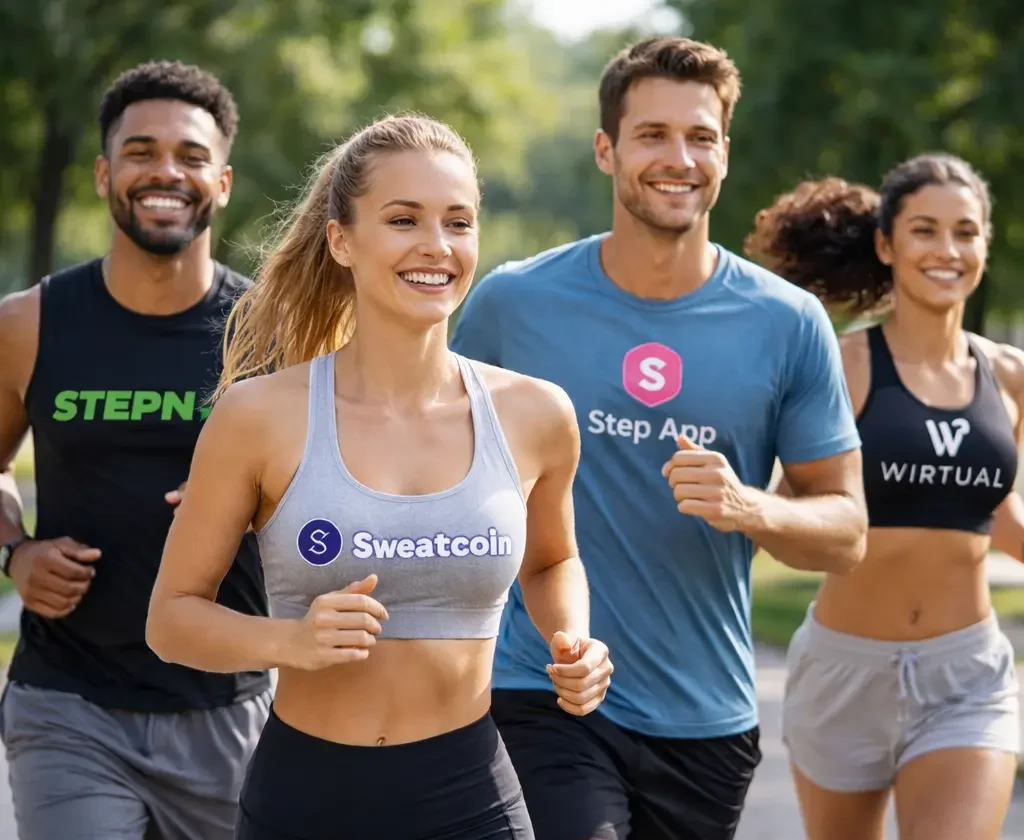
In March 2022, a Solana-based app called STEPN promised users up to $400 per day for simply walking their dog. By December 2025, the global walk-to-earn sector—once valued at nearly $700 million—has all but vanished, leaving behind a trail of broken sneakers, depleted savings accounts, and millions of users who learned the hard way that you cannot mint money from footsteps
. This is the story of how a financial model that never made sense attracted the world’s most vulnerable investors, and why 99 % of these projects collapsed under the weight of their own mathematical impossibility.
The Seductive Illusion: Turning Steps into “Yield”
Walk-to-earn (W2E) marketed itself as the intersection of GameFi, fitness, and universal basic income. The pitch was intoxicatingly simple:
- Buy an NFT sneaker (or character) for $100–$5 000.
- Walk, jog, or run; GPS verifies movement.
- Earn inflationary utility tokens (GST, SWEAT, WLK, etc.).
- Sell tokens on the open market for real dollars.
Venture capital rushed in. Sequoia, Solana Capital, and Binance Labs poured $9.2 million into STEPN alone
. KuCoin listed 30 M2E tokens; CoinGecko tracked a sector-wide cap of $700 million at the 2022 peak
. Telegram groups with 200 k members swapped “shoe-breeding” strategies like digital ranchers. The rhetoric wrote itself: “What if every step you took paid your rent?”
II. The Balance-Sheet Time-Bomb: Why the Math Never Added Up
Beneath the gamified veneer, every W2E project ran an open-ended liability scheme:Table
Copy
| Incoming Cash Flows | Outgoing Cash Flows |
|---|---|
| 1. NFT sneaker minting fees | 1. Daily token emissions to walkers |
| 2. Marketplace trading royalties | 2. Referral & leaderboard rewards |
| 3. Optional “energy” micro-payments | 3. Staking yields & liquidity mining |
There was no external revenue. No advertising, no subscription SaaS, no data-monetization layer—just an ever-growing obligation to pay users for an activity that generates zero economic value for the protocol
. In effect, each new sneaker buyer financed yesterday’s walkers. The treadmill needed perpetual acceleration to stay level.
Tokenomics papers waved at “burn mechanisms”: repair costs, breeding fees, mystery-box sinks. But burns were denominated in the same inflationary token they were supposed to support. When GST price fell, burn costs fell in lock-step, creating a death spiral rather than a stabilizer
.
The On-Chain Evidence: 700 000 → 35 000 Wallets
STEPN’s daily active wallets peaked at 705 000 in May 2022; by April 2024 the count was < 35 000—a 95 % collapse
. GST, once $8.51, trades for <$0.01 in December 2025. Similar arcs:
- Sweatcoin (no-entry-fee model): SWEAT token down 98 % since TGE.
- Walkers (Cardano): WLK liquidity <$30 k on Minswap; team wallet last active July 2024.
- Step App (FITFI): market cap fell from $180 M to <$4 M; inflation rate still 40 % y/y.
NFT sneaker floors evaporated. A STEPN “Uncommon Jogger” that cost 12 SOL ($1 200 in April 2022) now lists for 0.03 SOL ($3). Twitter feeds once full of $300-day screenshots are now ghost towns of #LunaClassic-style cope.
The Human Cost: Victims Who Couldn’t Afford the Lesson
Because W2E marketed itself as “free money for being healthy”, it attracted demographics traditionally under-served by crypto: minimum-wage workers, retirees, and students. Interviews conducted by Coin Bureau and Adapulse reveal recurring patterns
:
- Maria, Manila – housekeeper who spent three weeks’ salary ($450) on a “Walker” NFT so her 12-year-old son could earn while walking to school. Earned $18 before the wallet stopped syncing.
- Carlos, São Paulo – delivery driver who rented sneakers on STEPN’s lending market, paying 30 % of daily yield to the owner; when GST fell below repair costs, he owed the protocol 4 SOL.
- Aisha, Lagos – university student who took a micro-loan via Binance Pay to buy four sneakers, convinced by a TikTok influencer’s “$1 k-month” claim. Loan APR compounded at 96 %; collateral liquidated when GST < $0.002.
These stories repeat across Telegram “support” groups with thousands of members. The common denominator: people who could not absorb a 100 % loss were sold an asset with zero intrinsic value and unlimited dilution risk.
The Regulatory Aftermath: “Unregistered Securities” on Foot
Beginning 2023, class-action suits landed in Singapore, the U.K., and California. Plaintiffs argue W2E NFTs meet Howey-test criteria:
- Investment of money ✅
- Common enterprise (protocol) ✅
- Expectation of profit from others’ efforts ✅
In October 2025, the U.K. High Court allowed Davis v. Find Satoshi Lab to proceed, refusing the defendant’s motion to classify GST as “in-game currency” rather than an investment contract. A parallel SEC Wells notice to Sweatcoin Ltd. cites “unregistered securities offering via move-to-earn tokens.”
Exchanges have pre-emptively delisted. KuCoin removed 11 M2E pairs in Q3 2025; Crypto.com halted GST/USDT after $200 k 24-h volume—a 99.8 % drop from peak
. Liquidity evaporated faster than the projects could issue governance votes.
The Uncomfortable Truth: Ponzinomics Masquerading as Wellness
W2E’s defenders insist the idea—incentivizing fitness—is noble. Critics reply that intent does not override arithmetic. Every token rewarded was a liability that required the next buyer to hold the bag. The sector never produced a sustainable sink capable of absorbing millions of daily inflationary tokens because physical steps are not an economic output the market values at scale.
Comparisons to airline frequent-flyer miles miss a key point: airlines have real revenue seats and break-even load factors to subsidize point redemptions. W2E had only new entrants’ entry fees. Once net inflows turned negative—triggered by the broad 2022 crypto bear market—the structure imploded.
The Ghost Sneakers Still Walk
Today, a handful of zombie apps still track steps and spit out worthless tokens. Their Discord channels survive on hopium: “Wait for the next bull run,” “V2 tokenomics incoming,” “Partnership with Nike any day.” But the liquidity gates are closed, and CEXs have moved on. The sneakers minted in 2022 exist as eternal reminders on OpenSea—unburnable, unsellable, their GPS metadata frozen at the last coordinates where anyone still believed the math could work.
Walk-to-earn did not fail because users lost interest; it failed because it was never financially viable. It promised risk-free yield for a universal activity, a combination that only ever exists at the expense of someone else’s capital. The 99 % failure rate was not an accident—it was the equilibrium state of an industry that mistook Ponzi velocity for product-market fit. The footsteps of 2022 echo today as a warning: if the product pays you for something the market doesn’t price, you are the product—and the bill always comes due.