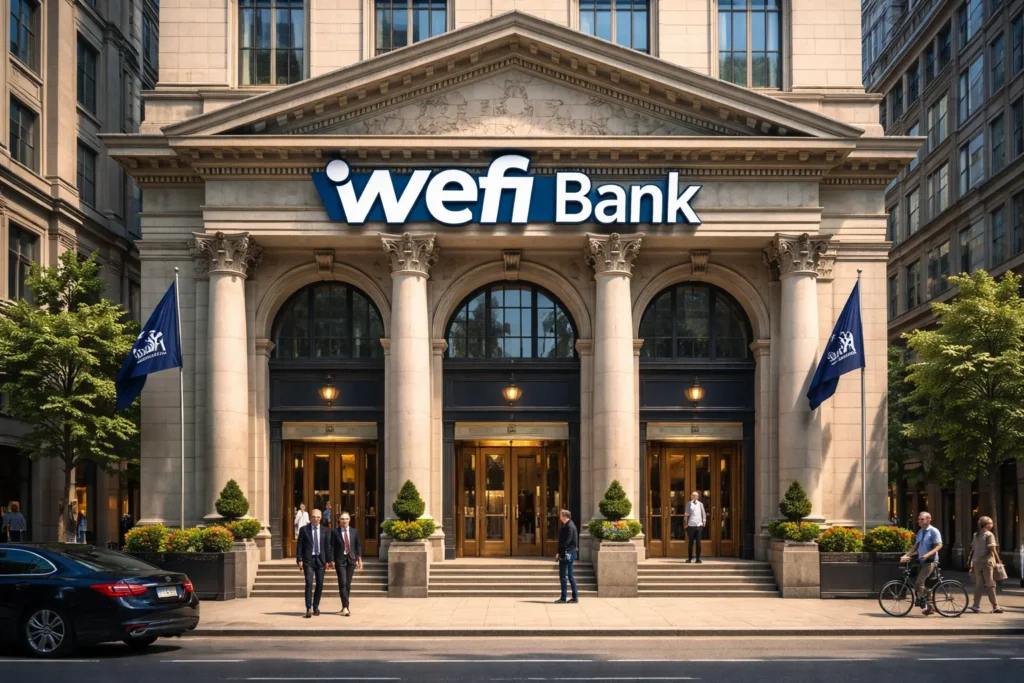
An industry defined by narratives — and exceptions
2024–2025 has been an uncomfortable period for much of Web3.
Bitcoin has underperformed relative to major equity indices, with the S&P 500 and Nasdaq printing all-time highs while crypto markets remain volatile and sentiment-driven. Inflation, while moderating in headline figures, remains structurally embedded across housing, energy, and services — a dynamic that has historically hurt speculative assets more than productive ones.¹ ²
Against this backdrop, the majority of Web3 projects have followed a familiar pattern: ambitious whitepapers, aggressive token launches, short-lived hype cycles, and long periods of under-delivery. This dynamic is not new, but it has become harder to ignore in a market where capital is more selective and narratives alone no longer sustain valuations.
Yet within this environment, WeFi Bank has quietly diverged from the trend.
Sitting outside the top 100 tokens by market capitalisation, WeFi has nonetheless delivered relative token resilience, steady product expansion, and growing ecosystem attention — all while largely avoiding the speculative spotlight. For many traders and long-term holders, this has led to an uncomfortable question in hindsight: why wasn’t this on the radar earlier?
This article attempts to answer three core questions:
What exactly is WeFi Bank?
Why has it bucked broader Web3 and macro trends this year?
Is this performance structurally durable through 2026 — or simply another delayed narrative?
We approach this with skepticism. Where information cannot be independently verified, it is framed as reported rather than confirmed. Where data is available, it is cited from high-quality sources. And where comparisons are drawn, they are grounded in historical precedent rather than optimism.
What is WeFi Bank?
At its core, WeFi Bank positions itself as a decentralised, non-custodial banking and liquidity protocol, focused on capital efficiency, structured DeFi products, and composable financial primitives rather than consumer-facing hype.
Unlike many projects that brand themselves as “banks” while offering little more than staking dashboards, WeFi’s architecture appears to be built around three pillars:
On-chain credit and liquidity mechanisms
Risk-aware yield structures
Institutional-leaning design choices
According to publicly available documentation and developer communications, WeFi aims to bridge aspects of traditional financial structuring — such as collateralisation, liquidation logic, and risk segmentation — with the transparency and programmability of DeFi.³
This framing places it in contrast with much of the sector, which, as discussed in Amateur Hour Web3, is frequently dominated by teams with limited operational, financial, or governance experience despite managing hundreds of millions in user capital.
Notably, WeFi has attracted attention from users researching the project through both positive and negative lenses — a dynamic reflected in traffic patterns to resources such as VaaSBlock’s overview of WeFi, which has become a landing page for users actively seeking critical assessments rather than promotional content.
This alone is an early signal worth noting: serious users research risk.
The macro context WeFi is operating within
To understand WeFi’s divergence, it’s important to contextualise the environment it is operating in.
Meanwhile, crypto markets have been constrained by:
Regulatory overhang in the US and Europe
Reduced retail speculation
The unwind of leverage-driven DeFi strategies that dominated 2020–2022
Bloomberg and the Financial Times have both highlighted that crypto’s correlation to risk assets has weakened, undermining the thesis that Bitcoin and Web3 assets are a reliable hedge against inflation in the short to medium term.⁴ ⁵
In this environment, projects dependent on pure narrative momentum have struggled.
Projects tied to actual financial activity, however — lending, liquidity provision, structured yield — have shown relative resilience. This distinction matters when evaluating WeFi’s performance.
Token performance: resilience without spectacle
While WeFi’s token does not sit among the largest by market capitalisation, its relative performance versus sector benchmarks has been notable.
Key observations (based on publicly available chart data and third-party analytics platforms):
Lower drawdowns compared to many DeFi governance tokens during market corrections
More stable on-chain liquidity profiles
Reduced volatility relative to narrative-driven launches
Importantly, this performance has occurred without aggressive influencer marketing, exchange-driven hype, or short-term incentive programs — strategies that often inflate early metrics at the cost of long-term stability.
As noted by Delphi Digital in multiple research pieces, *“sustainable token performance in DeFi correlates more strongly with real usage and capital efficiency than with total value locked alone.”*⁶
WeFi appears — at least for now — to align with this thesis.
Team and execution: competence over charisma
One of the most persistent failure modes in Web3 is not technical — it is organisational.
As explored in Amateur Hour Web3, many projects are run by teams that lack experience in:
Risk management
Financial product design
Long-term governance
Adversarial thinking
WeFi’s team, based on reported backgrounds and public appearances, appears to skew toward engineering- and finance-led execution rather than marketing-led growth. While full verification of individual résumés is limited (as is common in Web3), several contributors have demonstrable histories in DeFi infrastructure and quantitative systems.
This does not guarantee success — but it materially reduces certain categories of failure.
Vitalik Buterin has repeatedly emphasised that *“most DeFi failures are not due to bad code, but bad assumptions about incentives and human behaviour.”*⁷
WeFi’s comparatively conservative rollout strategy suggests awareness of this risk.
Code, audits, and transparency
Where available, WeFi’s smart contracts and protocol documentation indicate a preference for modular, auditable components rather than experimental monoliths.
Reported audits and code reviews suggest:
Conservative parameterisation
Clear liquidation mechanics
Limited reliance on reflexive token incentives
However, it is important to state clearly: absence of public exploits does not equal absence of risk. As history has shown — from Compound forks to more recent cross-chain bridge failures — vulnerabilities often emerge under stress rather than normal conditions.⁸
This is where comparisons to cautionary examples become relevant.
A necessary warning: the Kadena lesson
The story of Kadena — explored in Kadena Failed— serves as a useful reminder that early technical strength and strong narratives do not guarantee longevity.
Kadena was once positioned as a technically superior Layer-1, backed by credible founders and strong initial adoption. Over time, however, ecosystem stagnation, strategic misalignment, and capital misallocation eroded its position.
The lesson is not that WeFi will follow the same path — but that structural execution matters more than early indicators.
For WeFi, this means:
Sustaining real usage through market cycles
Avoiding over-financialisation of its token
Maintaining governance discipline as capital inflows grow
History suggests that this is where many projects fail — not in their first year, but in their third.
Why WeFi may be bucking the trend — for now
Synthesising the available data, several factors appear to explain WeFi’s divergence:
Product-led growth rather than narrative-led growth
Risk-aware financial design
Lower exposure to reflexive speculation
Execution discipline in a capital-scarce environment
These characteristics align more closely with traditional financial product development than with Web3’s historical growth patterns — a distinction increasingly rewarded in today’s market.
As BlackRock CEO Larry Fink recently noted, *“Markets are becoming less tolerant of stories without cash flows.”*⁹
While DeFi does not generate cash flow in the traditional sense, protocols that facilitate real economic activity increasingly resemble financial infrastructure rather than speculative instruments.
Will it continue into 2026?
This is the hardest question — and the one that should not be answered with certainty.
For WeFi to sustain its trajectory, several conditions must hold:
Continued regulatory navigation without compromising decentralisation
Resistance to incentive-driven short-term growth traps
Ongoing technical robustness under increased usage
Governance maturity as token holders diversify
If these conditions are met, WeFi could remain an outlier — a quiet compounder in a sector still dominated by volatility.
If they are not, it risks becoming another example of early promise undone by scale.
Final assessment
WeFi Bank stands out in a year where standing out has been rare.
It is not a guarantee of future success — but it is a credible deviation from Web3’s most common failure patterns. In an industry still struggling to professionalise, WeFi currently appears — cautiously — to be an exception rather than the rule.
For investors, researchers, and analysts, the appropriate approach is neither hype nor dismissal, but rather ongoing scrutiny.
How One Project’s Failures Threaten an Entire Industry
The web3 industry stands at a critical crossroads. After years of promises about decentralization, democratization, and technological revolution, the sector faces an existential crisis of credibility. While legitimate projects struggle to gain mainstream adoption, a parade of poorly conceived, hastily executed ventures continues to erode public trust. Among these cautionary tales, Janitor AI emerges as a particularly instructive example of how not to build a sustainable AI-crypto hybrid platform.
This examination isn’t merely about cataloging another failed project—it’s about understanding how ventures like Janitor AI inflict disproportionate damage on the entire web3 ecosystem. In an industry already grappling with skepticism, regulatory scrutiny, and user fatigue, the consequences of such projects extend far beyond their immediate stakeholders, poisoning the well for legitimate innovation and reinforcing negative stereotypes that persist for years.
The Promise That Never Materialized: Janitor AI’s Illusion of Innovation
Janitor AI entered the market with an appealing premise that seemed to capture the zeitgeist of AI enthusiasm, meeting blockchain speculation. The platform promised to democratize conversational AI by allowing users to create customizable characters for both safe-for-work (SFW) and not-safe-for-work (NSFW) interactions. According to AI Box Tools’ comprehensive timeline, the project launched in mid-2023, positioning itself as a solution to the “sterile” nature of existing commercial chatbots.
The marketing narrative was compelling: a platform that would move “AI from a tool of the elite few to a playground for the creative many.” This positioning tapped directly into two of the most powerful trends in technology—AI democratization and creator empowerment. The project promised to address real pain points, particularly the censorship issues plaguing platforms like Character.AI, while offering users unprecedented freedom to build AI personalities.
But as Benjamin Fairchild’s forensic analysis reveals, the reality beneath this polished marketing veneer was far less impressive. Fairchild, a developer with over 15 years of production experience, approached the project with genuine curiosity and hope for innovation. Instead, he discovered what he describes as “a project being held together by user enthusiasm, not by product reliability.”
The Technical Mirage: What Janitor AI Actually Built
Fairchild’s investigation revealed a fundamental disconnect between Janitor AI’s marketing claims and its actual technical implementation. Rather than building a sophisticated AI platform, the project essentially functioned as a “frontend wrapper”—a user interface layered over existing APIs from OpenAI, Kobold, and Claude. This isn’t inherently problematic; many successful projects begin as aggregators or interface improvements. However, Janitor AI’s positioning as its own “AI platform” becomes actively misleading when users realize they’re “essentially bringing their own key to an external model.”
The technical analysis uncovered several critical weaknesses:
No Custom Infrastructure: Despite marketing claims of innovation, Janitor AI offered “very little custom logic. No serious fine-tuning. No clear governance on how prompts are stored, who sees what, or what protections exist against misuse or hijacking.”
Security Vulnerabilities: The platform lacked fundamental security measures, with no guarantees about data privacy, conversation retention policies, or user permission systems. Users creating characters had no clarity about who could access their content or what moderation filters existed—if any.
System Reliability Issues: Community reports documented frequent technical failures, including characters breaking mid-conversation, sessions resetting randomly, and settings disappearing without explanation. These weren’t minor bugs but indicative of “fragile infra and zero observability.”
The Tokenization Trap: When Speculation Replaces Utility
Perhaps no aspect of Janitor AI better exemplifies web3’s credibility problem than its approach to tokenization. The project launched a cryptocurrency token (JAN) despite having no functional use case within the platform. According to VaaSBlock’s risk assessment, the token achieved a transparency score of just 3/100—placing it in the lowest 10th percentile across all measured categories.
Fairchild’s analysis directly challenges the token’s legitimacy: “Why does a project that’s mostly a UI wrapper for third-party LLMs need a token? What is it actually for?” The answer appears to be speculative value extraction rather than utility creation. The token served no functional purpose within the application—users couldn’t purchase credits, access premium features, or participate in governance mechanisms.
The financial metrics paint a sobering picture. According to CoinGecko data, the JAN token reached an all-time high of $0.01647 but currently trades 97.62% below that peak, with a market capitalization of just $352,779. Daily trading volume of approximately $22,000 signals minimal genuine interest beyond speculative trading.
The Community Paradox: Enthusiasm Without Infrastructure
Janitor AI’s most troubling aspect might be how it cultivated an active, creative community while failing to provide the technical foundation necessary to support that community’s growth. Users invested significant time creating characters, sharing content, and building narratives within the platform. This genuine creative energy masked fundamental platform inadequacies.
As Fairchild notes, “It’s very clear that this is a project being held together by user enthusiasm, not by product reliability.” The community’s dedication became a smokescreen for technical deficiencies, creating a situation where users were “doing it in spite of the platform, not because of it.”
This dynamic represents a broader pattern in web3 failures: projects that successfully generate hype and user engagement without building sustainable infrastructure. The result is a community that becomes emotionally and creatively invested in a platform that cannot reliably serve their needs, leading to eventual disappointment that extends beyond the immediate user base to affect perception of the entire sector.
The Reputation Contagion: How Janitor AI Damages Web3’s Image
The damage inflicted by projects like Janitor AI extends far beyond their immediate user communities. In an industry already struggling with credibility issues, each high-profile failure reinforces negative stereotypes about web3 being a space dominated by speculation, poor execution, and extractive economics.
According to LinkedIn analysis of web3’s reputation crisis, the sector faces “Severe Reputation Damage from Scams and Hacks” that has created widespread public mistrust. Projects like Janitor AI contribute to this perception problem by appearing to prioritize token speculation over product development, reinforcing the stereotype that web3 is more about financial engineering than technological innovation.
The timing of these failures proves particularly damaging. As Hacken’s 2024 security report documents, web3 projects lost over $2.9 billion across various exploits and failures in 2024 alone. While Janitor AI’s technical shortcomings don’t represent a security breach, they contribute to the same narrative of an industry that cannot deliver on its promises.
Comparative Context: Learning from Other AI Platform Failures
Janitor AI’s trajectory becomes more concerning when examined alongside other AI platform failures that have damaged both individual projects and broader industry credibility. The pattern of technical overpromise leading to user disappointment appears repeatedly across the AI-chatbot landscape.
Recent analysis from Beta Boom documents numerous cases where AI chatbots have failed spectacularly, from NYC’s business chatbot giving illegal advice to Air Canada’s customer service bot making promises the company couldn’t honor. These failures share common characteristics with Janitor AI: inadequate testing, poor governance, and insufficient human oversight.
The Forbes examination of Meta’s chatbot failures provides particularly relevant insights. The report documents how Meta’s AI systems, despite massive resources and technical expertise, failed catastrophically when they prioritized engagement over safety. The tragic case of a user who died trying to meet an AI persona illustrates how technical failures can have real-world consequences when platforms lack proper governance structures.
The Web3 Fragility Factor: Why Current Failures Matter More
The web3 industry currently exists in what can only be described as a fragile state. After years of speculative excess, regulatory uncertainty, and high-profile failures, the sector faces unprecedented scrutiny from users, investors, and regulators. In this environment, projects like Janitor AI don’t just represent individual failures—they threaten the credibility of legitimate innovation occurring elsewhere in the space.
The industry’s fragility manifests in several ways:
User Trust Deficit: According to CivicScience research, consumer confidence in new technology platforms has declined significantly, with users becoming more skeptical of projects that promise revolutionary capabilities without clear utility.
Regulatory Scrutiny: As ChainGPT’s security analysis notes, regulatory bodies are paying closer attention to web3 projects, with inadequate security and governance practices potentially triggering legal consequences for project creators and investors.
Investment Climate: The venture capital environment for web3 projects has cooled considerably, with investors demanding stronger fundamentals and clearer paths to sustainability. Projects that damage industry reputation make it harder for legitimate ventures to secure necessary funding.
The Accountability Vacuum: Governance Failures in Decentralized Projects
Janitor AI’s failure highlights a critical weakness in the web3 ecosystem: the lack of accountability mechanisms for projects that damage industry reputation. Unlike traditional businesses, where regulatory frameworks and legal structures provide some protection for consumers and stakeholders, many web3 projects operate in governance vacuums.
The project demonstrates several governance failures:
Transparency Deficits: VaaSBlock’s analysis assigned Janitor AI a transparency score of just 3/100, noting the absence of clear documentation about team members, technical architecture, or business model sustainability.
Community Exploitation: Rather than building genuine community governance, the project used community creativity and engagement as free labor to enhance platform value without providing reliable infrastructure in return.
Token Holder Disenfranchisement: JAN token holders had no meaningful governance rights or utility within the platform, creating a situation where speculative investors bore financial risk without any influence over project direction.
The Innovation Dilution Effect: How Bad Projects Crowd Out Good Ones
Perhaps the most insidious damage inflicted by projects like Janitor AI is how they dilute attention and resources from legitimate innovation. When speculative projects capture headlines and investor interest through marketing rather than substance, they create market conditions where genuine innovation struggles to compete.
This dynamic operates through several mechanisms:
Attention Economy Distortion: Media coverage and social media discussion disproportionately focus on projects with dramatic price movements or controversial failures, making it harder for substantive projects to gain recognition.
Capital Misallocation: Investor funds flow toward projects that promise quick returns through token speculation rather than those building sustainable value through genuine innovation.
Talent Misdirection: Skilled developers and entrepreneurs may be drawn to projects that appear to offer quick success through token launches rather than those requiring long-term commitment to solving real problems.
The Path Forward: Learning from Janitor AI’s Failures
Utility Must Precede Tokenization: Projects should demonstrate clear utility and sustainable user value before introducing speculative elements like cryptocurrency tokens. The token should enhance existing functionality rather than serve as a substitute for it.
Transparency Builds Trust: Projects operating in the web3 space must exceed traditional transparency standards, providing clear documentation about team members, technical architecture, financial structures, and governance mechanisms.
Community Value Must Be Reciprocal: While community engagement is crucial for platform success, projects must provide reliable infrastructure and genuine value in return for user participation and content creation.
The Broader Implications: Industry Reputation at a Crossroads
Janitor AI’s story represents more than a single project failure—it embodies the credibility crisis facing the entire web3 industry. As Odaily’s analysis of major web3 attacks documents, the sector lost over $2.49 billion to various failures in 2024 alone. While Janitor AI’s technical shortcomings don’t represent a security breach, they contribute to the same narrative of an industry struggling to deliver on its promises.
The timing of these failures proves particularly damaging. As traditional technology companies make significant advances in AI development, blockchain-based projects risk being left behind due to reputation damage from speculative failures. The industry’s ability to attract top talent, secure investment, and gain user adoption depends heavily on demonstrating that it can produce reliable, valuable innovations rather than temporary speculative vehicles.
Conclusion: The Stakes for Web3’s Future
Janitor AI’s trajectory from promising AI platform to cautionary tale illuminates broader challenges facing the web3 industry. In a sector already grappling with credibility issues, each high-profile failure reinforces negative stereotypes and makes it harder for legitimate innovation to gain traction.
The project’s failures—technical inadequacy, token speculation without utility, governance deficits, and community exploitation—represent exactly the kind of behavior that has earned web3 its reputation as a space prioritizing hype over substance. As the industry faces increasing regulatory scrutiny, user skepticism, and competition from traditional technology companies, such failures carry consequences that extend far beyond individual projects.
The path forward requires fundamental changes in how web3 projects approach development, governance, and community engagement. Rather than viewing token launches as shortcuts to valuation, projects must focus on building sustainable utility that serves genuine user needs. Instead of treating communities as marketing tools, platforms must provide reciprocal value that justifies user investment of time, creativity, and attention.
Most importantly, the industry must develop accountability mechanisms that prevent reputation damage from spreading across the entire ecosystem. Whether through self-regulatory organizations, improved due diligence standards, or community-driven quality assessment, web3 needs systems that protect legitimate innovation from being tainted by speculative failures.
Janitor AI’s story serves as a warning about what happens when marketing outpaces development, when speculation replaces utility, and when community enthusiasm is exploited rather than cultivated. The web3 industry cannot afford to continue repeating these patterns if it hopes to achieve its transformative potential.
The market is always right, and it has spoken clearly about projects that prioritize token speculation over product development. Until the industry internalizes these lessons and builds systems that consistently reward substance over speculation, the cycle of hype, failure, and reputation damage will continue—ultimately threatening the entire web3 experiment’s viability.
In an industry struggling to prove its legitimacy, projects like Janitor AI don’t just fail on their own terms—they actively undermine the credibility of an entire ecosystem. The web3 sector’s future depends on learning from these failures and building systems that consistently deliver value rather than promises.
The entertainment industry has witnessed a remarkable cycle over the past two decades—a technological pendulum that has swung from rampant piracy to legitimate streaming dominance and back again. This isn’t merely a story about technology; it’s a masterclass in market economics, where consumer behavior ultimately dictates the rules of engagement. As we stand at another potential inflection point with major industry consolidation on the horizon, the question remains: has Hollywood finally learned its lesson, or are we doomed to repeat this cycle indefinitely?
The Golden Age of Piracy: When Convenience Trumped Legality
The early 2000s marked the beginning of what would become the first great wave of digital piracy. Napster had already primed consumers for the idea that digital content should be instantly accessible, but it was BitTorrent’s decentralized architecture that truly revolutionized content consumption. By 2004, The Pirate Bay had emerged as the flagship of what would become a vast ecosystem of torrent sites, offering everything from the latest Hollywood blockbusters to obscure indie films—all available at the click of a button.
The appeal was undeniable. Why pay $15-20 for a DVD when you could download the same content for free? Why wait months for international releases when torrents appeared within days—or sometimes hours—of theatrical premieres? The market had spoken, and it demanded immediate, affordable access to content. Traditional media companies, clinging to outdated distribution models, inadvertently created the perfect conditions for piracy to flourish.
As Benjamin Fairchild noted in his analysis, “We complained too much about streaming, now torrents are back“—but this observation captures only the latest chapter of a much longer story. The original rise of torrenting wasn’t just about cost; it was about filling a vacuum that legitimate services refused to address.
The Streaming Revolution: When the Industry Finally Listened
Netflix’s pivot from DVD-by-mail to streaming in 2007 represented more than just a business model evolution—it was the industry’s first genuine acknowledgment of what consumers had been demanding all along. The company’s early streaming offerings were modest, but the value proposition was revolutionary: unlimited access to a growing library of content for a single monthly fee.
The market response was swift and decisive. By 2011, Netflix had fundamentally altered consumer expectations about content access. The convenience of legitimate streaming began to outweigh the hassle of torrenting for many users. No more worrying about malware-infected files, inconsistent quality, or the ethical quandaries of piracy. Netflix had created a service that was actually better than piracy—something the industry had previously deemed impossible.
This success triggered a gold rush. Amazon Prime Video, Hulu, HBO Max, Disney+, Apple TV+, and countless others entered the market, each promising their own slice of the streaming pie. For a brief, glorious moment, it seemed the industry had solved the piracy problem through genuine innovation rather than litigation. Consumers had access to more content than ever before, and creators were being compensated for their work.
The Fragmentation Trap: When Success Breeds Failure
The streaming revolution’s success contained the seeds of its own destruction. As research from Alliotts reveals, streaming service fragmentation (SSF) has become the industry’s most pressing challenge. What began as a consumer-friendly revolution has devolved into a confusing, expensive maze of competing platforms.
According to Nielsen reports, 46% of audiences believe the number of platforms makes it difficult to find content, while 50% struggle to know which shows are available on which services. The average American now maintains subscriptions to four streaming services but regularly watches content on only two of them.
The financial burden has become substantial. Data from Deciphr shows that a Netflix subscription that cost $8.99 in 2019 now runs $15.49, while the cumulative cost of accessing premium content across multiple platforms can easily exceed $100 monthly. This “subscription fatigue” has created a perfect storm: consumers are paying more than ever but feeling increasingly frustrated with the value they receive.
The statistics paint a sobering picture. Research from Panda Security documents that illegal streaming and digital piracy surged from 130 billion visits in 2020 to 216 billion by 2024—a 66% increase in just four years. More tellingly, 96% of all TV and film piracy now originates from content that was previously available on streaming platforms.
The Quality Crisis: When Content Becomes Commodity
Parallel to the fragmentation issue runs another, perhaps more insidious problem: the decline in content quality and the explosion of quantity. As streaming platforms compete for subscribers, they’ve adopted a “more is better” approach to content creation, often prioritizing volume over quality.
The numbers are staggering. According to Academy of Animated Art’s streaming statistics, the number of titles available to TV viewers has grown by 1 million programs since 2020. This content inflation has created a paradox of choice where consumers face overwhelming options but struggle to find genuinely compelling content.
This oversaturation has practical consequences. Consumers report spending more time browsing than actually watching content, while the perceived value of individual shows and movies has diminished. When everything is available, nothing feels special—a psychological phenomenon that drives consumers back toward more curated, intentional viewing experiences, even if those experiences require piracy.
The Return of Torrenting: History Repeats Itself
The resurgence of torrenting represents more than simple cost-cutting—it’s a fundamental rejection of the streaming ecosystem’s failure to deliver on its original promise. Modern pirates aren’t just seeking free content; they’re pursuing a superior user experience that legitimate services have failed to provide.
Contemporary torrenting offers several advantages that streaming services struggle to match: comprehensive content libraries spanning multiple platforms, no geographical restrictions, offline viewing capabilities, and freedom from subscription commitments. Perhaps most importantly, torrenting provides a unified interface for content discovery and consumption—something the fragmented streaming landscape cannot offer.
The demographic shift is particularly revealing. While early torrenting was dominated by tech-savvy young males, current piracy statistics show growth across all age groups and demographics. Data from CivicScience indicates that 41% of streaming subscribers have canceled services due to subscription fatigue, with younger consumers most likely to pay over $100 monthly for multiple subscriptions.
The Consolidation Question: Will History Repeat?
As the industry grapples with these challenges, major consolidation appears inevitable. The proposed Warner Bros. Discovery and Paramount merger represents more than corporate restructuring—it signals recognition that the current fragmented model is unsustainable. But will consolidation solve the underlying problems, or merely create new ones?
The merger’s implications extend beyond simple market share calculations. A combined Warner Bros.-Paramount entity would control an unprecedented content library, potentially offering consumers a more comprehensive single-platform experience. However, this consolidation also raises concerns about reduced competition, potentially higher prices, and decreased innovation.
Industry analysts remain divided on whether consolidation will reduce piracy. Some argue that fewer, more comprehensive platforms will reduce consumer frustration and subscription fatigue. Others contend that reduced competition will lead to higher prices and less consumer-friendly policies, potentially driving more users toward piracy.
The Music Industry Lesson: A Roadmap for Salvation
Interestingly, the solution to streaming’s piracy problem may already exist within the entertainment industry itself. The music streaming sector has largely avoided the fragmentation crisis plaguing video services. Platforms like Spotify, Apple Music, and Amazon Music offer comprehensive catalogs from multiple labels and artists, eliminating the need for consumers to maintain multiple subscriptions.
This unified approach has proven remarkably effective at combating piracy. Music piracy has declined significantly since the establishment of comprehensive streaming services, suggesting that consumers prefer legitimate options when they offer genuine value and convenience. The video streaming industry could adopt similar licensing models, allowing platforms to share content while competing on user experience, pricing, and original programming.
The Market’s Verdict: Learning from Consumer Behavior
The cyclical nature of torrenting activity offers profound insights into market dynamics and consumer psychology. When legitimate services fail to meet consumer needs—whether through high costs, poor user experience, or content fragmentation—piracy emerges as a market correction mechanism. Conversely, when legitimate options provide superior value, consumers readily abandon illegal alternatives.
This pattern suggests that anti-piracy efforts focusing solely on enforcement are fundamentally misguided. The most effective piracy prevention strategy involves creating legitimate services that genuinely outperform illegal alternatives. This requires more than competitive pricing; it demands superior user experience, comprehensive content access, and respect for consumer preferences.
The Future Equilibrium: Breaking the Cycle
As we stand at another potential inflection point, the industry faces a critical choice: continue the cycle of fragmentation and consolidation, or fundamentally reimagine how content is distributed and monetized. The proposed mega-mergers represent short-term solutions to systemic problems, potentially setting the stage for another cycle of consumer frustration and piracy resurgence.
A more sustainable approach might involve embracing the music industry’s licensing model, creating comprehensive platforms that aggregate content from multiple sources while maintaining competitive differentiation. This could include revenue-sharing agreements that ensure content creators are fairly compensated while providing consumers with the unified access they clearly desire.
Alternatively, the industry might explore new monetization models that prioritize access and convenience over ownership. Subscription fatigue has created opportunities for innovative pricing structures, including usage-based models, family sharing plans, and content-specific packages.
The Invisible Hand’s Final Verdict
The rise, fall, and resurrection of torrenting activity ultimately demonstrates the market’s remarkable ability to self-correct. Consumer behavior serves as an invisible hand that guides the entertainment industry toward equilibrium, punishing anti-consumer practices while rewarding genuine innovation and value creation.
The streaming wars are far from over, but their resolution will ultimately be determined not by corporate strategy or regulatory intervention, but by billions of individual consumer choices. The industry can either learn from these patterns and create sustainable, consumer-friendly models, or continue the cycle of disruption and correction that has defined the digital entertainment era.
As Benjamin Fairchild’s analysis suggests, the torrenting resurgence represents more than a simple return to piracy—it’s a market signal that the current streaming ecosystem has failed to deliver on its fundamental promise. Whether the industry chooses to interpret and act on these signals will determine whether we break the cycle or remain trapped in an endless loop of consumer rejection and industry correction.
The market is always right, and it has spoken clearly: consumers want comprehensive, affordable, convenient access to content. Until the industry delivers on this promise, the pendulum will continue to swing between legitimate services and piracy, with consumers ultimately determining the equilibrium point. The question is not whether this cycle will continue, but whether the industry has the wisdom to break it before consumer patience finally expires.
The streaming revolution was supposed to end piracy. Instead, it has revealed that consumer behavior remains the ultimate arbiter of market success. As we face another wave of industry consolidation, the entertainment business must decide whether to learn from history or remain condemned to repeat it.
Late-night crawl through expired domains, and bam, /graph-coinbase-quiz. Used to be live. Used to be gold. Back in twenty twenty-one, that link was a ticket: three dollars in GRT for a two-minute explainer and typing “blockchain data.” Coinbase slapped it on their Earn page like confetti. The Graph pumped. Traders cheered. Then nothing. Price bled ninety-eight percent. Users vanished. The page died. Nobody remembers the questions. Except me.
Incentives Are Not Marketing
Because that wasn’t marketing. That was malpractice. Olabisi Adelaja nailed it: short-term incentives kill long-term trust. And boy, did they. Web3 loves stealing from the big boys — Pepsi giveaways, Coke towels, Apple’s gravity — but skips the part where people actually want the thing.
Token Giveaways Create Looters, Not Users
They hand out tokens like arcade chips, wait for applause, then watch the crowd cash out and bolt. That’s not loyalty. That’s looting. Coinbase kept the tip jar. The Graph paid the cover for a party that left stains.
The Graph: A Case Study in Paid Attention
The Graph’s Coinbase Earn campaign illustrates the structural failure of incentive-led growth. To secure placement, the project likely committed between $50,000 and $500,000 in tokens or fiat for visibility on the Earn platform. The mechanic was simple. Watch a short explainer. Answer basic questions. Claim a reward worth roughly four dollars.
Completion was high. Retention was not. Users learned just enough to extract value, then exited. The campaign generated distribution, not adoption. It succeeded at education theater while failing at behavior change. When rewards stopped, so did participation.
This was not a messaging failure. It was a design failure. The incentive trained users to treat the protocol as disposable income, not infrastructure. The outcome was predictable, even if inconvenient to acknowledge.
The Data Everyone Ignored
Web3 marketing analysis generally involves listening to the most bullish people in the room, not considering trends or questioning norms. DappRadar later showed that 93.5 percent of wallets went dark within forty days.[1] A Twitter dev admitted: “I watched our quiz winners dump before the confetti hit.” Price? $2.84 in February. Roughly $0.04 now.[2] Not volatility. Vanity.
Coinbase Isn’t the Villain. It’s the Casino.
An anonymous VC put it plainly: “We backed elegance — not exchange homework. We lost on dilution.” Coinbase needed logins, not love. Eight million active users out of roughly one hundred twenty million accounts. Ninety-two percent ghosts. They need tricks. Projects get graves.
Same Tape, Different Tokens
The pattern repeated across projects. AMP’s Earn-driven exposure produced a short-term price spike of roughly 15 percent, followed by an 85 percent decline within three months. Flow surged on quiz-driven attention, then collapsed as speculative demand evaporated. Serum saw trading volumes fall by more than 70 percent after promotional activity peaked.
Each case followed the same script. Temporary incentives attracted opportunistic wallets. Those wallets extracted value and exited. What remained was diluted supply and no durable user behavior. Different tokens. Identical outcomes.
VCs Optimized Distribution and Forgot Retention
Distribution first, retention later. Later never came. Retention metrics were buried. Bullish markets rewarded vibes, not durability. Nobody asked whether users came back. Until prices fell and the emperor stood naked.
Why Pepsi Towels Worked and Web3 Quizzes Didn’t
Pepsi ran contests in the eighties because people bought soda forever. Coke gave towels because people needed them. Emotional. Reusable. Apple didn’t mail fifty bucks to open Safari. They built tools you begged for. Web3 had no product, so it bribed you to leave.
Beautiful Code, Broken Businesses
The code is often beautiful. Cardano’s stake. Solana’s speed. Ethereum’s grit. The technology isn’t the problem. The teams are. Avalanche dumped cash on influencers and earn-and-burns. Every wallet that got five AVAX at twenty-five sold. Never touched a subnet.
The bull run masked everything. No A/B tests. No habit formation. No long-term data. Just Twitter dopamine and token charts. Coinbase Earn wasn’t growth. It was pure hype.
Who Pays. Who Stays. Who Loses.
This isn’t Coinbase’s fault. They’re the casino. The suckers are the founders who wear hoodies like armor, act like Pepsi, but run raffle booths. The next time a project airs tokens, runs a quiz, or begs for your wallet, ask three questions: who pays, who stays, who loses. Spoiler: everyone but Coinbase loses. The towel from Pepsi lasts longer than your Web3 bag.
Footnotes [1] DappRadar, NFT user activity decay metrics (wallet inactivity following promotional campaigns). [2] Historical price data for GRT (Coinbase / CoinMarketCap). [3] Chainalysis, post-incentive value retention analysis across token distributions. [4] Dune Analytics dashboard tracking Flow wallet activity over time.
When Wallacy first stepped onto the Web3 stage in late 2022, it arrived with the kind of swagger only a Vietnamese gaming unicorn could muster. Backed by Appota Group’s 50-million-user empire and led by Jason Tran, a founder who had already shepherded one of Southeast Asia’s largest game publishers, Wallacy promised to do for crypto wallets what Nintendo did for handheld gaming: make them fun, addictive, and deceptively profitable. The pitch was seductive—why shouldn’t managing digital assets feel less like balancing a checkbook and more like crushing candy?
The wallet’s neon-soaked interface, play-to-earn mini-games, and futures trading with up to 100x leverage represented a bold experiment in gamified finance. But beneath the gamified veneer lay a complex web of tokenomics, regulatory ambiguity, and the persistent question of whether turning financial instruments into arcade games serves users or simply keeps them spinning for one more round. This is the story of how Wallacy rose from the bustling startup ecosystem of Hanoi to become one of crypto’s most intriguing wallet experiments—and why its trajectory offers lessons about the limits and possibilities of gamification in serious finance.
The Genesis: From Gaming Empire to Web3 Wallet
To understand Wallacy’s ambitions, one must first understand Appota Group, the Vietnamese digital entertainment conglomerate that birthed it. Founded in 2011, Appota had grown from a mobile game studio into a sprawling ecosystem encompassing game publishing, digital payments, multi-channel networks, and even HR SaaS solutions. By 2022, the company boasted over 50 million users across Southeast Asia and had become Vietnam’s answer to Tencent—a homegrown giant with tendrils reaching into every aspect of digital life.
Jason Tran, Appota’s co-founder and the driving force behind Wallacy, had spent over a decade building gaming ecosystems. His LinkedIn profile tells the story of a founder who understood not just how to build products, but how to build habits—how to turn casual users into daily active players, how to monetize engagement without killing enjoyment, and perhaps most importantly, how to keep users coming back even when the initial novelty wore off. These skills, honed in the cutthroat world of mobile gaming, would prove both Wallacy’s greatest asset and its most significant liability.
The transition from games to wallets might seem jarring, but in Tran’s view, it was a natural evolution. Traditional crypto wallets, he argued in early interviews, suffered from the same engagement problems that plagued early mobile games—they were functional but joyless, utilitarian but uninspiring. Why couldn’t checking your portfolio feel as satisfying as completing a daily quest? Why couldn’t swapping tokens provide the same dopamine hit as defeating a virtual opponent? The answer, Wallacy’s team believed, was to wrap serious financial tools in the psychological mechanics that made mobile gaming so addictive.
The timing seemed propitious. October 2022, when Wallacy officially launched, represented a peculiar moment in crypto history. The industry was emerging from the euphoric highs of 2021’s NFT boom but hadn’t yet descended into the full despair of 2023’s bear market. Play-to-earn games like Axie Infinity had proven that crypto and gaming could intersect profitably, even if the sustainability of such models remained questionable. Meanwhile, the collapse of centralized lenders like Celsius and BlockFi had created a vacuum for user-friendly DeFi tools that could offer yield without counterparty risk. Into this breach stepped Wallacy, promising to be both wallet and arcade, financial tool and entertainment platform.
The Architecture: Building a Casino Where the House Doesn’t Always Win
Wallacy’s technical architecture reveals the project’s hybrid ambitions from the moment users create their first wallet. The platform positions itself as a “non-custodial hybrid wallet,” a phrase that immediately raises eyebrows among crypto purists. How can a wallet be both non-custodial—meaning users maintain sole control of their private keys—and hybrid, a term that traditionally implies some degree of centralization? The answer lies in Wallacy’s clever compartmentalization of features.
The wallet’s core functionality—storing, sending, and receiving cryptocurrencies across multiple blockchains—remains truly non-custodial. Users generate their own seed phrases, and private keys never leave their devices. This foundation provides the security guarantees that experienced crypto users demand while maintaining the decentralization ethos that underpins Web3 philosophy. However, Wallacy layers centralized services atop this decentralized foundation, creating a product that feels unified to users while operating across a spectrum of custody arrangements.
The gaming elements exemplify this approach. When users participate in Wallacy’s play-to-earn tournaments or spin the rewards hub’s prize wheel, they’re not actually interacting with smart contracts on-chain. Instead, they’re engaging with Wallacy’s centralized servers, which track points, manage leaderboards, and distribute rewards. These rewards, denominated in the platform’s WLP (Wallacy Loyalty Points) or GEM tokens, can later be converted to actual cryptocurrency, but the conversion happens through Wallacy’s internal systems rather than decentralized protocols. This architecture allows for the rapid, gas-free transactions that make casual gaming feasible while maintaining the security of users’ main holdings.
The futures trading feature, launched in late 2023, represents perhaps Wallacy’s most ambitious technical integration. Offering up to 100x leverage across 140 trading pairs, the feature operates through a partnership with OKX, one of the world’s largest cryptocurrency exchanges. Users can open and manage leveraged positions directly from their Wallacy wallet interface, but the actual trading occurs on OKX’s centralized infrastructure. This arrangement provides Wallacy users access to deep liquidity and sophisticated trading tools while keeping the experience seamlessly integrated into the wallet’s gamified interface. However, it also means that users’ trading activities are subject to OKX’s terms of service, regulatory oversight, and custody arrangements—creating a curious hybrid where users’ spot holdings remain non-custodial while their derivative positions are fully centralized.
This architectural approach enables Wallacy to offer features that would be impossible or impractical on purely decentralized infrastructure. The platform’s cross-chain bridge, for instance, can move assets between networks in seconds rather than the minutes or hours required by decentralized bridges. The rewards hub can distribute thousands of micro-prizes daily without burdening users with gas fees. Daily check-in bonuses can be awarded instantly, creating the kind of frictionless experience that mobile gamers expect. But this convenience comes with trade-offs that become apparent when examining the platform’s tokenomics and long-term sustainability.
The Tokenomics: When Loyalty Points Meet Liquidity Mining
Wallacy’s reward systems operate through a multi-token ecosystem that reveals much about the project’s priorities and potential vulnerabilities. At the center sits WLP (Wallacy Loyalty Points), an off-chain point system that users accumulate through various activities: daily check-ins, game victories, successful trades, NFT ownership, and referrals. WLP exists only within Wallacy’s centralized database—users cannot trade it, transfer it, or use it outside the platform. This design choice provides Wallacy complete control over inflation rates, distribution mechanics, and redemption options while avoiding the regulatory scrutiny that might accompany a freely tradeable token.
However, WLP’s utility extends beyond mere bragging rights. Users can convert WLP to GEM tokens at a fixed rate (10 GEM = $1), and GEM tokens can then be swapped for actual cryptocurrencies like USDT, BNB, or ETH. This two-step conversion process creates a buffer between Wallacy’s centralized reward system and the decentralized crypto markets while giving users a tangible path from engagement to real value. The system resembles airline frequent flyer programs—points earned through loyalty can eventually be redeemed for something with actual market value, but the issuer maintains absolute control over the exchange rate and redemption window.
The economics become more complex when examining the Wallace Token (WLT), which exists as a separate tradeable cryptocurrency. According to CoinPaprika data, WLT reached an all-time high of $0.002458 but currently trades at essentially zero with no daily volume. This dramatic collapse reflects broader challenges facing utility tokens issued by crypto projects—when the token’s primary use case is speculation rather than genuine utility, price becomes decoupled from any fundamental value. WLT holders were promised governance rights, fee discounts, and exclusive access to certain features, but the token’s utility never achieved the critical mass necessary to sustain demand once speculative interest waned.
The interplay between these different reward mechanisms creates incentives that sometimes conflict with users’ financial best interests. The daily check-in system, for instance, rewards users for opening the app every few hours, gamifying engagement in ways that can encourage compulsive behavior. The weekly leaderboards pit users against each other in competitions where the top performers receive outsized rewards, creating zero-sum dynamics where one user’s gain necessarily comes from others’ losses. Meanwhile, the futures trading feature offers up to 100x leverage—a tool that can generate massive returns for skilled traders but statistically guarantees losses for most participants over time.
These incentive structures reveal the fundamental tension in Wallacy’s design: the platform profits from user engagement regardless of whether that engagement generates positive outcomes for individual users. More trades, more game plays, more check-ins all benefit Wallacy through increased trading fees, spread capture, and data collection, even when those activities prove unprofitable for users. This alignment problem isn’t unique to Wallacy—it plagues most gamified finance platforms—but Wallacy’s particularly aggressive monetization strategies make it especially visible.
The Gaming Layer: When Finance Becomes a Slot Machine
Wallacy’s mini-games represent perhaps the most controversial aspect of its gamification strategy. Titles like “Blocky Block,” “Chop Chop,” “Karate,” and “Wallacy Shooter” borrow heavily from hyper-casual mobile gaming, the category specifically designed to maximize addiction through simple mechanics and rapid reward cycles. These games require no crypto knowledge to play—users tap, swipe, and shoot their way to GEM rewards that can eventually be converted to real cryptocurrency. The genius lies in how seamlessly the games integrate financial incentives into entertainment, creating experiences that feel like pure gaming while carrying real monetary stakes.
The tournament system amplifies both the potential rewards and the psychological manipulation. Players can enter competitive modes where they compete against other users for pooled prizes, with entry fees paid in WLP and top performers receiving outsized rewards. The structure mirrors poker tournaments—skilled players can consistently profit while casual participants subsidize the prize pool. However, unlike poker, where skill development is transparent and game mechanics are well-understood, Wallacy’s games introduce random elements and opaque scoring systems that make it difficult for players to assess their true edge. The result is a system where users believe they’re competing on skill while often participating in disguised lotteries.
The NFT integration adds another layer of complexity and potential exploitation. Wallacy regularly releases limited-edition NFTs tied to specific games or events, promising holders exclusive rewards, tournament access, or enhanced earning rates. These NFTs often sell out quickly, creating artificial scarcity and FOMO that drives immediate revenue for Wallacy while potentially leaving buyers with worthless digital collectibles. The Blocky Block NFT campaign, for instance, promised early supporters access to a 500 GEM giveaway, but the long-term value of these NFTs remains entirely dependent on Wallacy’s continued operation and goodwill—factors outside buyers’ control.
The psychological mechanisms at work in Wallacy’s gaming layer deserve particular scrutiny. The platform employs virtually every known technique from behavioral psychology to maximize engagement: variable reward schedules (users never know exactly how much they’ll earn), loss aversion (daily streaks that reset if users miss check-ins), social proof (leaderboards showing other users’ earnings), and artificial scarcity (limited-time events and NFT drops). These techniques prove remarkably effective at driving short-term engagement but may create compulsive behaviors that persist even when the financial returns no longer justify the time investment.
The conversion from gaming rewards to actual cryptocurrency creates an especially potent psychological trap. Because users earn points that can become “real money,” the games carry stakes that exceed pure entertainment value while remaining abstract enough to encourage risk-taking behaviors that users would avoid with actual cash. A player might happily spend hours grinding for $2 worth of GEM tokens while refusing to work a minimum-wage job that pays $15 per hour—the gamified wrapper makes the low return feel acceptable because it doesn’t register as traditional labor. This dynamic allows Wallacy to extract enormous amounts of user attention for minimal actual payout while maintaining the illusion of generosity.
The Trading Infrastructure: Professional Tools in Toy Packaging
Wallacy’s integration of sophisticated trading tools into its gamified interface represents perhaps its most ambitious attempt to bridge entertainment and finance. The platform’s futures trading feature, developed in partnership with OKX, offers professional-grade capabilities including up to 100x leverage, real-time charting, and over 140 trading pairs across Ethereum-compatible chains. However, these powerful tools come wrapped in an interface that emphasizes excitement over education, potentially encouraging inexperienced users to take risks they don’t fully understand.
The decision to offer 100x leverage deserves particular scrutiny. While such high leverage is common in crypto derivatives markets, it typically requires sophisticated risk management and deep understanding of liquidation mechanics. Wallacy’s interface, however, presents leverage selection as just another slider in a colorful, game-like environment. Users can move from 1x to 100x leverage with a simple swipe, potentially without understanding that a 1% adverse price movement will liquidate their entire position. The platform does provide warnings and educational content, but these are easily dismissible and pale in comparison to the excitement marketing that emphasizes potential gains rather than catastrophic losses.
The gamification of high-risk trading creates concerning incentives. Daily trading competitions reward users for volume rather than profitability, encouraging over-trading that statistically reduces long-term returns. The integration of trading with gaming rewards means users might make trading decisions based on game-related goals—needing GEM tokens for a tournament entry, for instance—rather than sound investment strategy. Meanwhile, the social features allow users to share their biggest wins but provide no mechanism for tracking cumulative performance, creating an environment where survivorship bias and selection effects make risky strategies appear more successful than they actually are.
The partnership with OKX provides Wallacy users access to deep liquidity and institutional-grade execution, but it also means that Wallacy profits from trading volume regardless of user outcomes. This creates the same conflict of interest that plagues traditional brokerage models—platforms make money when users trade, not when users profit. The gamified wrapper may actually exacerbate this problem by encouraging trading for entertainment rather than investment purposes, potentially leading to higher turnover and larger losses for users who treat the platform as a game rather than a financial tool.
Security and Transparency: The Audit Problem
For a platform handling users’ financial assets, Wallacy’s approach to security and transparency raises significant concerns. Despite operating for over two years and claiming to manage assets for hundreds of thousands of users, Wallacy has not published any third-party security audits of its smart contracts, wallet infrastructure, or gaming systems. This lack of external verification is particularly troubling given the platform’s hybrid architecture, which combines non-custodial wallet functionality with centralized gaming and trading services.
The absence of published audits doesn’t necessarily indicate active malfeasance, but it does violate best practices established by reputable crypto projects. Major wallets like MetaMask, Trust Wallet, and Coinbase Wallet all publish regular security audits, often conducted by multiple firms, and maintain open-source code repositories that allow public scrutiny. Wallacy’s code remains closed-source, making it impossible for independent researchers to verify the platform’s security claims or identify potential vulnerabilities. This opacity extends to the platform’s smart contracts, which handle token swaps, bridging, and reward distributions without public verification of their security properties.
VaaSBlock’s assessment of Wallacy highlights these transparency issues starkly, awarding the project a transparency score of just 4/100 and ranking it in the lower 10th percentile of all listed organizations. The evaluation specifically notes that Wallacy “has not undergone an RMA audit and remains unverified,” with particular concerns about the lack of documentation around the project’s revenue model and corporate governance structure. While centralized exchanges can operate successfully without perfect transparency, Wallacy’s positioning as a “non-custodial hybrid wallet” creates expectations of openness that the project has failed to meet.
The platform’s corporate structure adds another layer of opacity. While Wallacy operates under the Appota Group umbrella, the specific legal entity responsible for the wallet, the jurisdiction governing user agreements, and the regulatory compliance measures in place remain unclear. This lack of clarity becomes particularly problematic when users encounter issues—whether technical problems, disputed transactions, or concerns about fair play in tournaments—because the legal framework for resolving disputes remains ambiguous. Unlike regulated financial institutions or even licensed crypto exchanges, Wallacy users have no clear recourse when things go wrong.
The gaming components present additional transparency challenges. Because tournament outcomes, reward distributions, and random elements occur on Wallacy’s centralized servers rather than verifiable smart contracts, users must trust that the platform operates fairly without any mechanism for independent verification. The algorithms determining game scores, tournament rankings, and prize distributions remain proprietary, creating opportunities for manipulation that would be impossible in transparent, on-chain systems. While no evidence suggests Wallacy actively rigs its games, the absence of verifiable fairness mechanisms leaves users vulnerable to potential abuse.
The Regulatory Landscape: Operating in Shadows
Wallacy’s regulatory status reflects the broader ambiguity facing gamified crypto platforms that straddle multiple categories of financial regulation. By combining non-custodial wallet services with centralized gaming, trading, and reward systems, Wallacy operates in regulatory gray areas that span securities law, gaming regulation, and financial services oversight. This positioning has allowed the platform to avoid the strict compliance requirements imposed on traditional financial institutions while offering services that functionally resemble regulated products.
The platform’s token offerings raise particular regulatory questions. While WLP exists as an off-chain point system, its convertibility to GEM tokens and ultimately to tradeable cryptocurrency creates functional equivalence to security tokens. Users invest time and sometimes money to earn WLP, which can be exchanged for assets with market value. This arrangement resembles loyalty programs, but the integration with trading and gaming creates complexities that existing regulatory frameworks don’t clearly address. The Wallace Token (WLT) presents even clearer securities law implications, though its current lack of trading volume may have reduced regulatory scrutiny.
Vietnam’s evolving crypto regulatory framework adds another dimension to Wallacy’s legal position. While the platform operates from Vietnam under the Appota Group umbrella, Vietnamese authorities have not yet established clear regulatory frameworks for hybrid wallet-gaming platforms. The State Bank of Vietnam has prohibited cryptocurrency as a means of payment but has not specifically addressed platforms like Wallacy that offer wallet services alongside gaming and trading features. This regulatory vacuum allows Wallacy to operate without specific licenses while creating uncertainty about the platform’s long-term legal standing.
The international regulatory picture grows more complex when considering Wallacy’s global user base. Users from jurisdictions with strict gaming regulations, such as the European Union or United States, access Wallacy’s services without clear legal frameworks governing their participation. The platform’s tournament systems, which require entry fees and offer cash prizes, functionally operate as gambling services in many jurisdictions but avoid gaming regulations through their crypto wrapper. This regulatory arbitrage may provide short-term operational freedom but creates long-term risks as global crypto regulations mature and harmonize.
User Experience: The Joy and Pain of Gamified Finance
Wallacy’s user experience represents both the platform’s greatest achievement and its most dangerous trap. The onboarding process exemplifies this duality—new users can create a wallet, complete their first game, and earn cryptocurrency within minutes, all through an interface that feels more like playing a mobile game than managing financial assets. The immediate gratification of earning GEM tokens through simple games creates a powerful psychological hook that traditional wallets cannot match. Users report genuine excitement about daily check-ins, tournament participation, and leaderboard rankings in ways that transform portfolio management from chore to entertainment.
The gaming interface itself demonstrates sophisticated design thinking. Wallacy’s mini-games borrow the most addictive elements from hyper-casual gaming—simple mechanics that require minimal skill but provide constant positive feedback. The progression systems, with their experience points, achievement badges, and social leaderboards, create multiple layers of psychological reward that extend far beyond the actual cryptocurrency earned. Many users report spending hours engaged with Wallacy’s games while earning only a few dollars worth of tokens, suggesting that the entertainment value rather than financial return drives much of the platform’s engagement.
However, this gamified wrapper also obscures important financial realities in ways that can prove harmful. The conversion from WLP to GEM to actual cryptocurrency involves multiple steps with opaque exchange rates, making it difficult for users to calculate their true hourly earnings. The excitement of tournament victories can mask the mathematical reality that most participants lose money when entry fees are considered. The social features that highlight big winners create survivorship bias that makes risky strategies appear more successful than they actually are. Users caught up in the gaming elements may make financial decisions based on game-related goals rather than sound investment strategy.
The platform’s mobile-first design amplifies both the positive and negative aspects of gamification. The constant notifications about tournaments, rewards, and friend activities create persistent engagement that can border on compulsive. Users report checking the app dozens of times per day, driven by fear of missing daily rewards or tournament deadlines. This level of engagement benefits Wallacy through increased trading volume and data collection but may create unhealthy relationships with financial decision-making among users who begin treating serious portfolio management as casual gaming.
The Numbers Game: Token Performance and User Metrics
Wallacy’s public metrics reveal a project that achieved impressive user acquisition while struggling with token economics and long-term retention. The platform claims over 400,000 users across its various services, with its play-to-earn games recording more than 1 million plays by late 2023. However, these headline numbers obscure more concerning trends in token performance, trading volume, and user engagement quality.
The Wallace Token (WLT) presents the most stark metric of user sentiment. After reaching an all-time high of $0.002458 during the 2023 crypto market enthusiasm, WLT currently trades at essentially zero with no daily volume according to CoinPaprika data. This 99.9% decline reflects not just broader crypto market conditions but specific concerns about Wallacy’s token utility and long-term viability. Unlike governance tokens for successful DeFi protocols, WLT never achieved meaningful use cases beyond speculative trading, leaving it vulnerable to complete collapse when investor interest waned.
The platform’s gaming metrics show a similar pattern of initial enthusiasm followed by declining engagement. While Wallacy celebrated reaching 1 million game plays, the lack of updated milestones suggests growth may have plateaued. The weekly WLP leaderboards, designed to drive competitive engagement, show prize pools that have remained static at a few hundred dollars despite the platform’s claimed user growth, indicating either declining participation or increasing concentration among a small group of active users. The various NFT campaigns, while initially oversubscribed, now show limited secondary market activity, suggesting that early adopters may have moved on to other platforms.
Trading volume through Wallacy’s futures integration provides perhaps the most reliable indicator of user engagement quality. The platform’s partnership with OKX gives users access to professional-grade derivatives trading, but the concentration of high-leverage options creates incentives for over-trading that benefit Wallacy while potentially harming users. The availability of 100x leverage across 140 trading pairs generates trading volume that exceeds what would emerge from purely investment-focused activity, suggesting that much of Wallacy’s trading engagement may represent gambling behavior dressed in financial sophistication.
The geographic distribution of Wallacy’s user base also reveals limitations in the platform’s growth strategy. While Appota’s strength in Southeast Asia provided an initial user pipeline, the platform has struggled to gain traction in more developed crypto markets where users may be more skeptical of gamified financial products. The concentration in emerging markets, while providing large user numbers, may also limit the average revenue per user and create regulatory risks as local authorities develop crypto policies.
The Competitive Landscape: Wallets at War
Wallacy operates in an increasingly crowded wallet market dominated by established players like MetaMask, Trust Wallet, and Coinbase Wallet, each offering different trade-offs between functionality, security, and user experience. Against these incumbents, Wallacy’s gamification strategy represents either brilliant differentiation or dangerous distraction, depending on one’s perspective on the proper role of financial tools.
MetaMask, with its browser extension dominance and deep integration with Ethereum’s DeFi ecosystem, appeals to users who prioritize access to decentralized applications and maintain substantial crypto holdings. The platform’s open-source nature and backing by ConsenSys provide credibility that Wallacy cannot match, while its extensive developer ecosystem ensures constant innovation in wallet functionality. However, MetaMask’s utilitarian interface and complex network management create barriers for casual users—the exact audience Wallacy targets with its simplified, game-like approach.
Trust Wallet, backed by Binance, offers perhaps the closest comparison to Wallacy’s multi-chain ambitions while maintaining the credibility of association with a major exchange. Trust Wallet’s support for over 70 blockchains exceeds Wallacy’s current offerings, while its integration with Binance’s ecosystem provides access to extensive liquidity and services. However, Trust Wallet’s relatively traditional wallet interface lacks the engagement mechanics that drive Wallacy’s user retention, potentially leaving room for a more entertaining alternative.
Coinbase Wallet represents the institutional approach to user-friendly crypto storage, leveraging the regulated exchange’s brand recognition and compliance infrastructure. The platform’s connection to traditional finance through Coinbase’s regulated exchange provides on-ramps and off-ramps that Wallacy cannot offer, while its educational content and gradual feature introduction help onboard crypto newcomers safely. However, Coinbase’s centralized nature and regulatory compliance requirements create restrictions that Wallacy’s more freewheeling approach avoids.
Wallacy’s unique positioning attempts to carve out a niche that none of these established players occupy—a wallet that functions as entertainment rather than just utility. Whether this represents a sustainable competitive advantage or a fundamental misunderstanding of user needs remains the central question facing the platform. The success of gaming-focused blockchain projects like Axie Infinity suggests appetite for crypto entertainment, but the sustainability challenges facing those same projects provide cautionary lessons about building financial products primarily around engagement rather than utility.
The Sustainability Question: Can Fun Finance Last?
The fundamental challenge facing Wallacy mirrors the broader question confronting gamified finance: can platforms that prioritize engagement over utility survive long-term user scrutiny? The project’s impressive early growth demonstrates the power of psychological engagement mechanisms to drive adoption, but the sustainability of this approach depends on whether users eventually demand more substantial value from their financial tools.
Wallacy’s revenue model reveals the tightrope the project must walk between entertainment and finance. The platform generates income through trading fees on its futures integration, spreads on token swaps, NFT sales, and potentially through market-making activities on user trades. However, this revenue depends on continued user activity rather than the long-term appreciation of user assets—creating incentives for Wallacy to prioritize engagement over user profitability. Unlike traditional investment platforms that succeed when users succeed, Wallacy’s hybrid model can thrive even when users lose money, as long as they remain active.
The token economics compound this sustainability challenge. The continuous emission of WLP and GEM tokens as rewards requires either constant user growth to absorb new supply or increasing utility to drive demand. Without genuine use cases for these tokens beyond conversion to other cryptocurrencies, their value depends entirely on Wallacy’s ability to maintain the illusion of generosity while gradually reducing reward rates. This dynamic mirrors the unsustainable economics of play-to-earn games, where early participants profit at the expense of later users—a structure that inevitably collapses when growth slows.
The regulatory environment adds another sustainability pressure. As global crypto regulations mature, platforms like Wallacy that operate in gray areas between gaming, finance, and gambling may face crackdowns that require fundamental business model changes. The European Union’s MiCA regulations, the United States’ evolving crypto enforcement, and Asian countries’ varying approaches to crypto gaming all create risks that could force Wallacy to either become a regulated financial institution or abandon its most engaging features. Neither option aligns with the platform’s current positioning as a fun, accessible crypto wallet.
User behavior patterns also suggest potential sustainability challenges. While Wallacy’s gamification drives impressive initial engagement, the platform has not yet demonstrated that users maintain long-term relationships with financial products primarily valued for entertainment. The history of gamified apps shows that novelty wears off—today’s addictive game becomes tomorrow’s forgotten folder. When users eventually prioritize portfolio performance over daily entertainment, Wallacy’s gaming features may become liabilities rather than assets, particularly if users associate the platform with losses incurred through excessive trading or tournament participation.
The Road Ahead: Evolution or Extinction?
Wallacy’s development roadmap for 2024 and beyond reveals a project at an inflection point, attempting to evolve from a gamified wallet into a comprehensive Web3 platform while addressing the sustainability concerns that threaten its long-term viability. The team’s stated plans include expanding multi-chain support, introducing more sophisticated DeFi integrations, developing a native decentralized exchange, and creating additional utility for the WLT token. However, these ambitions face the fundamental tension between maintaining the entertainment value that drives user engagement and developing the financial utility that ensures long-term sustainability.
The expansion of Wallacy’s trading infrastructure represents perhaps the most critical near-term development. The platform’s partnership with OKX provides a foundation for offering more sophisticated financial products, but Wallacy must decide whether to deepen this centralized integration or develop decentralized alternatives that align more closely with Web3 principles. The introduction of automated market-making, yield farming, and lending protocols could provide genuine utility that justifies long-term user retention, but these features must compete with established DeFi platforms that offer similar services without the gaming wrapper.
The gaming elements that define Wallacy’s current identity face their own evolution challenges. The platform’s mini-games, while initially engaging, show signs of aging that could require significant development investment to maintain user interest. However, developing new games or more sophisticated gaming experiences requires resources that might be better invested in core financial infrastructure. The team must decide whether to double down on gamification as their core differentiator or gradually transition toward more traditional wallet functionality that emphasizes utility over entertainment.
The regulatory landscape will likely force certain evolutionary paths regardless of Wallacy’s preferences. As global authorities develop clearer frameworks for crypto services, Wallacy will need to choose between seeking formal financial services licenses—which would require significant compliance investments and operational changes—or positioning itself purely as a gaming platform with incidental crypto features. Neither option perfectly aligns with the current hybrid model, suggesting that significant business model changes lie ahead regardless of which path the project chooses.
Lessons Learned: What Wallacy Teaches Us About Gamified Finance
Wallacy’s journey from ambitious startup to cautionary tale offers several important lessons for the broader crypto industry as it grapples with making decentralized finance accessible to mainstream users. The project’s successes and failures illuminate both the potential and the pitfalls of applying gaming mechanics to serious financial tools, providing guidance for future projects attempting similar integrations.
The power of psychological engagement mechanisms to drive crypto adoption cannot be understated. Wallacy’s ability to attract hundreds of thousands of users to a new wallet in a saturated market demonstrates that entertainment value can overcome the inertia that prevents many potential users from engaging with traditional crypto tools. The platform’s daily active user metrics, tournament participation rates, and social media engagement all exceed what purely utilitarian wallets achieve, suggesting that gamification addresses real barriers to crypto adoption beyond mere technical complexity.
However, Wallacy’s experience also reveals the sustainability challenges facing projects that prioritize engagement over utility. The platform’s token performance, user retention patterns, and regulatory challenges all stem from fundamental misalignments between short-term engagement metrics and long-term value creation. Users attracted primarily through entertainment rather than financial utility show less loyalty when market conditions change, create less sustainable revenue streams, and face regulatory environments designed for gambling rather than investment products.
The regulatory ambiguity surrounding gamified finance represents perhaps the most significant barrier to long-term success for projects like Wallacy. The platform’s operation across multiple regulatory categories—wallet provider, gaming platform, trading venue, and token issuer—creates compliance challenges that pure-play companies avoid. Future projects must either design their gamification strategies to fit within existing regulatory frameworks or invest heavily in legal infrastructure to navigate evolving global crypto regulations.
The user protection challenges revealed by Wallacy’s high-leverage trading integration highlight the ethical responsibilities facing gamified finance platforms. While entertainment value can drive adoption, financial products carry risks that pure entertainment does not. The obligation to ensure users understand these risks conflicts with engagement strategies that emphasize excitement over education, creating tensions that responsible projects must navigate carefully.
Conclusion: The Future of Fun Finance
Wallacy represents both the promise and the peril of gamified finance—a project that demonstrates the enormous potential for entertainment to drive crypto adoption while revealing the sustainability challenges facing platforms that prioritize engagement over utility. The platform’s innovative approach to wallet design, its successful integration of gaming mechanics with financial tools, and its ability to attract users from gaming backgrounds all represent genuine achievements that the broader crypto industry should study and learn from.
However, Wallacy’s struggles with token economics, regulatory clarity, and long-term user retention also illustrate the fundamental difficulties of building sustainable financial products around entertainment rather than utility. The platform’s evolution from ambitious startup to cautionary tale reflects broader challenges facing the crypto industry as it attempts to bridge the gap between the decentralized finance ecosystem and mainstream user expectations.
The future of gamified finance likely lies not in choosing between entertainment and utility, but in finding sustainable ways to integrate engagement mechanisms with genuine financial value creation. Projects that can maintain the psychological appeal that drives user adoption while building business models that align platform success with user profitability may succeed where Wallacy has struggled. This requires not just better game design, but better token economics, clearer regulatory positioning, and more sophisticated approaches to user education and protection.
As the crypto industry matures, the lessons from Wallacy’s experiment become increasingly relevant. The platform’s journey suggests that while gamification can serve as a powerful tool for driving adoption, sustainable success requires building products that users value for their financial utility even after the initial entertainment novelty wears off. Whether Wallacy itself can evolve to meet these challenges remains uncertain, but the project’s innovations and missteps provide valuable guidance for the next generation of projects attempting to make decentralized finance both accessible and engaging.
The ultimate legacy of Wallacy may not be as a successful wallet platform, but as a crucial experiment that helped the crypto industry understand both the potential and the limits of gamified finance. As projects continue to explore ways to bring decentralized finance to mainstream audiences, Wallacy’s experience offers both inspiration and warning—a reminder that while entertainment can open doors to financial innovation, sustainable success requires building on foundations of genuine utility, transparency, and user value that extend far beyond the thrill of the game.