

Tag: trading

  • Maple Finance Review: SYRUP Token Performance & Risks (2025)

    Maple Finance Review: SYRUP Token Performance & Risks (2025)

    By Dan Santarina, Grok Research Research Conducted: December 21, 2025 Read time: 25 minutes

    2025 was supposed to be crypto’s golden year under a pro-crypto administration, with regulatory tailwinds and institutional hype. Instead, it turned into a grind: Bitcoin plunged from $126,000 highs to sub-$86,000 troughs, ending down ~2% YTD amid tariff fears and risk-off moves. Ethereum dipped below $3,000, and altcoins averaged double-digit losses, with many questioning if retail had fled for good. Yet, Maple Finance scaled impressively, surpassing a $4B TVL and $1M+ monthly revenue, positioning itself as an on-chain asset manager that blends traditional finance (TradFi) credit with blockchain transparency. Skepticism is warranted amid legal and market headwinds, but metrics show it diverging positively from the Web3 average.

    How to Read This Article: This deep dive prioritizes verifiable facts over unverified claims. We frame “reported” or “claimed” elements with skepticism where evidence is thin. All data is sourced from public records, market trackers, and official statements as of December 2025. Treat projections as speculative. This is not investment advice.

    TL;DR

    • Maple Finance positioned itself as an “onchain asset manager” in 2025, blending TradFi expertise with DeFi lending, targeting institutions amid a volatile and broadly disappointing crypto market.
    • Key outlier: SYRUP token (launched Nov 2024, post-MPL migration) surged up to 6x from April lows around $0.093 to peaks near $0.66 in June, ending YTD around $0.41—up ~162% from Jan open—while Bitcoin dropped ~2% YTD and the broader altcoin market averaged -15% YTD.
    • Strengths: AUM scaling to $4B+ highs, revenue milestones (~$1M+ monthly), key integrations like Aave for syrupUSDT and partnerships with Bitwise and Elwood.
    • Risks: Regulatory scrutiny (e.g., AML/KYC pressures), market fatigue evidenced by Solana’s 63% active wallet drop, and questions on yield sustainability amid industry exodus; potential token correction amid legal disputes and recent 7-day -18% dips.
    • Outlook: Potential for $0.72-$2 SYRUP by 2030 in bullish scenarios, but dilution, regulation, and competition loom.
    • Contrast: Despite a pro-crypto U.S. president boosting sentiment early in 2025, broader Web3 results were dismal—Ethereum down ~9% in December alone, altcoins like XRP destroying portfolios—making Maple’s resilience a stark divergence from the average project’s underperformance.

    The Onchain Lending Revolution: What is Maple Finance and Its Core Innovation?

    Maple Finance operates as an on-chain platform for secured lending and yield-bearing assets, focusing on institutions. Core products include:

    • syrupUSDC/USDT: Liquid, overcollateralized yield assets (APYs variable, averaging ~5-8% in 2025 snapshots despite market dips).
    • Institutional Lending: Permissioned pools with onchain-verifiable loans and collateral.
    • Borrowing Solutions: Tailored financing, with $12B+ in cumulative loans and 99% repayment rates.

    Innovation: Merging DeFi transparency with TradFi risk management, reducing opacity while mitigating defaults. 2025 developments included partnerships with Aave for syrupUSDT integrations and Bitwise for DeFi allocations. User base targeted non-US institutions; TVL hit $4B+ despite broader crypto fatigue. Caveat: Yields market-dependent, not guaranteed.

    The Team: TradFi Veterans with Crypto Ties?

    Maple’s leadership draws heavily from traditional finance (TradFi) and crypto, with a focus on debt markets, operations, and tech. We dug into the founders’ and key executives’ backgrounds, emphasizing major roles, company performances during their tenures, and potential impacts. Public data is limited, but available bios and reports provide insight. No major scandals surfaced, but ties to volatile sectors invite scrutiny—did their experiences truly drive Maple’s outlier performance, or is it market timing?

    • Sidney Powell (Co-Founder & CEO): Australian fintech entrepreneur with a capital markets background. Started at National Australia Bank (NAB), a top Australian bank, in institutional banking and debt capital markets. During his early tenure (circa 2010s), NAB navigated post-GFC recovery, posting steady profits (~AUD 5-6B annually) and expanding internationally, though facing regulatory fines for misconduct. As a junior banker, Powell’s direct impact was likely minimal, but he gained expertise in securitization (over $3B involved). Later, at a smaller financial firm (unnamed, where he met Flanagan), he honed skills in alternative credit, key to Maple’s model. CFA candidate; no red flags, but TradFi roots raise questions: Can he adapt to crypto’s volatility without repeating NAB’s compliance pitfalls?
    • Joe Flanagan (Co-Founder & Executive Chairman): Accounting and IT background from Saint Louis University and Xavier College. Big 4 consulting experience (likely EY or similar), focusing on finance, operations, and management. Big 4 firms like EY maintained strong performance in the 2010s, with global revenues growing ~7-10% annually amid audit demands. As a consultant, Flanagan’s role was advisory, contributing to client efficiencies but not directly tied to firm-wide results. Previously CFO at an unnamed firm; met Powell at a smaller financial company post-corporate life. His operational expertise aligns with Maple’s scaling, but tough question: In a shrinking crypto talent pool, does his pre-crypto focus limit innovation, or does it ground the team in real-world finance?
    • Matt Collum (CTO): Tech architect with prior role at ExtendMedia (acquired by Wave, now part of Content Management Systems). ExtendMedia specialized in digital media delivery; during Collum’s tenure (pre-2010 acquisition), it grew as OTT streaming boomed, leading to a successful exit. His contributions likely included scaling infrastructure, directly relevant to Maple’s onchain tech. However, limited public details on his role—did he drive the acquisition, or was he a supporting player? Crypto transition raises scrutiny: Can media tech expertise handle DeFi’s security demands without exploits?
    • Ryan O’Shea (COO): Operations specialist with Chartered Accountants Ireland (ACA) and BSc in Finance from University College Cork. Key roles: EY (Big 4, stable growth ~8% annual revenue in 2010s), Head of Strategy at Kraken (crypto exchange), and Co-Founder/CEO of AltaBid.com (auction platform). At Kraken (circa 2020s), the exchange expanded user base 5x and navigated regulatory wins amid crypto boom/bust; as strategy head, O’Shea likely influenced growth strategies, positively impacting valuation (Kraken hit $10B+). EY tenure built compliance skills; AltaBid was small-scale. Strong crypto-TradFi blend, but question: If Kraken faced hacks/security issues during his time, does that signal risks for Maple’s ops?

    Overall, the team claims “decades of experience” in TradFi and crypto, with no major red flags in public records. Their prior firms performed well (growth, acquisitions), though individual impacts were likely mid-level. Tough scrutiny: In a year of crypto talent exodus (e.g., Solana wallets down 63%), is Maple attracting top hires? Yes—46+ open positions in engineering, marketing, ops, and capital markets as of late 2025, including remote roles to tap global talent. Recent hires include a Hong Kong team member for Asia expansion; Head of Talent Acquisition James Baulcomb oversees recruitment. Glassdoor reviews (limited sample) rate employee satisfaction ~3.6-3.8/5, average for fintech, with positives on flexibility but notes on workload. But if momentum stalls, will talent stick amid industry grift complaints on X?

    Code and Technical Architecture: Transparency Meets Security?

    Maple Finance’s technical foundation emphasizes Ethereum compatibility, with deployments on Ethereum mainnet and layer-2 chains like Base, Arbitrum, and Plasma for scalability and lower fees. Core architecture revolves around modular smart contracts, including PoolManager (handles lender deposits/withdrawals), LoanManager (manages borrowing terms, repayments), and WithdrawalManager (processes queued redemptions). These utilize ERC-4626 standards for tokenized vaults, enabling composability with other DeFi protocols. Onchain verifiability is a hallmark: All loans, collateral, and transactions are traceable via blockchain explorers, reducing opacity in traditional lending.

    Security measures include multiple audits; in 2025, protocol contracts underwent at least two independent reviews prior to September upgrades, with additional audits for the Withdrawal Manager contract in November. Firms like Cyberscope and others (implied in reports) validated code, identifying and fixing vulnerabilities. An active bug bounty program on Immunefi offers rewards up to critical levels for smart contract issues. No major breaches reported in 2025, despite industry-wide hacks totaling ~$3B (e.g., access control flaws accounting for 67% of losses). Upgrades addressed efficiency, such as the Withdrawal Manager to handle redemptions during volatility.

    Transparency is strong onchain, with verifiable metrics like repayment rates (99%) and AUM. However, offchain elements—such as delegate-led credit assessments and partnerships (e.g., Elwood for risk tooling)—remain less verifiable, relying on trust in experts rather than pure code. Tough question: In a year of $2.4B+ losses industry-wide, does Maple’s “institutional-grade” security hold, or is it one exploit away from impairment?

    Token Performance: Key 2025 Moments and Market Dynamics

    $SYRUP (governance and utility token, launched Nov 2024 as MPL successor via 1:100 migration) outperformed amid broader market gloom, but did it truly decouple, or follow select moves? Historical data shows SYRUP didn’t strictly follow major market moves like BTC’s October drawdown (-30% from highs) or altcoin averages (-15% YTD); instead, it surged on protocol-specific catalysts like migration completion (April), Binance listing (May), and revenue buybacks. YTD return ~162% from ~$0.156 open to ~$0.41 close, contrasting BTC’s -2% and CoinMarketCap Top 100’s ~ -12% (proxy for altcoins). However, SYRUP underperformed market averages in Q1 (-23% vs. BTC +6%, alts -8%), reflecting migration uncertainty, before diverging positively in Q2.

    Phases:

    • Late 2024 Launch to Q1 2025: Started at ~$0.24 (Nov), dipped to ~$0.156 by year-end amid migration uncertainty and broader crypto consolidation. Q1 saw further decline to ~$0.12, tracking altcoin weakness.
    • April-June: Bottomed at $0.093 (April low), then 6x rally to $0.657 ATH (June 25), driven by migration deadline, Binance listing, and AUM growth.
    • July-September: Pullback to ~$0.40 (Sep), -39% from ATH, but held above lows amid revenue highs and integrations.
    • Q4: Stabilized ~$0.32-0.41, with 16% buyback boost in November; resilient vs. BTC’s late-year fade.

    Performance Comparison Table (Key 2025 Periods vs. Benchmarks; Data from CoinMarketCap, CoinGecko trackers):

    PeriodSYRUP Price RangeSYRUP % ChangeBTC % ChangeCMC Top 100 % Change (Alt Proxy)
    Jan-Mar (Q1)$0.156 to $0.12-23%+6%-8%
    Apr-Jun (Q2)$0.093 to $0.657+606%+12%+5%
    Jul-Sep (Q3)$0.657 to $0.40-39%-15%-18%
    Oct-Dec (Q4)$0.40 to $0.41+2.5%-10%-6%
    YTD Overall$0.156 to $0.41+162%-2%-12%

    Tokenomics: Total supply 1.21B (post-migration; circulating ~1.14B, max unlimited but vested), with governance, fee-sharing (25% revenue to buybacks), and staking utilities. Unique utility? Yes—SYRUP empowers staking for yield participation, governance votes on protocol upgrades, and aligns with revenue growth (e.g., buybacks funded $2M+ in 2025). This ties directly to real-world institutional lending (e.g., overcollateralized loans, Bitcoin Yield), unlike speculative alts—explaining gains via utility-driven demand amid AUM spikes, not market hype. Circulating supply grew with vesting; dilution risks noted. Divergence: While altcoins averaged -15% YTD (e.g., XRP down sharply), SYRUP’s +162% highlighted utility over speculation. However, recent 7-day -18% dips amid profit-taking and legal uncertainties signal correction risks, especially if revenue stalls or broader DeFi fatigue persists. Analysts warn of potential pullbacks to $0.23 support if disputes like Core Foundation escalate, diluting momentum.

    Regulatory Strategy and Global Expansion

    Maple finance maintains a non-US focus with repeated claims of compliance, emphasizing KYC/AML integration in permissioned pools to enable institutional participation. Announced steps include multi-jurisdictional compliance frameworks, full KYC/AML procedures for pools, and adherence to regulations for borrowers sourcing capital. Implemented evidence: Permissioned pools with verifiable KYC/AML (e.g., for syrupUSDC/USDT), restricting US access to yields, and partnerships implying compliance (e.g., with regulated entities). However, no verifiable top-tier registrations (e.g., FINTRAC or SEC equivalents) surfaced in public records—claims remain “reported” without detailed filings, raising questions on depth vs. surface-level implementation. Tough scrutiny: With heightened U.S. scrutiny despite pro-crypto policies, is Maple’s strategy robust, or reliant on offshore focus to sidestep stricter rules?

    Global expansions in 2025 centered on partnerships and chain integrations: September’s tie-up with Elwood Technologies for institutional credit strategies, providing execution, portfolio management, and risk tooling to scale onchain adoption. Securitization deals advanced via Elwood, targeting yield, compliance, and liquidity for institutions. Other moves: syrupUSDC launch on Arbitrum (Sep 2025) for layered yields, Aave integrations, and Asia-focused hires (e.g., Hong Kong team member). Hires clue at implementation: 46+ openings signal scaling intent, with talent acquisition led by James Baulcomb; recent additions support expansions, but limited details on regulatory-specific roles (e.g., compliance officers) temper confidence in execution vs. announcement. Risks: Ongoing Core Foundation lawsuit over Bitcoin yields highlights exposure; multi-jurisdictional costs could strain if scrutiny intensifies.

    Why Bucking the Trend? Competitive Analysis and Market Positioning

    Maple’s edge in a tough 2025 stems from its institutional focus and TradFi ties, differentiating it from pure DeFi players like Aave (overcollateralized lending with flash loans) and Morpho (P2P matching for efficiency). While Aave dominates retail with $20B+ TVL and broad asset support, Maple targets underserved credit markets via expert delegates managing undercollateralized loan, blending blockchain transparency with real-world credit assessment. Morpho, with $3.9B TVL and 38% YTD growth, optimizes rates through meta-morphing, but lacks Maple’s institutional curation. Maple’s active loan growth led the sector (67% market share), outpacing both amid DeFi’s record $55B TVL.

    Vulnerabilities: Smart contract risks persist (e.g., potential exploits in complex pools), and reliance on delegates introduces offchain opacity vs. Aave/Morpho’s fully automated models. Positioning as “DeFi’s private credit answer” attracted $100M+ TradFi inflows, with products like syrupUSDC on Morpho (curated by Gauntlet/MEV Capital) and Aave partnerships bridging ecosystems. What makes it different? Real-world yields from overcollateralized institutional loans (99% repayments), not memecoin hype—thriving where speculation failed, as RWAs like Maple grew amid altcoin lags. Tough question: If DeFi commoditizes, can Maple’s hybrid model sustain premiums over pure onchain rivals?

    Risks, Challenges, and 2026 Outlook

    Maple’s 2025 path wasn’t without hurdles, testing its resilience in a volatile market.

    • Yield Sustainability: Market-dependent; 2025 dips, like the October 10 volatility event ($19B industry liquidations), exposed temporary impairments in pools, though Maple’s risk management mitigated major losses.
    • Legal/Regulatory: AML pressures and multi-jurisdictional costs; the Core Foundation dispute over Bitcoin yields led to a Cayman Islands injunction, alleging confidentiality breaches and IP misuse, risking TVL drops (e.g., reported $107M impact) and ongoing claims.
    • Technical: Hacks (industry $3B losses), dilution from vesting unlocks, and smart contract vulnerabilities—despite audits and bug bounties.
    • Other Challenges: Measured growth prioritized risk over speed, but competition from RWAs and TradFi encroachment could erode edges; X users highlight broader crypto “disruption” with fraud risks.
    • Outlook: $2M+ revenue potential with $100M ARR target by 2026 end; predictions vary—$0.295 (TradingBeasts), $0.35 (Kraken), up to $0.72-$2 in bullish scenarios—but selective bulls favor leaders amid dilution and legal overhangs. Tough question: If momentum fades, will support evaporate like Solana’s wallets (down 63% YTD)?

    Industry Headwinds: Tough Questions for Crypto, with Maple as a Positive Exception

    Crypto’s 2025 narrative: Pro-crypto president, yet uneven results, why? Regulatory clarity helped BTC early, but altcoins lagged due to saturation, rug pulls, and fatigue. X users echo exodus: “Crypto sucks now,” “wasted years,” with many citing grift and inefficiency. Solana’s wallet drop signals broader retail flight—has crypto lost its mojo for good? Uncomfortable truths: Overpromised adoption, AML risks, competition from TradFi/tech. Maple stands out via institutional utility, but can it sustain if Web3 shrinks? If yields dry up or regs tighten, will it join the “destroyed portfolios” list?

    Exception or Harbinger?

    Maple’s 2025 wins, AUM growth, SYRUP surge amid dips—suggest a maturing model focused on real credit over hype. Based on our findings—sustained revenue ($900K+ in Dec alone), institutional inflows ($3B+ cross-chain deposits), and protocol resilience (no breaches, 99% repayments), I believe this is real momentum(like WeFI), not fleeting hype. X sentiment reinforces: Founders “locked-in,” growth “accelerating,” fundamentals “compounding.” Yet, legal woes and market risks temper optimism. Exception amid fatigue, or sign of selective survival?

    FAQ: Maple Finance, Onchain Asset Management, and SYRUP

    Q: Is Maple regulated?

    A: Maple claims multi-jurisdictional compliance with KYC/AML in permissioned pools, restricting US access to yields, but no top-tier registrations (e.g., SEC, FINTRAC) are publicly verified—relying on frameworks and partnerships for “robust” adherence.

    Q: How do yields work?

    A: Yields stem from overcollateralized institutional loans in permissioned pools, managed by expert delegates; variable APYs (averaged 5-8% in 2025) depend on market rates, not guaranteed, with transparency via onchain dashboards.

    Q: What’s SYRUP’s value prop?

    A: Beyond governance and staking, SYRUP captures 25% of protocol revenue via buybacks ($2M+ in 2025), aligning holders with growth; +162% YTD vs. altcoin averages -15%, driven by utility in yield participation.

    Q: Risks of holding SYRUP?

    A: Volatility from market dips, dilution via vesting, regulatory/legal issues (e.g., Core dispute), and potential corrections (recent -18% weekly; analysts eye $0.23 support if resolved poorly).

    Q: How secure is Maple?

    A: Multiple 2025 audits (e.g., for Withdrawal Manager), bug bounties on Immunefi, and no breaches despite $3B industry hacks; onchain focus mitigates risks, but offchain delegate decisions add opacity.

    Q: Why Maple over Aave or Morpho?

    A: Maple’s institutional curation and TradFi credit expertise target private credit (67% active loan share), vs. Aave’s retail flash loans or Morpho’s P2P efficiency; integrations (e.g., syrupUSDC on both) enhance composability.

    Q: Is Maple’s growth hype or real?

    A: Real—backed by $900K+ Dec revenue, $3B+ deposits, 60x TVL growth; X views praise “locked-in” team and fundamentals over speculation.

    Sources & Notes

    Tier 1 (Market Data): CoinGecko, CoinMarketCap, Yahoo Finance. Tier 2 (Official/Reports): Maple.finance, Modular Capital, Reflexivity Research. Tier 3 (Analyses/News): Nasdaq, The Block, DL News, Brookings, CoinLore, 99Bitcoins, StealthEX, Crypto.news, 21Shares, Our Crypto Talk, TokenMetrics, iDenfy, KYC-Chain, Rapidz, Elwood, CoinDesk, MarketWatch, Finance.Yahoo, FXNewsGroup, CrowdFundInsider, FinanceFeeds, MEXC, BlockchainAppFactory, Artemis, InvestingNews, Bitget, Consensys, Morningstar, OKX, Intellectia, Mexc, Cyberscope, 23stud, 3commas, Kraken, CoinCodex, Binance, Coinbase, Bitscreener, Beincrypto, Margex, LBank, DigitalCoinPrice.

    Disclosure: Research draws from blockchain analytics, market data platforms, and public filings. No affiliation with Maple Finance.

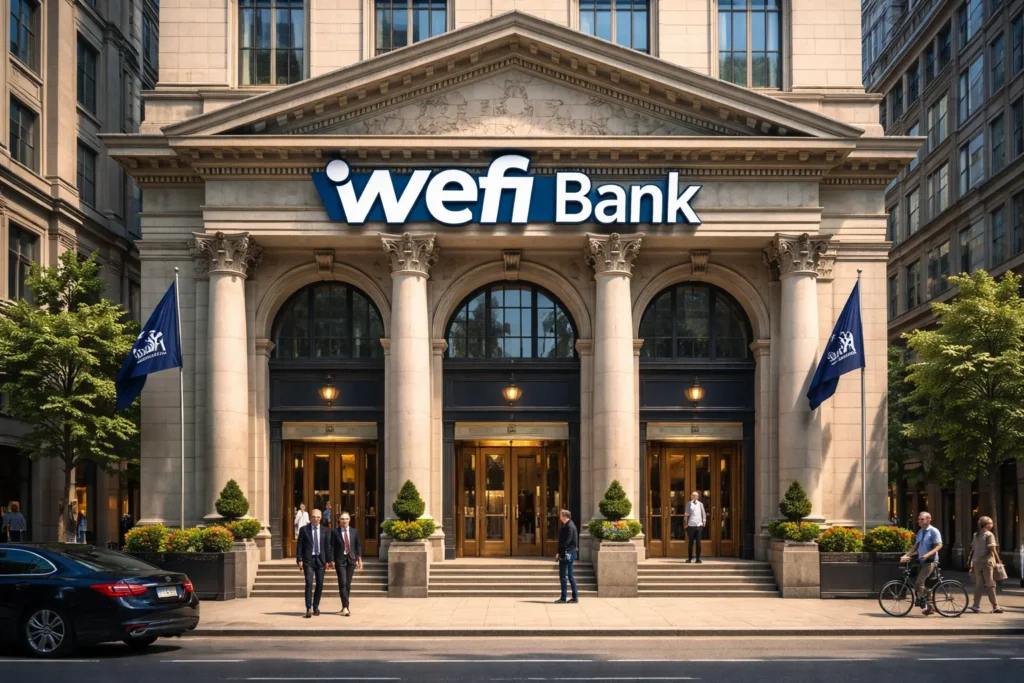
  • WeFi Bank: The Quiet Outlier in a Difficult Web3 Year

    WeFi Bank: The Quiet Outlier in a Difficult Web3 Year

    An industry defined by narratives — and exceptions

    2024–2025 has been an uncomfortable period for much of Web3.

    Bitcoin has underperformed relative to major equity indices, with the S&P 500 and Nasdaq printing all-time highs while crypto markets remain volatile and sentiment-driven. Inflation, while moderating in headline figures, remains structurally embedded across housing, energy, and services — a dynamic that has historically hurt speculative assets more than productive ones.¹ ²

    Against this backdrop, the majority of Web3 projects have followed a familiar pattern: ambitious whitepapers, aggressive token launches, short-lived hype cycles, and long periods of under-delivery. This dynamic is not new, but it has become harder to ignore in a market where capital is more selective and narratives alone no longer sustain valuations.

    Yet within this environment, WeFi Bank has quietly diverged from the trend.

    Sitting outside the top 100 tokens by market capitalisation, WeFi has nonetheless delivered relative token resilience, steady product expansion, and growing ecosystem attention — all while largely avoiding the speculative spotlight. For many traders and long-term holders, this has led to an uncomfortable question in hindsight: why wasn’t this on the radar earlier?

    This article attempts to answer three core questions:

    1. What exactly is WeFi Bank?
    2. Why has it bucked broader Web3 and macro trends this year?
    3. Is this performance structurally durable through 2026 — or simply another delayed narrative?

    We approach this with skepticism. Where information cannot be independently verified, it is framed as reported rather than confirmed. Where data is available, it is cited from high-quality sources. And where comparisons are drawn, they are grounded in historical precedent rather than optimism.


    What is WeFi Bank?

    At its core, WeFi Bank positions itself as a decentralised, non-custodial banking and liquidity protocol, focused on capital efficiency, structured DeFi products, and composable financial primitives rather than consumer-facing hype.

    Unlike many projects that brand themselves as “banks” while offering little more than staking dashboards, WeFi’s architecture appears to be built around three pillars:

    • On-chain credit and liquidity mechanisms
    • Risk-aware yield structures
    • Institutional-leaning design choices

    According to publicly available documentation and developer communications, WeFi aims to bridge aspects of traditional financial structuring — such as collateralisation, liquidation logic, and risk segmentation — with the transparency and programmability of DeFi.³

    This framing places it in contrast with much of the sector, which, as discussed in Amateur Hour Web3, is frequently dominated by teams with limited operational, financial, or governance experience despite managing hundreds of millions in user capital.

    Notably, WeFi has attracted attention from users researching the project through both positive and negative lenses — a dynamic reflected in traffic patterns to resources such as VaaSBlock’s overview of WeFi, which has become a landing page for users actively seeking critical assessments rather than promotional content.

    This alone is an early signal worth noting: serious users research risk.


    The macro context WeFi is operating within

    To understand WeFi’s divergence, it’s important to contextualise the environment it is operating in.

    Crypto vs equities: a widening perception gap

    Since late 2023, US equities have benefited from:

    • AI-driven earnings narratives (Magnificent Seven)
    • Fiscal stimulus tailwinds
    • Strong consumer spending despite inflation pressure

    Meanwhile, crypto markets have been constrained by:

    • Regulatory overhang in the US and Europe
    • Reduced retail speculation
    • The unwind of leverage-driven DeFi strategies that dominated 2020–2022

    Bloomberg and the Financial Times have both highlighted that crypto’s correlation to risk assets has weakened, undermining the thesis that Bitcoin and Web3 assets are a reliable hedge against inflation in the short to medium term.⁴ ⁵

    In this environment, projects dependent on pure narrative momentum have struggled.

    Projects tied to actual financial activity, however — lending, liquidity provision, structured yield — have shown relative resilience. This distinction matters when evaluating WeFi’s performance.


    Token performance: resilience without spectacle

    While WeFi’s token does not sit among the largest by market capitalisation, its relative performance versus sector benchmarks has been notable.

    Key observations (based on publicly available chart data and third-party analytics platforms):

    • Lower drawdowns compared to many DeFi governance tokens during market corrections
    • More stable on-chain liquidity profiles
    • Reduced volatility relative to narrative-driven launches

    Importantly, this performance has occurred without aggressive influencer marketing, exchange-driven hype, or short-term incentive programs — strategies that often inflate early metrics at the cost of long-term stability.

    As noted by Delphi Digital in multiple research pieces, *“sustainable token performance in DeFi correlates more strongly with real usage and capital efficiency than with total value locked alone.”*⁶

    WeFi appears — at least for now — to align with this thesis.


    Team and execution: competence over charisma

    One of the most persistent failure modes in Web3 is not technical — it is organisational.

    As explored in Amateur Hour Web3, many projects are run by teams that lack experience in:

    • Risk management
    • Financial product design
    • Long-term governance
    • Adversarial thinking

    WeFi’s team, based on reported backgrounds and public appearances, appears to skew toward engineering- and finance-led execution rather than marketing-led growth. While full verification of individual résumés is limited (as is common in Web3), several contributors have demonstrable histories in DeFi infrastructure and quantitative systems.

    This does not guarantee success — but it materially reduces certain categories of failure.

    Vitalik Buterin has repeatedly emphasised that *“most DeFi failures are not due to bad code, but bad assumptions about incentives and human behaviour.”*⁷

    WeFi’s comparatively conservative rollout strategy suggests awareness of this risk.


    Code, audits, and transparency

    Where available, WeFi’s smart contracts and protocol documentation indicate a preference for modular, auditable components rather than experimental monoliths.

    Reported audits and code reviews suggest:

    • Conservative parameterisation
    • Clear liquidation mechanics
    • Limited reliance on reflexive token incentives

    However, it is important to state clearly: absence of public exploits does not equal absence of risk. As history has shown — from Compound forks to more recent cross-chain bridge failures — vulnerabilities often emerge under stress rather than normal conditions.⁸

    This is where comparisons to cautionary examples become relevant.


    A necessary warning: the Kadena lesson

    The story of Kadena — explored in Kadena Failed — serves as a useful reminder that early technical strength and strong narratives do not guarantee longevity.

    Kadena was once positioned as a technically superior Layer-1, backed by credible founders and strong initial adoption. Over time, however, ecosystem stagnation, strategic misalignment, and capital misallocation eroded its position.

    The lesson is not that WeFi will follow the same path — but that structural execution matters more than early indicators.

    For WeFi, this means:

    • Sustaining real usage through market cycles
    • Avoiding over-financialisation of its token
    • Maintaining governance discipline as capital inflows grow

    History suggests that this is where many projects fail — not in their first year, but in their third.


    Why WeFi may be bucking the trend — for now

    Synthesising the available data, several factors appear to explain WeFi’s divergence:

    1. Product-led growth rather than narrative-led growth
    2. Risk-aware financial design
    3. Lower exposure to reflexive speculation
    4. Execution discipline in a capital-scarce environment

    These characteristics align more closely with traditional financial product development than with Web3’s historical growth patterns — a distinction increasingly rewarded in today’s market.

    As BlackRock CEO Larry Fink recently noted, *“Markets are becoming less tolerant of stories without cash flows.”*⁹

    While DeFi does not generate cash flow in the traditional sense, protocols that facilitate real economic activity increasingly resemble financial infrastructure rather than speculative instruments.


    Will it continue into 2026?

    This is the hardest question — and the one that should not be answered with certainty.

    For WeFi to sustain its trajectory, several conditions must hold:

    • Continued regulatory navigation without compromising decentralisation
    • Resistance to incentive-driven short-term growth traps
    • Ongoing technical robustness under increased usage
    • Governance maturity as token holders diversify

    If these conditions are met, WeFi could remain an outlier — a quiet compounder in a sector still dominated by volatility.

    If they are not, it risks becoming another example of early promise undone by scale.


    Final assessment

    WeFi Bank stands out in a year where standing out has been rare.

    It is not a guarantee of future success — but it is a credible deviation from Web3’s most common failure patterns. In an industry still struggling to professionalise, WeFi currently appears — cautiously — to be an exception rather than the rule.

    For investors, researchers, and analysts, the appropriate approach is neither hype nor dismissal, but rather ongoing scrutiny.

    In Web3, skepticism is not the same as pessimism.

    It is risk management.

  • The Crypto Quant Trap: How Wall Street’s Mathematical Gold Rush Is Starving Innovation and Undermining Society’s Future

    The Crypto Quant Trap: How Wall Street’s Mathematical Gold Rush Is Starving Innovation and Undermining Society’s Future

    In the hallowed halls of MIT, Stanford, and Princeton, a quiet but profound shift has occurred. The brightest minds, those who once dreamed of curing cancer, colonizing Mars, or solving climate change, are increasingly drawn to a different calling: the sterile, high-stakes world of quantitative trading. Instead of building the future, they’re building algorithms to exploit millisecond-price discrepancies in financial markets that contribute nothing to human progress.

    This isn’t just a career preference shift—it’s a societal crisis masquerading as talent optimization. As Benjamin Fairchild discovered when he made his own transition from web development to quantitative trading, the field offers something that traditional innovation sectors increasingly cannot: the promise of applying rigorous intellectual capabilities to problems with immediate, substantial financial rewards. In his revealing analysis, Fairchild describes how quantitative trading “validated everything I had suspected deep down, that markets can be approached like a software system. Those strategies could be coded, tested, deployed, and refined. That probability and statistics could replace opinion and bias.”

    The implications extend far beyond individual career choices. We’re witnessing a fundamental reallocation of human capital away from value creation toward value extraction, with consequences that threaten both technological progress and social stability.

    The Mathematics of Misallocation: Quantifying the Brain Drain

    The numbers paint a sobering picture. Wall Street firms now capture approximately one-third of Ivy League graduates, with many of the most technically sophisticated students—those holding advanced degrees in mathematics, physics, computer science, and engineering—being siphoned into financial engineering roles. According to Hacker News analysis, this represents a systematic harvesting of talent that “no doubt causes harm to US economy. Can you imagine what a young, really bright scientist/engineer can do putting in 120 hours/week at a stretch?”

    The engineering talent shortage has reached crisis proportions. Boston Consulting Group research reveals that the US needs approximately 400,000 new engineers annually, but due to skills gaps and educational mismatches, nearly one in three engineering positions remain unfilled each year. Meanwhile, the CSG Talent analysis shows that engineering talent is being “sought after by businesses, even if they don’t have specific industry experience,” creating bidding wars that financial firms consistently win through superior compensation packages.

    The cryptocurrency sector has become particularly adept at this talent acquisition, offering developers the intoxicating combination of cutting-edge technology and Wall Street-level compensation. LinkedIn data shows weekly active developers in crypto have plummeted from 12,000 in April 2024 to just 7,290 by March 2025—a 40% decrease that directly correlates with the migration of technical talent toward quant trading roles that offer more immediate financial rewards.

    The Crypto Quant Invasion: When Algorithms Attack Innovation

    The impact of quant traders entering cryptocurrency markets has been profound and largely negative. What began as an experimental financial system designed to democratize access to financial services has become increasingly dominated by sophisticated algorithmic trading systems that extract value while contributing nothing to the underlying technology or ecosystem development.

    According to Phemex Academy’s analysis, high-frequency trading has moved “from a controversial niche to a foundational force in both traditional and crypto markets, reshaping liquidity and competition.” However, this transformation comes at a steep cost. HFT algorithms create what researchers term “ghost liquidity”—order book depth that disappears too quickly for genuine market participants to utilize, effectively squeezing out smaller traders and amplifying market volatility.

    The Kenson Investments research documents how HFT practices have introduced systematic market manipulation into cryptocurrency trading. Techniques like spoofing (placing fake orders to manipulate price perception), wash trading (artificial volume creation through self-trading), and quote stuffing (overwhelming exchanges with rapid-fire orders) have become commonplace, distorting price discovery mechanisms that legitimate investors rely upon.

    The scale of this manipulation became chillingly clear when the US Department of Justice revealed that major “market makers” were providing “market-manipulation-as-a-service” to cryptocurrency projects. Companies like ZM Quant and CLS Global openly discussed generating artificial trading volume through algorithms that could execute “ten times per minute or twenty times a minute” to “pump the price” and create the illusion of market activity.

    The Volume Deception: How Quants Are Destroying Market Integrity

    The most damaging aspect of quant trading’s cryptocurrency invasion has been the systematic destruction of reliable market metrics. Trading volume, historically a key indicator of market health and genuine investor interest, has become meaningless due to algorithmic manipulation.

    The SEC’s enforcement actions against crypto market makers revealed that algorithms were generating “quadrillions of transactions and billions of dollars of artificial trading volume each day” through wash trading and other manipulative practices. This artificial volume serves no economic purpose while creating false signals that mislead genuine investors about market conditions and asset liquidity.

    According to Kaiko Research’s analysis, the FBI’s investigation into market manipulation revealed that quant trading firms were explicitly hired to “create the illusion of active markets” for newly issued tokens, artificially boosting prices and visibility to attract real investors. This practice has become so widespread that legitimate market making—the provision of genuine liquidity to facilitate efficient price discovery—has been largely replaced by algorithmic manipulation designed to extract value from unsuspecting market participants.

    The consequences extend beyond individual investor losses. As Amberdata’s research demonstrates, HFT activity creates “fluctuating order book depth” where “the perceived liquidity at a given moment might not be as robust upon execution, especially in volatile market conditions.” This uncertainty drives away genuine long-term investors while attracting more speculative traders, creating a negative feedback loop that undermines market stability.

    The Innovation Opportunity Cost: What Society Loses

    The migration of top technical talent to quant trading represents more than a simple career preference shift—it’s a massive opportunity cost for human progress. Every brilliant mind devoted to optimizing algorithmic trading strategies represents innovations that will never be developed, diseases that will remain uncured, and problems that will persist unsolved.

    Consider the compound impact: A software engineer earning $500,000 annually at a quant hedge fund might generate substantial personal wealth, but their work contributes marginally to economic productivity. The same engineer developing renewable energy technology, medical devices, or educational software could create value that benefits millions while generating economic returns that compound over decades.

    The IBM analysis of tech talent shortage reveals that engineering talent shortages are “having a significant impact on the demand for Engineers and there simply isn’t enough talent at a lower level, to ensure there are experienced Engineers at mid and senior levels.” When quant firms absorb senior engineers, they don’t just fill positions—they remove mentors who would train the next generation of innovators.

    This brain drain creates cascading effects throughout the innovation ecosystem. Startups struggle to find technical co-founders, research institutions lose post-doctoral researchers to finance, and infrastructure projects face delays due to talent shortages. The Boston Consulting Group research shows that nearly one in three engineering positions remain unfilled annually, representing billions in lost economic potential.

    The Societal Sickness: When Greed Outweighs Value Creation

    The quant trading talent migration reveals deeper societal pathologies about how we value different forms of work and contribution. We’ve created economic incentives that systematically reward value extraction over value creation, speculation over innovation, and short-term arbitrage over long-term problem-solving.

    This misalignment reflects what economists term “rent-seeking behavior”—economic activity focused on capturing existing wealth rather than creating new value. Quantitative trading, at its core, represents the pinnacle of rent-seeking: using mathematical sophistication to extract fractions of pennies from market inefficiencies while contributing nothing to economic productivity or human welfare.

    The societal implications are profound. When our brightest minds conclude that optimizing trading algorithms offers better career prospects than curing cancer or reversing climate change, we send a clear message about what we truly value as a civilization. We’ve created a system where financial engineering pays exponentially more than actual engineering, where arbitrage profits exceed innovation profits, where moving money around becomes more lucrative than moving humanity forward.

    As Fairchild’s journey illustrates, the appeal isn’t simply monetary—it’s the promise of applying rigorous intellectual capabilities to problems with measurable, immediate outcomes. In quantitative trading, success is quantifiable, feedback is instantaneous, and meritocracy appears more pure than in other fields where politics, funding constraints, and institutional barriers can delay or derail promising work.

    The Cultural Corruption: How Quant Thinking Infects Innovation

    Perhaps most insidiously, the quant trading mentality is beginning to corrupt how we approach genuine innovation. The focus on measurable metrics, optimization for efficiency, and pursuit of algorithmic solutions is being applied to domains where such approaches may be counterproductive.

    We’re seeing startups that promise to “disrupt” education through algorithmic learning platforms, “optimize” healthcare through predictive analytics, or “revolutionize” agriculture through automated trading of commodity futures. While technology certainly has roles in these sectors, the quant mindset often reduces complex human challenges to optimization problems, potentially creating solutions that work beautifully in spreadsheets but fail catastrophically in real-world application.

    The cryptocurrency sector exemplifies this corruption. What began as an experiment in decentralized financial systems has become increasingly dominated by quant trading strategies that extract value while contributing nothing to the underlying technology. The DailyCoin analysis reveals how “speculators dominate. Skeptics get canceled. And builders? They leave.”

    The Path Forward: Realigning Incentives with Value Creation

    Addressing the quant trading brain drain requires fundamental changes in how society rewards different types of contribution. This isn’t about demonizing quantitative trading or its practitioners—many are brilliant individuals making rational decisions within existing incentive structures. Instead, we need to create alternative pathways that make value creation as attractive as value extraction.

    Several approaches show promise:

    Mission-Driven Compensation: Organizations like the US Digital Service and effective altruism groups have begun offering competitive compensation for technical talent working on socially important problems. Expanding these models could help level the financial playing field.

    Equity in Innovation: Making it easier for researchers, engineers, and entrepreneurs to capture upside from innovations they develop could help align financial incentives with value creation. This includes reforming intellectual property systems and creating new funding mechanisms for long-term research.

    Cultural Narrative Shift: We need to elevate the status of scientists, engineers, and entrepreneurs who create genuine value, celebrating their contributions as much as we admire financial success stories.

    Regulatory Reform: Updating financial regulations to reduce the profitability of purely extractive activities while maintaining market efficiency could help redirect talent toward productive uses.

    The Existential Question: What Do We Value as a Society?

    The quant trading phenomenon ultimately raises fundamental questions about what kind of civilization we want to build. Do we want to be remembered as the generation that perfected algorithmic trading while climate change accelerated? Will history judge us for prioritizing arbitrage profits over breakthrough innovations?

    The market is always right in the sense that it reflects our collective values and priorities. If we’ve created a system where extracting value from existing systems pays more than creating new value, we shouldn’t blame individuals for making rational choices within that system. Instead, we should examine why we’ve built incentives that systematically misallocate our most precious resource—human intelligence and creativity.

    As Fairchild discovered in his transition from web development to quantitative trading, the field offers genuine intellectual satisfaction and the opportunity to apply rigorous analytical skills to complex problems. The challenge isn’t convincing brilliant people to leave quant trading—it’s creating alternative opportunities that offer similar intellectual rewards while contributing to human progress.

    The cryptocurrency market manipulation, brain drain from critical innovation sectors, and systematic misallocation of talent represent symptoms of a deeper societal illness: we’ve confused financial optimization with value creation, market efficiency with social progress, and individual wealth accumulation with collective prosperity.

    Until we address these fundamental misconceptions, we’ll continue watching our brightest minds disappear into the mathematical maw of quantitative trading, leaving humanity’s most pressing problems unsolved while algorithms optimize the extraction of value from systems that produce nothing of lasting worth.

    The question isn’t whether quantitative trading will continue to attract top talent—it’s whether we care enough about our collective future to build alternatives that make value creation as intellectually satisfying and financially rewarding as the sophisticated extraction mechanisms that currently dominate our financial landscape. The answer to that question will determine whether this generation is remembered for perfecting the science of moving money around, or for solving the fundamental challenges facing human civilization.


    In an era where algorithms can generate billions through market manipulation while researchers struggle to fund cancer cures, we must confront a sobering reality: we’ve built a system that systematically rewards the wrong things. The migration of our brightest minds to quantitative trading isn’t just a career trend—it’s a civilization-level failure of priorities that threatens our capacity to address humanity’s most pressing challenges.