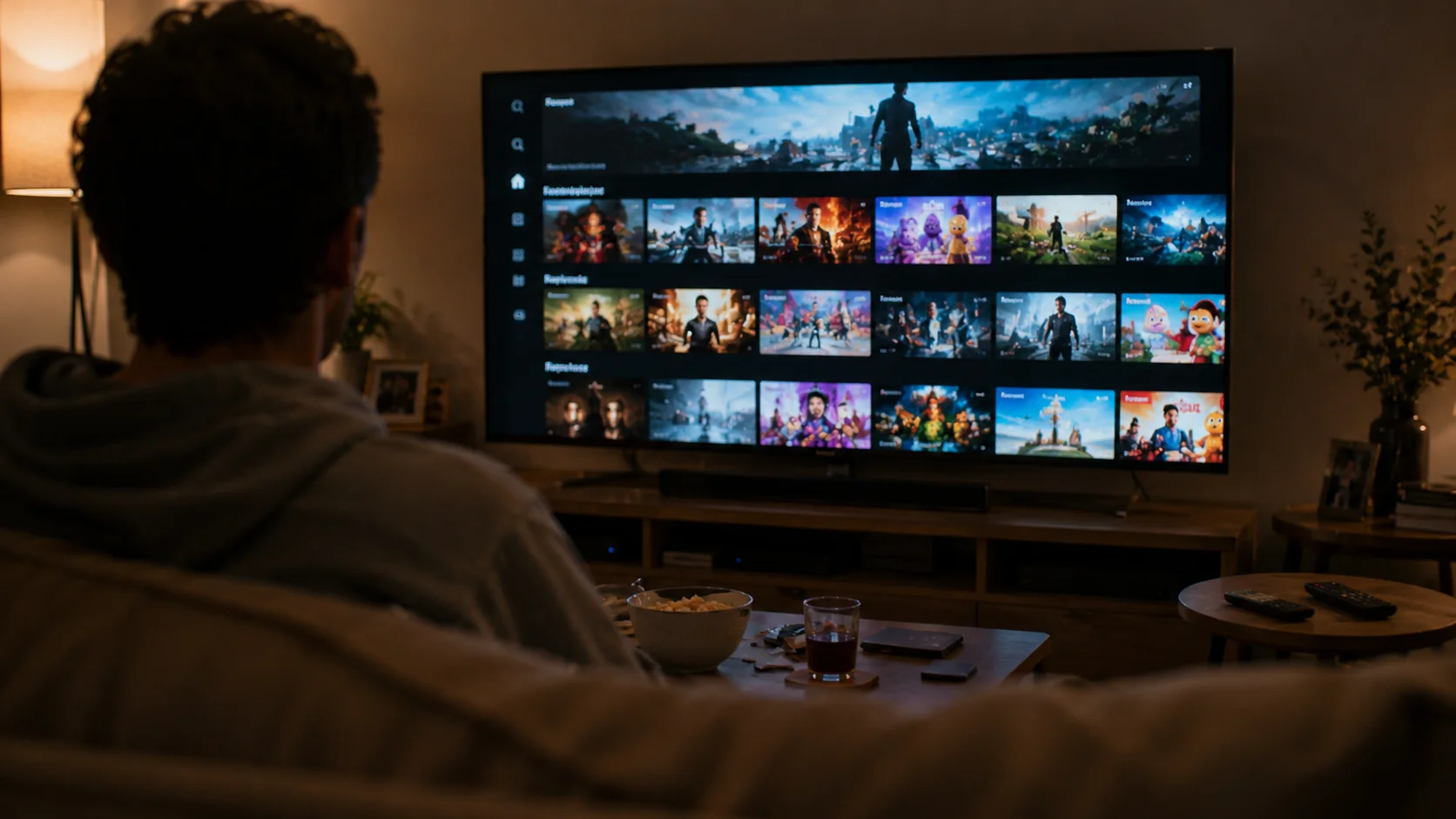
YouTube has surpassed Netflix as the most-watched streaming platform on television screens in the United States, capturing approximately 13% of total TV viewing time compared with Netflix’s 9%. This isn’t a close race — it’s a structural reversal. The company that invented subscription streaming, raised prices annually, fought password-sharing, and invested $17 billion in content last year is now second to a free platform that has never produced a scripted series. YouTube CEO Neal Mohan declared in 2026 that “YouTube is the new television” — and the Nielsen data backs it. The billion-dollar question for the streaming industry is what this means for the subscription model that every platform from Disney to Apple has bet its future on.
The Numbers That Reframe the Streaming Wars
The 13% vs 9% TV viewing share comparison needs context to land with full weight. Nielsen’s total TV measurement tracks every minute of viewing across broadcast, cable, and streaming platforms. YouTube now accounts for 13% of that total, making it the single largest streaming platform by viewing time on TV screens — not just on mobile, where YouTube has always dominated, but on the living room television that networks and streaming services have treated as their primary battleground.
Netflix finished December 2025 with a 9% share of TV viewing. That’s a meaningful gap — 13% to 9% represents roughly 44% more viewing time on YouTube than Netflix, among a population of viewers who are watching on TV screens rather than laptops or phones. For context, Disney+ and HBO Max are well below both, competing for single-digit percentage shares.
The broader streaming category captured 47.5% of all TV viewing in December 2025 — the highest share ever recorded. Traditional broadcast and cable now represent less than half of American TV viewing, a threshold that would have seemed impossible to cross a decade ago. Within that streaming majority, YouTube’s position as the single largest platform means the platform that disrupted television didn’t come from Hollywood — it came from San Bruno, California, and was built by teenagers filming gaming videos and makeup tutorials.
Why Free Beat Subscription
The mechanism behind YouTube’s TV viewing dominance is worth examining precisely because it runs counter to what the streaming industry bet on. Netflix’s playbook — premium content, ad-free subscription, exclusive releases — became the template that Disney+, HBO Max, Apple TV+, and Peacock all followed to varying degrees. The implicit assumption was that television viewers would pay for content they couldn’t get elsewhere.
YouTube’s playbook is the opposite. Content is free. Creators bear the production cost. Revenue comes from advertising. The quality floor is low; the volume is essentially infinite; and the recommendation algorithm handles discovery better than any editorial programming team can. The result is a platform where a viewer can spend 13% of their total TV viewing time — multiple hours per day — without ever paying for a subscription.
Connected TV ad spending reaching $38 billion in 2026 is what makes this model commercially viable at YouTube’s scale. eMarketer’s analysis shows YouTube capturing a disproportionate share of CTV ad revenue due to its pricing flexibility — advertisers can buy YouTube CTV inventory at CPMs that compete directly with traditional TV, without the audience guarantee minimums that broadcast networks require. YouTube’s revenue already leads Netflix by $15 billion annually, driven by advertising rather than subscriptions.
What Disney’s $24 Billion Content Bet Is Competing Against
Disney announced at its 2026 upfront presentation that it anticipates spending $24 billion on content across entertainment and sports this year. The upfront slate includes Ahsoka Season 2 (2027 Disney+), VisionQuest (October 14 Disney+), Avatar: Fire and Ash, and live sports through ESPN — a strategy built around owned franchise IP and exclusive live events that YouTube cannot replicate.
Disney’s strategic logic is defensible: YouTube cannot produce Game of Thrones, Avengers, or live NFL games. The content categories where subscription streaming can charge a premium are exactly the content categories that require the kind of production budgets and IP ownership that YouTube’s creator model can’t touch. A $24 billion content spend is a statement that Disney believes the franchise IP moat is durable enough to sustain subscription pricing against free competition.
The risk is that the moat is narrower than the spending implies. YouTube can’t compete with Ahsoka, but it can — and does — compete for the viewing hours that happen between premium franchise releases. A Disney+ subscriber who watches 10 hours of content per month may watch 30 hours of YouTube in the same period. The subscription fee is justified by the 10 hours of premium content; the 30 hours of YouTube are free margin for a platform that collects ad revenue on every minute.
The Netflix Response: Buying What YouTube Can’t Copy
Netflix’s response to YouTube’s viewing dominance has been to acquire what YouTube structurally cannot replicate. The $82.7 billion Warner Bros. acquisition — pending regulatory approval — gives Netflix the HBO content library and Warner Bros. studio infrastructure. The deal creates the single largest premium content library in streaming history — content that is definitionally unavailable on YouTube.
Netflix has also been pushing into live sports and events — an area where YouTube competes through live creator content but lacks the exclusive rights packages that drive must-watch viewing. The NFL, NBA, and major sporting events command the kind of appointment television behavior that keeps subscribers paying even when they spend the majority of their viewing time on YouTube.
The ad-supported tier is Netflix’s most direct competitive response to YouTube’s free model. With 60% of new Netflix sign-ups choosing the ad-supported tier and a $3 billion annual ad revenue target, Netflix is essentially building a premium version of YouTube’s ad-supported free model — same business mechanics, better content, monthly fee. Whether that premium justifies the subscription cost to consumers who have YouTube free on every screen is the commercial test Netflix is running in real time.
Crypto and Web3 Creator Economy Implications
YouTube’s dominance raises the creator monetization question that blockchain-native platforms have been trying to answer for five years. YouTube creators receive approximately 55% of ad revenue generated by their content — the remaining 45% goes to YouTube. That split, and YouTube’s unilateral ability to demonetize content it deems policy-violating, has driven creator interest in decentralized alternatives since 2019.
Platforms like Odysee (built on the LBRY blockchain), Theta Network (which built a decentralized video delivery CDN with TFUEL token rewards), and newer Web3 creator economy projects offer creators higher revenue shares and censorship-resistance that YouTube cannot provide. As YouTube’s TV viewing dominance grows, the economic stakes of the 45% platform cut grow proportionally — a creator generating $1 million in annual ad revenue is paying YouTube $450,000 for distribution.
The creator economy’s relationship with crypto monetization is evolving alongside YouTube’s dominance rather than against it. The most successful Web3 creator platforms don’t try to replace YouTube’s distribution reach — they layer token-based monetization on top of existing content distribution, allowing creators to earn on both platforms simultaneously. Token-gated content, NFT-based fan memberships, and on-chain creator royalties are additive to YouTube revenue rather than competitive with it.
The advertising-first model that YouTube has proven at scale is also creating an economic template for decentralized streaming platforms. If CTV ad spending reaches $38 billion and growing, a decentralized video platform that captures even 1% of that market — $380 million in annual ad revenue redistributed to creators and token holders rather than centralized to Alphabet’s balance sheet — creates meaningful economic value on-chain.
The Long Game: Whom Does YouTube Actually Threaten?
YouTube’s 13% TV viewing share doesn’t threaten all streaming platforms equally. It most directly threatens the mid-tier streaming services — Peacock, Tubi, Pluto TV, and other FAST-tier platforms — that compete primarily on free content with ad-supported models. YouTube does that better than any of them, with a larger content library, a superior recommendation algorithm, and a brand recognition advantage that no challenger can match.
Netflix and Disney are less immediately threatened because their competitive positions are built on content categories YouTube genuinely cannot replicate: scripted drama at HBO quality, Marvel franchise content, live sports rights. Netflix’s own internal analysis, referenced in European press coverage, acknowledges YouTube as a primary long-term competitive threat — not for premium originals, but for the broad viewing time that sustains subscriber satisfaction between major release events.
The 2026 streaming landscape is settling into a two-tier structure: a free tier dominated by YouTube (and to a lesser extent, Tubi and FAST channels), and a premium tier where Netflix-WBD, Disney+, and Apple TV+ compete for subscription wallet share using exclusive content that YouTube’s model structurally cannot produce. The question is whether the premium tier can sustain subscription pricing as YouTube continues to expand its footprint on the television screen that streaming platforms spent a decade treating as their exclusive territory.
The Product Decision Behind Why Free Beat Subscription
I have spent enough time inside product teams that I can recognise the pattern in YouTube’s win over the subscription streamers, and it is more interesting than the headline framing suggests. The pattern is what happens when one product team understands what its users actually want and another product team mistakes what users say they want for what they actually do.
Subscription streaming was built on a survey-research insight: users say they want fewer ads, higher production quality, and curated catalogues. Each of those is a real preference. None of them, taken individually or together, is the strongest preference. The strongest user preference, when you watch behaviour rather than ask questions, is the one neither survey captured cleanly: users want the lowest possible friction to find something watchable in the next ninety seconds.
YouTube built around that lower-order preference and the subscription platforms did not. The result is the viewership shift the article documents. The product lesson generalises: when survey signals and behavioural signals disagree, behavioural signals are usually right, and the team that builds against them wins. The platforms that read this honestly will rebuild parts of their discovery surfaces around the same friction-minimisation logic. The platforms that interpret the data as a content problem will spend another five years buying expensive shows and discovering that the shows do not move the metric they thought the survey was telling them about.
FAQ
How did YouTube become the most-watched streaming platform on TV?
YouTube reached 13% of total U.S. TV viewing time through a combination of factors: its free, ad-supported model removes any subscription barrier; the recommendation algorithm drives extended viewing sessions efficiently; the volume of content is effectively infinite compared to any subscription library; and the platform’s mobile-first user base has migrated to connected TVs as smart TV adoption became universal. YouTube has benefited from the shift of streaming from laptop/phone consumption to television-screen consumption — as streaming captured 47.5% of all TV viewing in December 2025, YouTube’s already dominant content position translated directly into TV viewing share that now exceeds Netflix’s 9%.
What does YouTube’s TV dominance mean for subscription streaming?
Subscription streaming faces a structural challenge from YouTube’s viewing dominance: YouTube captures the viewing hours that happen between premium content releases, leaving subscription platforms dependent on a shrinking share of total viewing time while maintaining subscription prices that require perceived value across the full month. The response from Netflix (acquiring Warner Bros. for premium content and library depth) and Disney (spending $24 billion on franchise IP and live sports) is to double down on content categories YouTube structurally cannot replicate. Whether that content justifies subscription pricing when YouTube occupies 13% of total TV time — free — is the commercial test streaming economics are running in real time.
How much is YouTube’s TV ad revenue in 2026?
YouTube’s total advertising revenue significantly exceeds Netflix’s, with YouTube’s annual revenue leading Netflix by approximately $15 billion when comparing advertising-driven income. Google reported $10.26 billion in YouTube ad revenue in a single quarter (Q3 2025), up 15% year-over-year. Connected TV ad spending is on track to reach $38 billion in 2026, with YouTube capturing a disproportionate share due to its TV viewing leadership and flexible CTV pricing that competes directly with traditional broadcast. Netflix targets $3 billion in ad revenue for 2026 — a fraction of YouTube’s scale, even as Netflix’s ad tier grows rapidly.
Can decentralized video platforms compete with YouTube’s TV dominance?
Decentralized video platforms face YouTube’s distribution scale and recommendation algorithm as nearly insurmountable advantages in direct competition. The viable path for Web3 video platforms is not replacing YouTube’s distribution but adding tokenized monetization layers that improve creator economics: higher revenue shares (vs YouTube’s 55%), censorship-resistant publishing, and NFT-based fan monetization that operates in parallel with YouTube content. Theta Network’s decentralized CDN infrastructure and Odysee’s LBRY-based publishing are the most developed alternatives, but neither competes with YouTube on total content volume or recommendation quality. The realistic Web3 opportunity is capturing the creator monetization layer that sits above YouTube’s distribution infrastructure.
What is Disney’s strategic response to YouTube’s growth?
Disney’s strategic response is to invest $24 billion in content that YouTube’s creator model cannot replicate: franchise IP (Ahsoka, VisionQuest, Marvel, Star Wars), theatrical tentpoles (Avatar: Fire and Ash), and live sports through ESPN. Disney’s thesis is that the content categories commanding subscription premiums — appointment television from beloved franchises, live sports rights, exclusive film releases — create sufficient viewer value to sustain Disney+ subscription pricing against free YouTube competition. The risk is that Disney+ captures only a portion of total viewer time while YouTube occupies the majority, leaving Disney dependent on maintaining the perceived value of its exclusive windows to justify a subscription price that YouTube makes unnecessary for most viewing.
Sources
- Crisp Idea — YouTube vs Netflix streaming platform market share 2026
- Apprupt — U.S. TV viewership statistics 2026
- eMarketer — YouTube CTV growth and pricing edge 2026 streaming outlook
- The Streamable — Disney 2026 UpFront streaming announcements
- IndexBox — YouTube revenue tops Netflix as streaming competition intensifies
- Value Your Network — Netflix warns Europe about YouTube’s TV competition
- Adwave — YouTube TV viewing share Q4 2025