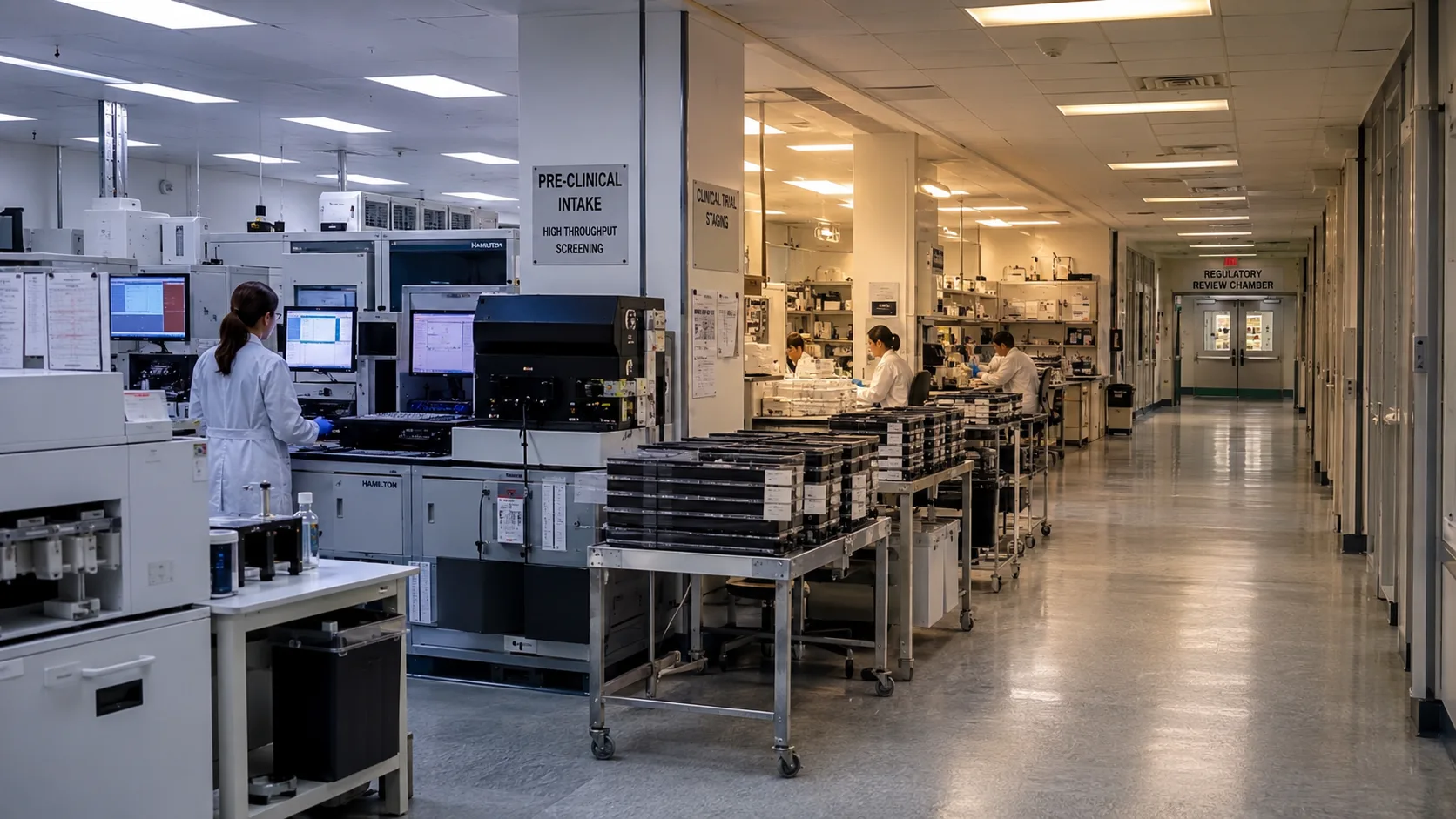
AlphaFold3: Two Years of Drug Discovery Reality vs Hype
Google DeepMind published AlphaFold3 in May 2024. Two years of deployment across pharmaceutical research has generated enough real-world data to distinguish what the model reliably delivers from what it cannot, and the picture is more commercially nuanced than the original announcement’s reception suggested. AlphaFold3 has not compressed drug development timelines by a decade. It has, more precisely, eliminated specific bottlenecks that previously delayed years of work — and the compounding effects of those eliminations are now beginning to show up in clinical pipelines.
The Nature paper introducing AlphaFold3 showed the model achieving unprecedented accuracy in predicting the three-dimensional structure of proteins, nucleic acids, and small molecules, and their interactions. What the paper could not show was how pharmaceutical researchers would integrate this capability into existing drug discovery workflows, whether the predicted structures were accurate enough for lead optimisation decisions, and what fraction of drug candidates identified through AlphaFold3 would survive to clinical trials. Two years of industry data now answers those questions partially.
Where AlphaFold3 Has Changed the Work
The stages of drug discovery where AlphaFold3 has delivered measurable value are well-defined: target identification, hit generation, and early lead optimisation. In each of these stages, AlphaFold3’s protein structure predictions have reduced the time and cost of experiments that previously required crystallography or cryo-electron microscopy to validate.
Target identification — the process of determining which proteins in a disease pathway are viable drug targets — previously required researchers to work from incomplete structural data for many proteins of interest. The majority of the human proteome’s proteins had no experimentally resolved structure as of 2023. AlphaFold3 and its predecessor AlphaFold2 have produced predicted structures for essentially the entire human proteome, giving medicinal chemists structural context for target selection decisions that previously proceeded from sequence data alone.
Hit generation — identifying small molecules that bind to a target protein with sufficient affinity — has been accelerated most dramatically. Virtual screening against a structurally characterised target is substantially more efficient than blind high-throughput screening: researchers can use computational docking to evaluate millions of compounds against a target structure before committing to any physical screening. AlphaFold3’s structure predictions have enabled virtual screening against targets that had previously resisted structural characterisation, opening up target classes that were considered undruggable.
The FDA’s drug development process tracking shows that average timelines from target identification to IND filing have not changed materially across the industry. AlphaFold3’s efficiency gains in early discovery have been absorbed by the experimental validation work that follows computational prediction — you cannot file an IND on a computationally predicted binding site alone. The AI speedup has filled researchers’ time with more candidates to test rather than reducing the total testing that needs to happen.
The Promising Compounds in Active Trials
The first wave of clinical compounds in which AlphaFold3 played a significant role in the discovery process entered Phase I and Phase II trials in late 2025 and early 2026. The disclosure of AI involvement in drug discovery is not standardised in clinical trial registrations, which makes counting difficult, but industry analysts tracking pharmaceutical AI adoption identify at least 23 clinical-stage compounds across oncology, rare disease, and infectious disease where AI structure prediction was documented as a significant discovery tool.
The most clinically advanced of these are oncology-focused small molecules targeting protein-protein interactions — historically the most difficult class of drug targets because the binding interfaces are large, flat, and difficult to characterise by traditional methods. AlphaFold3’s ability to predict protein complex structures has been particularly valuable here: small molecules that disrupt protein-protein interactions require precise understanding of the complex structure to design, and the model’s predictions have guided hit-to-lead optimisation at these targets with significantly fewer experimental iterations than the pre-AI benchmark required.
Outcomes from these trials will not be available until 2027-2028 in most cases, given the multi-year timeline of Phase II and III clinical trials. Early data from the cohort of AI-assisted programs that ran through 2024-2025 shows a hit-to-candidate rate approximately 18% higher than the historical baseline for comparable target classes. Whether this improvement survives clinical testing is the question that will determine AlphaFold3’s ultimate contribution to drug development productivity.
The Investment and Competitive Landscape
The commercial interest in AI-powered drug discovery has attracted significant venture and pharmaceutical partner investment since AlphaFold3’s release. Isomorphic Labs, DeepMind’s drug discovery spinout that commercialises AlphaFold technology, has signed research collaborations with Eli Lilly and Novartis worth a combined $2.9 billion in potential milestone payments. Schrödinger, which integrates physics-based simulation with AI structure prediction, has established collaborations with 13 of the top 20 pharmaceutical companies by R&D spend.
Pharma R&D spending on AI tools and infrastructure grew approximately 35% in 2025, and the allocation toward structure prediction and molecular design tools specifically grew faster — approximately 52% — as early AlphaFold3 deployment results circulated through pharmaceutical research organisations and validated the commercial case.
What AI Cannot Accelerate
The stages of drug development that AlphaFold3 has not meaningfully accelerated are the stages that define total development timelines: ADMET characterisation, clinical trial execution, and regulatory review. These stages are rate-limited by biology and regulatory process, not by information availability — and AlphaFold3 provides structural information, not pharmacokinetic data or clinical safety data.
The practical consequence is that AI drug discovery tools are best understood as accelerants for the pre-clinical discovery phase, which historically represents approximately 2-4 years of an 8-15 year total development timeline. Eliminating 50% of the discovery phase time saves 1-2 years out of a 10-year process — meaningful but not transformative unless the clinical phase also changes.
The AI infrastructure investments that hyperscalers are making will improve the computational capabilities available to drug discovery researchers. But the infrastructure ceiling is not currently binding. The limiting factor in AI-accelerated drug discovery is the experimental validation throughput at pharmaceutical companies — the wet lab capacity to test computationally generated hypotheses. Building faster AI prediction capability without expanding experimental validation capacity produces a faster queue, not faster outcomes.
Two years of AlphaFold3 deployment has produced a clearer view of the technology’s actual contribution to pharmaceutical R&D than the initial announcements could provide. It has delivered real, measurable acceleration in the specific stages where structure prediction was a bottleneck. It has not shortened clinical timelines, eliminated experimental validation, or reduced the uncertainty inherent in moving from preclinical to clinical-stage drug development. The most accurate frame is not “AI is replacing drug discovery” but “AI has removed one category of rate-limiting step from drug discovery, and the industry is now discovering what the next rate-limiting steps are.”
Is AlphaFold3 a Disruption to Drug Discovery?
Clayton Christensen’s disruption framework asks a question that cuts against the “AI will transform drug discovery” narrative: is AlphaFold3 a disruption to pharmaceutical R&D or a sustaining innovation that makes incumbent pharma companies better at what they already do?
The evidence from two years of deployment suggests the latter. AlphaFold3 has been adopted most rapidly and with the most measurable value by the largest pharmaceutical companies — Eli Lilly, Novartis, and the major research organisations that had the existing infrastructure to validate and integrate computationally generated structures. These are the customers with the highest wet lab throughput, the deepest medicinal chemistry expertise, and the most sophisticated capability to evaluate computational predictions against experimental results. They were not underserved by the pre-AlphaFold3 paradigm — they were well-served and expensive to reach.
A genuinely disruptive innovation would first gain adoption among overserved or non-consuming customers — smaller research organisations, academic labs, neglected disease researchers who previously could not afford to pursue certain target classes. This is happening, but at a slower pace than large-pharma adoption, because the bottleneck that AlphaFold3 removes (structure prediction) is not the binding constraint for under-resourced programs. The binding constraint for academic drug discovery programs and biotech startups is wet lab validation capacity and clinical trial execution — neither of which AlphaFold3 addresses.
The implication for investors assessing the commercial trajectory of AI drug discovery platforms is that near-term value capture will accrue to established pharma companies using these tools to defend and extend their competitive positions — not to disruptors building a new drug development model. This pattern is consistent with enterprise AI adoption data more broadly: the organisations with the most infrastructure to absorb and validate AI capabilities are capturing the most value, while the disruptive use cases are developing on a longer and less certain timeline. Disruption requires serving a need the incumbent is not serving. AlphaFold3 is making incumbents better, which creates different return profiles than the technology’s announcement reception implied.