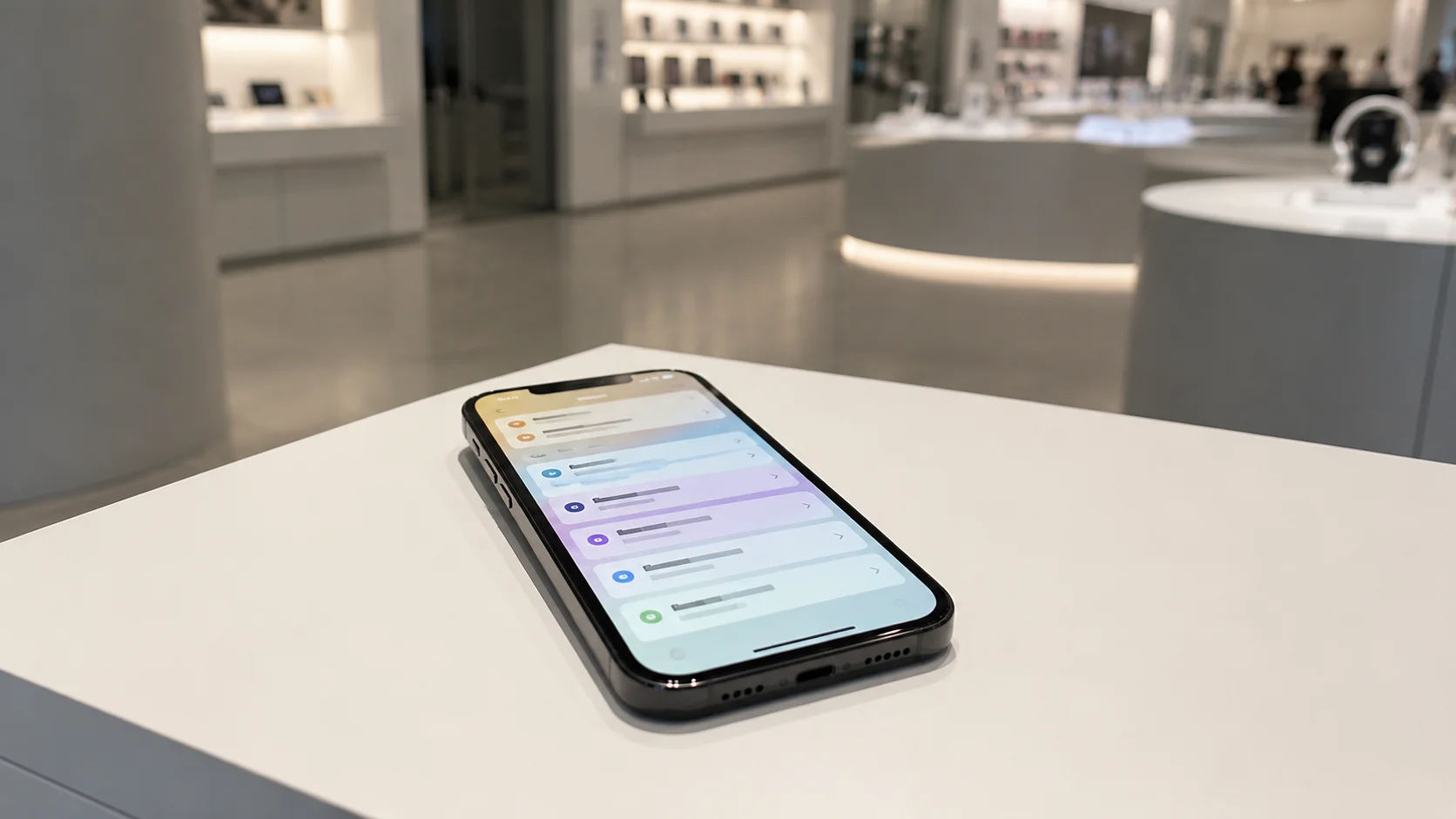
Apple is about to end its ChatGPT exclusivity deal and turn iOS 27 into a competitive marketplace for AI models. The feature — internally called “Extensions” — lets users route Apple Intelligence requests to Google Gemini, Anthropic Claude, or OpenAI ChatGPT, selectable per use case or set as a system-wide default. WWDC 2026 on June 8 is the expected announcement date, with consumer rollout in fall. This is a structural shift in how AI models reach consumers: instead of competing for app downloads, Google and Anthropic will now compete for the system-level default on 1.4 billion active Apple devices. For the AI model industry, the device is becoming the distribution layer — and Apple just decided it won’t pick winners.
What iOS 27 Extensions Actually Does
The “Extensions” framework works by letting users select a third-party AI model as the engine behind Apple Intelligence features — Siri responses, Writing Tools, image generation, and more. According to 9to5Mac’s report, which broke the story on May 5, users can choose different models for different tasks — Gemini for search-heavy queries, Claude for writing assistance, ChatGPT for general use — or set a single model as the default across all Apple Intelligence requests.
The mechanism is App Store-native. Google and Anthropic would add Extensions support to their existing Gemini and Claude iOS apps, and those apps would then appear as selectable providers in iOS Settings. Apple retains control of the distribution channel and the user interface — the model becomes a pluggable backend rather than a separate product.
What changes is the competitive surface. Previously, winning AI users on iPhone meant winning App Store downloads and daily active use of a standalone app. Under Extensions, it means becoming someone’s system default — the model that answers when they ask Siri to draft an email, rewrite a document, or summarize a webpage. TechCrunch described it as “Choose Your Own Adventure for AI models” — and the prize for winning isn’t a download, it’s ambient presence across every iOS workflow.
Why Apple Is Doing This Now
The ChatGPT deal Apple struck with OpenAI in 2024 for iOS 18 was a pragmatic first move — Apple needed a capable AI backend quickly, and OpenAI was ready. But that deal carried a strategic cost: it made Apple’s AI capabilities dependent on a single vendor, and it created a perception problem as Google’s Gemini and Anthropic’s Claude demonstrated capabilities equal to or better than GPT-4o in specific domains.
The regulatory environment accelerated the decision. The EU’s Digital Markets Act (DMA) and ongoing U.S. antitrust scrutiny of Apple’s App Store practices created pressure to demonstrate openness in AI distribution, not just app distribution. An Extensions framework that routes system AI through a competitive marketplace is a defensible posture in both jurisdictions — it’s structurally similar to the browser choice screens the EU mandated for Windows, applied to AI models.
There’s also a purely commercial logic. Apple doesn’t build foundation models. Its advantage is the device, the OS, and the 1.4 billion user install base. By becoming the AI model distribution layer rather than a competitor to OpenAI or Google in model development, Apple captures revenue from every model provider that wants iOS access without having to win the arms race for training compute.
What This Means for OpenAI’s iPhone Advantage
OpenAI’s 2024 deal with Apple gave it an extraordinary distribution advantage: ChatGPT was the default AI behind Siri for every iOS 18 user who opted into Apple Intelligence. That’s a different order of magnitude from App Store downloads. The Extensions framework ends that exclusivity — or at minimum, demotes it from default to one option among several.
The OpenAI relationship with Apple isn’t ending. ChatGPT will remain available as an Extensions provider, and it may remain the pre-set default for new users who haven’t made an active choice. But the dynamic shifts from “ChatGPT is iOS AI” to “ChatGPT is one of several iOS AI options.” For OpenAI’s commercial model — which depends heavily on converting free users to ChatGPT Plus subscriptions — the loss of exclusive default status is a material distribution risk.
Google and Anthropic gain most from this change. Gemini integration into iOS means Google’s AI model is accessible to the same hardware installed base that Google has historically struggled to penetrate deeply. For Anthropic, the Claude iOS extension puts it in direct competition for system-default status — a position that drives enterprise and consumer paid subscriptions more efficiently than any marketing campaign.
The On-Device AI Agent Implications
The Extensions framework matters beyond simple AI feature selection. It creates the infrastructure for on-device AI agents that can operate across Apple’s app ecosystem using whichever model the user — or a developer — has designated as the system intelligence layer.
That has direct implications for crypto wallet and DeFi management on iOS. An AI agent running as a system extension can, in principle, monitor a user’s on-chain portfolio, surface gas fee alerts, draft transaction confirmations in plain language, and flag suspicious contract interactions — all within the native iOS interface rather than inside a standalone app. The agent doesn’t need to be a crypto specialist; it uses whatever Claude, Gemini, or GPT-4o capability is available via the Extension, combined with data from apps like MetaMask, Coinbase Wallet, or Phantom that are already installed.
Crypto wallet infrastructure is already being rebuilt around AI-native primitives — iOS 27 Extensions gives that infrastructure an OS-level entry point that doesn’t require a new app install or explicit user action per interaction. The model just needs to be the system default, and the wallet app needs an Extensions-compatible API. That’s a much lower friction path to AI-assisted DeFi than anything currently available.
The AI Model Market Structure Shifts
The immediate consequence of Extensions is a distribution arms race between Google, Anthropic, and OpenAI for the iOS default position. That race won’t be won on model quality alone — it will be won on integration quality, trust signals, and pricing. A model that integrates seamlessly with iCloud data, respects Apple’s privacy architecture, and offers a compelling free tier has a structural advantage over one that requires sign-in to an external service for every query.
Anthropic’s positioning is interesting here. Claude’s reputation for lower hallucination rates on factual tasks and more careful handling of sensitive information aligns well with Apple’s privacy-first brand positioning. A Claude iOS Extension that emphasizes on-device processing and privacy commitments could win a segment of Apple users that Google Gemini — with its Google account integration and data sharing implications — cannot easily reach.
The deeper consequence is what Extensions does to the standalone AI app category. If the most valuable AI interactions happen at the system level — responding to user queries, processing documents, managing communications — then the standalone AI app becomes less important than the system integration. ChatGPT’s 100-million-plus active user base was built partly on the iPhone app. If that user base migrates to using Claude or Gemini through the iOS system layer, ChatGPT’s app loses the daily interaction surface that drives subscription conversions.
Crypto and Web3 Protocol Angles
The competitive pressure from iOS 27 Extensions accelerates the case for decentralized AI inference infrastructure. If three major foundation model providers are competing to become the default on Apple devices, the AI model market faces a winner-takes-distribution dynamic that concentrates power at the OS layer. The counter-architecture is AI inference that runs without platform permission — on-chain or through decentralized compute networks that any app or agent can access without routing through Apple’s Extensions framework.
Networks like Bittensor (TAO), which incentivizes decentralized AI model development and inference, and io.net, which aggregates distributed GPU capacity for inference workloads, offer the infrastructure for AI models that don’t need Apple’s approval to reach users. Akash Network similarly provides decentralized cloud compute that model developers can run inference on without hyperscaler dependency.
For crypto-native AI applications — wallet management agents, on-chain analytics, DeFi strategy execution — the choice isn’t necessarily between being an Apple Extension or being a standalone app. It’s between relying on centralized model distribution for intelligence, or building on decentralized inference infrastructure that operates regardless of which model Apple users have set as their default. As AI agents take on more of the operational load in crypto, the infrastructure those agents run on matters as much as the models they use.
How To Read The iOS 27 Marketplace Probabilistically
The iOS 27 model-extensions announcement is a moment where the bullish narrative is easy to write and the actual probability distribution is less obvious than it first appears. Apple’s history with developer-facing platform openings — App Store, HealthKit, CarPlay, App Clips — does not converge on a single template. Some opened cleanly and became durable infrastructure. Others opened with restrictions that effectively neutered third-party participation within eighteen months. Estimating which pattern the model-extensions marketplace ends up following is the question worth doing.
The base rate from prior Apple platform openings, conservatively counted, is roughly even between “becomes meaningful third-party economy” and “becomes Apple’s preferred distribution channel for Apple’s own products with token third-party presence.” The variance is high. The factors that historically tip the outcome are well documented: how much of the platform value Apple needs to capture directly, how much regulatory scrutiny is in the room when the rules get written, and how big the secondary market becomes before the rules harden.
On those three, the model-extension marketplace has unusual specifics. The economic value of being the default AI provider on a billion phones is too large for Apple to give away cleanly. The regulatory scrutiny is intense across multiple jurisdictions. The secondary market — third-party AI models — is already large enough that Apple cannot simply close it without antitrust consequences. None of those determine the outcome individually, but together they suggest the probability of a genuinely open third-party economy is closer to a third than to a half. Worth tracking the actual revenue-share terms when published; they will move the estimate sharply.
FAQ
What is Apple’s iOS 27 Extensions feature for AI?
iOS 27 Extensions is Apple’s framework for letting users choose which AI model powers Apple Intelligence features — including Siri, Writing Tools, and other system-level AI capabilities. Instead of being locked to ChatGPT as the default AI backend (as in iOS 18), users will be able to select Google Gemini, Anthropic Claude, OpenAI ChatGPT, or potentially other models as their preferred AI system. The feature works through the App Store — AI providers add Extensions support to their existing iOS apps, which then appear as selectable options in iOS Settings. The announcement is expected at WWDC 2026 on June 8, with consumer rollout in fall 2026.
Why is Apple ending its ChatGPT exclusivity arrangement?
Apple is moving from ChatGPT exclusivity to a competitive model marketplace for several reasons. Regulatory pressure from the EU’s Digital Markets Act and U.S. antitrust scrutiny incentivizes demonstrating openness in AI distribution. Strategically, Apple’s advantage is its device ecosystem and install base — not model development — so becoming the distribution layer for multiple competing AI providers is more commercially valuable than exclusive commitment to one. Additionally, as Google Gemini and Anthropic Claude demonstrated capabilities competitive with GPT-4o, Apple’s AI offering was constrained by limiting users to a single provider.
What does iOS 27 Extensions mean for crypto and DeFi on iPhone?
The Extensions framework creates infrastructure for OS-level AI agents that can interact with any installed app, including crypto wallets and DeFi applications. An AI agent operating as a system extension could monitor on-chain positions, surface transaction alerts, explain contract interactions in plain language, and assist with DeFi decisions — all within the native iOS interface rather than inside a standalone app. Crypto wallet developers building Extensions-compatible APIs could make their applications significantly more capable without requiring users to switch contexts or install separate AI tools. This is a materially lower-friction path to AI-assisted crypto management than anything currently available on iOS.
How does this affect Google and Anthropic’s competitive position?
Both gain significantly. Google Gemini gains iOS system-level access to an installed base it has historically been unable to deeply penetrate — iPhone users who use Google services but have their device AI default set to ChatGPT. For Anthropic, the Claude iOS Extension puts it in competition for system default status with a model that is well-regarded for low hallucination rates and careful handling of sensitive information — attributes that align with Apple’s privacy positioning. The critical battleground will be integration quality, privacy architecture compatibility, and pricing rather than raw model capability benchmarks.
Could decentralized AI infrastructure benefit from this shift?
The iOS 27 Extensions framework concentrates AI model distribution power at the OS level, which accelerates the case for decentralized AI inference as an alternative architecture. Networks like Bittensor (TAO) and io.net offer AI inference that doesn’t require platform permission structures, which matters for crypto-native applications that need AI intelligence without routing through Apple’s Extensions approval process. As the dominant AI model providers compete for iOS default status, decentralized inference becomes more attractive for developers who want model-agnostic AI capabilities and aren’t willing to bet on which of the three major providers wins the distribution contest.
Sources
- 9to5Mac — iOS 27 Extensions report: Gemini, Claude, and more
- TechCrunch — Apple’s “Choose Your Own Adventure” AI model plans
- Business Standard — Apple Intelligence opening to third-party models
- The Apple Post — ChatGPT replacement options in iOS 27
- Apple Magazine — Siri Extensions competitive battleground analysis
- Nerd Level Tech — iOS 27 Extensions technical overview