
Category: blockchain

  • Maple Finance Review: SYRUP Token Performance & Risks (2025)

    Maple Finance Review: SYRUP Token Performance & Risks (2025)

    By Dan Santarina, Grok Research Research Conducted: December 21, 2025 Read time: 25 minutes

    2025 was supposed to be crypto’s golden year under a pro-crypto administration, with regulatory tailwinds and institutional hype. Instead, it turned into a grind: Bitcoin plunged from $126,000 highs to sub-$86,000 troughs, ending down ~2% YTD amid tariff fears and risk-off moves. Ethereum dipped below $3,000, and altcoins averaged double-digit losses, with many questioning if retail had fled for good. Yet, Maple Finance scaled impressively, surpassing a $4B TVL and $1M+ monthly revenue, positioning itself as an on-chain asset manager that blends traditional finance (TradFi) credit with blockchain transparency. Skepticism is warranted amid legal and market headwinds, but metrics show it diverging positively from the Web3 average.

    How to Read This Article: This deep dive prioritizes verifiable facts over unverified claims. We frame “reported” or “claimed” elements with skepticism where evidence is thin. All data is sourced from public records, market trackers, and official statements as of December 2025. Treat projections as speculative. This is not investment advice.

    TL;DR

    • Maple Finance positioned itself as an “onchain asset manager” in 2025, blending TradFi expertise with DeFi lending, targeting institutions amid a volatile and broadly disappointing crypto market.
    • Key outlier: SYRUP token (launched Nov 2024, post-MPL migration) surged up to 6x from April lows around $0.093 to peaks near $0.66 in June, ending YTD around $0.41—up ~162% from Jan open—while Bitcoin dropped ~2% YTD and the broader altcoin market averaged -15% YTD.
    • Strengths: AUM scaling to $4B+ highs, revenue milestones (~$1M+ monthly), key integrations like Aave for syrupUSDT and partnerships with Bitwise and Elwood.
    • Risks: Regulatory scrutiny (e.g., AML/KYC pressures), market fatigue evidenced by Solana’s 63% active wallet drop, and questions on yield sustainability amid industry exodus; potential token correction amid legal disputes and recent 7-day -18% dips.
    • Outlook: Potential for $0.72-$2 SYRUP by 2030 in bullish scenarios, but dilution, regulation, and competition loom.
    • Contrast: Despite a pro-crypto U.S. president boosting sentiment early in 2025, broader Web3 results were dismal—Ethereum down ~9% in December alone, altcoins like XRP destroying portfolios—making Maple’s resilience a stark divergence from the average project’s underperformance.

    The Onchain Lending Revolution: What is Maple Finance and Its Core Innovation?

    Maple Finance operates as an on-chain platform for secured lending and yield-bearing assets, focusing on institutions. Core products include:

    • syrupUSDC/USDT: Liquid, overcollateralized yield assets (APYs variable, averaging ~5-8% in 2025 snapshots despite market dips).
    • Institutional Lending: Permissioned pools with onchain-verifiable loans and collateral.
    • Borrowing Solutions: Tailored financing, with $12B+ in cumulative loans and 99% repayment rates.

    Innovation: Merging DeFi transparency with TradFi risk management, reducing opacity while mitigating defaults. 2025 developments included partnerships with Aave for syrupUSDT integrations and Bitwise for DeFi allocations. User base targeted non-US institutions; TVL hit $4B+ despite broader crypto fatigue. Caveat: Yields market-dependent, not guaranteed.

    The Team: TradFi Veterans with Crypto Ties?

    Maple’s leadership draws heavily from traditional finance (TradFi) and crypto, with a focus on debt markets, operations, and tech. We dug into the founders’ and key executives’ backgrounds, emphasizing major roles, company performances during their tenures, and potential impacts. Public data is limited, but available bios and reports provide insight. No major scandals surfaced, but ties to volatile sectors invite scrutiny—did their experiences truly drive Maple’s outlier performance, or is it market timing?

    • Sidney Powell (Co-Founder & CEO): Australian fintech entrepreneur with a capital markets background. Started at National Australia Bank (NAB), a top Australian bank, in institutional banking and debt capital markets. During his early tenure (circa 2010s), NAB navigated post-GFC recovery, posting steady profits (~AUD 5-6B annually) and expanding internationally, though facing regulatory fines for misconduct. As a junior banker, Powell’s direct impact was likely minimal, but he gained expertise in securitization (over $3B involved). Later, at a smaller financial firm (unnamed, where he met Flanagan), he honed skills in alternative credit, key to Maple’s model. CFA candidate; no red flags, but TradFi roots raise questions: Can he adapt to crypto’s volatility without repeating NAB’s compliance pitfalls?
    • Joe Flanagan (Co-Founder & Executive Chairman): Accounting and IT background from Saint Louis University and Xavier College. Big 4 consulting experience (likely EY or similar), focusing on finance, operations, and management. Big 4 firms like EY maintained strong performance in the 2010s, with global revenues growing ~7-10% annually amid audit demands. As a consultant, Flanagan’s role was advisory, contributing to client efficiencies but not directly tied to firm-wide results. Previously CFO at an unnamed firm; met Powell at a smaller financial company post-corporate life. His operational expertise aligns with Maple’s scaling, but tough question: In a shrinking crypto talent pool, does his pre-crypto focus limit innovation, or does it ground the team in real-world finance?
    • Matt Collum (CTO): Tech architect with prior role at ExtendMedia (acquired by Wave, now part of Content Management Systems). ExtendMedia specialized in digital media delivery; during Collum’s tenure (pre-2010 acquisition), it grew as OTT streaming boomed, leading to a successful exit. His contributions likely included scaling infrastructure, directly relevant to Maple’s onchain tech. However, limited public details on his role—did he drive the acquisition, or was he a supporting player? Crypto transition raises scrutiny: Can media tech expertise handle DeFi’s security demands without exploits?
    • Ryan O’Shea (COO): Operations specialist with Chartered Accountants Ireland (ACA) and BSc in Finance from University College Cork. Key roles: EY (Big 4, stable growth ~8% annual revenue in 2010s), Head of Strategy at Kraken (crypto exchange), and Co-Founder/CEO of AltaBid.com (auction platform). At Kraken (circa 2020s), the exchange expanded user base 5x and navigated regulatory wins amid crypto boom/bust; as strategy head, O’Shea likely influenced growth strategies, positively impacting valuation (Kraken hit $10B+). EY tenure built compliance skills; AltaBid was small-scale. Strong crypto-TradFi blend, but question: If Kraken faced hacks/security issues during his time, does that signal risks for Maple’s ops?

    Overall, the team claims “decades of experience” in TradFi and crypto, with no major red flags in public records. Their prior firms performed well (growth, acquisitions), though individual impacts were likely mid-level. Tough scrutiny: In a year of crypto talent exodus (e.g., Solana wallets down 63%), is Maple attracting top hires? Yes—46+ open positions in engineering, marketing, ops, and capital markets as of late 2025, including remote roles to tap global talent. Recent hires include a Hong Kong team member for Asia expansion; Head of Talent Acquisition James Baulcomb oversees recruitment. Glassdoor reviews (limited sample) rate employee satisfaction ~3.6-3.8/5, average for fintech, with positives on flexibility but notes on workload. But if momentum stalls, will talent stick amid industry grift complaints on X?

    Code and Technical Architecture: Transparency Meets Security?

    Maple Finance’s technical foundation emphasizes Ethereum compatibility, with deployments on Ethereum mainnet and layer-2 chains like Base, Arbitrum, and Plasma for scalability and lower fees. Core architecture revolves around modular smart contracts, including PoolManager (handles lender deposits/withdrawals), LoanManager (manages borrowing terms, repayments), and WithdrawalManager (processes queued redemptions). These utilize ERC-4626 standards for tokenized vaults, enabling composability with other DeFi protocols. Onchain verifiability is a hallmark: All loans, collateral, and transactions are traceable via blockchain explorers, reducing opacity in traditional lending.

    Security measures include multiple audits; in 2025, protocol contracts underwent at least two independent reviews prior to September upgrades, with additional audits for the Withdrawal Manager contract in November. Firms like Cyberscope and others (implied in reports) validated code, identifying and fixing vulnerabilities. An active bug bounty program on Immunefi offers rewards up to critical levels for smart contract issues. No major breaches reported in 2025, despite industry-wide hacks totaling ~$3B (e.g., access control flaws accounting for 67% of losses). Upgrades addressed efficiency, such as the Withdrawal Manager to handle redemptions during volatility.

    Transparency is strong onchain, with verifiable metrics like repayment rates (99%) and AUM. However, offchain elements—such as delegate-led credit assessments and partnerships (e.g., Elwood for risk tooling)—remain less verifiable, relying on trust in experts rather than pure code. Tough question: In a year of $2.4B+ losses industry-wide, does Maple’s “institutional-grade” security hold, or is it one exploit away from impairment?

    Token Performance: Key 2025 Moments and Market Dynamics

    $SYRUP (governance and utility token, launched Nov 2024 as MPL successor via 1:100 migration) outperformed amid broader market gloom, but did it truly decouple, or follow select moves? Historical data shows SYRUP didn’t strictly follow major market moves like BTC’s October drawdown (-30% from highs) or altcoin averages (-15% YTD); instead, it surged on protocol-specific catalysts like migration completion (April), Binance listing (May), and revenue buybacks. YTD return ~162% from ~$0.156 open to ~$0.41 close, contrasting BTC’s -2% and CoinMarketCap Top 100’s ~ -12% (proxy for altcoins). However, SYRUP underperformed market averages in Q1 (-23% vs. BTC +6%, alts -8%), reflecting migration uncertainty, before diverging positively in Q2.

    Phases:

    • Late 2024 Launch to Q1 2025: Started at ~$0.24 (Nov), dipped to ~$0.156 by year-end amid migration uncertainty and broader crypto consolidation. Q1 saw further decline to ~$0.12, tracking altcoin weakness.
    • April-June: Bottomed at $0.093 (April low), then 6x rally to $0.657 ATH (June 25), driven by migration deadline, Binance listing, and AUM growth.
    • July-September: Pullback to ~$0.40 (Sep), -39% from ATH, but held above lows amid revenue highs and integrations.
    • Q4: Stabilized ~$0.32-0.41, with 16% buyback boost in November; resilient vs. BTC’s late-year fade.

    Performance Comparison Table (Key 2025 Periods vs. Benchmarks; Data from CoinMarketCap, CoinGecko trackers):

    PeriodSYRUP Price RangeSYRUP % ChangeBTC % ChangeCMC Top 100 % Change (Alt Proxy)
    Jan-Mar (Q1)$0.156 to $0.12-23%+6%-8%
    Apr-Jun (Q2)$0.093 to $0.657+606%+12%+5%
    Jul-Sep (Q3)$0.657 to $0.40-39%-15%-18%
    Oct-Dec (Q4)$0.40 to $0.41+2.5%-10%-6%
    YTD Overall$0.156 to $0.41+162%-2%-12%

    Tokenomics: Total supply 1.21B (post-migration; circulating ~1.14B, max unlimited but vested), with governance, fee-sharing (25% revenue to buybacks), and staking utilities. Unique utility? Yes—SYRUP empowers staking for yield participation, governance votes on protocol upgrades, and aligns with revenue growth (e.g., buybacks funded $2M+ in 2025). This ties directly to real-world institutional lending (e.g., overcollateralized loans, Bitcoin Yield), unlike speculative alts—explaining gains via utility-driven demand amid AUM spikes, not market hype. Circulating supply grew with vesting; dilution risks noted. Divergence: While altcoins averaged -15% YTD (e.g., XRP down sharply), SYRUP’s +162% highlighted utility over speculation. However, recent 7-day -18% dips amid profit-taking and legal uncertainties signal correction risks, especially if revenue stalls or broader DeFi fatigue persists. Analysts warn of potential pullbacks to $0.23 support if disputes like Core Foundation escalate, diluting momentum.

    Regulatory Strategy and Global Expansion

    Maple finance maintains a non-US focus with repeated claims of compliance, emphasizing KYC/AML integration in permissioned pools to enable institutional participation. Announced steps include multi-jurisdictional compliance frameworks, full KYC/AML procedures for pools, and adherence to regulations for borrowers sourcing capital. Implemented evidence: Permissioned pools with verifiable KYC/AML (e.g., for syrupUSDC/USDT), restricting US access to yields, and partnerships implying compliance (e.g., with regulated entities). However, no verifiable top-tier registrations (e.g., FINTRAC or SEC equivalents) surfaced in public records—claims remain “reported” without detailed filings, raising questions on depth vs. surface-level implementation. Tough scrutiny: With heightened U.S. scrutiny despite pro-crypto policies, is Maple’s strategy robust, or reliant on offshore focus to sidestep stricter rules?

    Global expansions in 2025 centered on partnerships and chain integrations: September’s tie-up with Elwood Technologies for institutional credit strategies, providing execution, portfolio management, and risk tooling to scale onchain adoption. Securitization deals advanced via Elwood, targeting yield, compliance, and liquidity for institutions. Other moves: syrupUSDC launch on Arbitrum (Sep 2025) for layered yields, Aave integrations, and Asia-focused hires (e.g., Hong Kong team member). Hires clue at implementation: 46+ openings signal scaling intent, with talent acquisition led by James Baulcomb; recent additions support expansions, but limited details on regulatory-specific roles (e.g., compliance officers) temper confidence in execution vs. announcement. Risks: Ongoing Core Foundation lawsuit over Bitcoin yields highlights exposure; multi-jurisdictional costs could strain if scrutiny intensifies.

    Why Bucking the Trend? Competitive Analysis and Market Positioning

    Maple’s edge in a tough 2025 stems from its institutional focus and TradFi ties, differentiating it from pure DeFi players like Aave (overcollateralized lending with flash loans) and Morpho (P2P matching for efficiency). While Aave dominates retail with $20B+ TVL and broad asset support, Maple targets underserved credit markets via expert delegates managing undercollateralized loan, blending blockchain transparency with real-world credit assessment. Morpho, with $3.9B TVL and 38% YTD growth, optimizes rates through meta-morphing, but lacks Maple’s institutional curation. Maple’s active loan growth led the sector (67% market share), outpacing both amid DeFi’s record $55B TVL.

    Vulnerabilities: Smart contract risks persist (e.g., potential exploits in complex pools), and reliance on delegates introduces offchain opacity vs. Aave/Morpho’s fully automated models. Positioning as “DeFi’s private credit answer” attracted $100M+ TradFi inflows, with products like syrupUSDC on Morpho (curated by Gauntlet/MEV Capital) and Aave partnerships bridging ecosystems. What makes it different? Real-world yields from overcollateralized institutional loans (99% repayments), not memecoin hype—thriving where speculation failed, as RWAs like Maple grew amid altcoin lags. Tough question: If DeFi commoditizes, can Maple’s hybrid model sustain premiums over pure onchain rivals?

    Risks, Challenges, and 2026 Outlook

    Maple’s 2025 path wasn’t without hurdles, testing its resilience in a volatile market.

    • Yield Sustainability: Market-dependent; 2025 dips, like the October 10 volatility event ($19B industry liquidations), exposed temporary impairments in pools, though Maple’s risk management mitigated major losses.
    • Legal/Regulatory: AML pressures and multi-jurisdictional costs; the Core Foundation dispute over Bitcoin yields led to a Cayman Islands injunction, alleging confidentiality breaches and IP misuse, risking TVL drops (e.g., reported $107M impact) and ongoing claims.
    • Technical: Hacks (industry $3B losses), dilution from vesting unlocks, and smart contract vulnerabilities—despite audits and bug bounties.
    • Other Challenges: Measured growth prioritized risk over speed, but competition from RWAs and TradFi encroachment could erode edges; X users highlight broader crypto “disruption” with fraud risks.
    • Outlook: $2M+ revenue potential with $100M ARR target by 2026 end; predictions vary—$0.295 (TradingBeasts), $0.35 (Kraken), up to $0.72-$2 in bullish scenarios—but selective bulls favor leaders amid dilution and legal overhangs. Tough question: If momentum fades, will support evaporate like Solana’s wallets (down 63% YTD)?

    Industry Headwinds: Tough Questions for Crypto, with Maple as a Positive Exception

    Crypto’s 2025 narrative: Pro-crypto president, yet uneven results, why? Regulatory clarity helped BTC early, but altcoins lagged due to saturation, rug pulls, and fatigue. X users echo exodus: “Crypto sucks now,” “wasted years,” with many citing grift and inefficiency. Solana’s wallet drop signals broader retail flight—has crypto lost its mojo for good? Uncomfortable truths: Overpromised adoption, AML risks, competition from TradFi/tech. Maple stands out via institutional utility, but can it sustain if Web3 shrinks? If yields dry up or regs tighten, will it join the “destroyed portfolios” list?

    Exception or Harbinger?

    Maple’s 2025 wins, AUM growth, SYRUP surge amid dips—suggest a maturing model focused on real credit over hype. Based on our findings—sustained revenue ($900K+ in Dec alone), institutional inflows ($3B+ cross-chain deposits), and protocol resilience (no breaches, 99% repayments), I believe this is real momentum(like WeFI), not fleeting hype. X sentiment reinforces: Founders “locked-in,” growth “accelerating,” fundamentals “compounding.” Yet, legal woes and market risks temper optimism. Exception amid fatigue, or sign of selective survival?

    FAQ: Maple Finance, Onchain Asset Management, and SYRUP

    Q: Is Maple regulated?

    A: Maple claims multi-jurisdictional compliance with KYC/AML in permissioned pools, restricting US access to yields, but no top-tier registrations (e.g., SEC, FINTRAC) are publicly verified—relying on frameworks and partnerships for “robust” adherence.

    Q: How do yields work?

    A: Yields stem from overcollateralized institutional loans in permissioned pools, managed by expert delegates; variable APYs (averaged 5-8% in 2025) depend on market rates, not guaranteed, with transparency via onchain dashboards.

    Q: What’s SYRUP’s value prop?

    A: Beyond governance and staking, SYRUP captures 25% of protocol revenue via buybacks ($2M+ in 2025), aligning holders with growth; +162% YTD vs. altcoin averages -15%, driven by utility in yield participation.

    Q: Risks of holding SYRUP?

    A: Volatility from market dips, dilution via vesting, regulatory/legal issues (e.g., Core dispute), and potential corrections (recent -18% weekly; analysts eye $0.23 support if resolved poorly).

    Q: How secure is Maple?

    A: Multiple 2025 audits (e.g., for Withdrawal Manager), bug bounties on Immunefi, and no breaches despite $3B industry hacks; onchain focus mitigates risks, but offchain delegate decisions add opacity.

    Q: Why Maple over Aave or Morpho?

    A: Maple’s institutional curation and TradFi credit expertise target private credit (67% active loan share), vs. Aave’s retail flash loans or Morpho’s P2P efficiency; integrations (e.g., syrupUSDC on both) enhance composability.

    Q: Is Maple’s growth hype or real?

    A: Real—backed by $900K+ Dec revenue, $3B+ deposits, 60x TVL growth; X views praise “locked-in” team and fundamentals over speculation.

    Sources & Notes

    Tier 1 (Market Data): CoinGecko, CoinMarketCap, Yahoo Finance. Tier 2 (Official/Reports): Maple.finance, Modular Capital, Reflexivity Research. Tier 3 (Analyses/News): Nasdaq, The Block, DL News, Brookings, CoinLore, 99Bitcoins, StealthEX, Crypto.news, 21Shares, Our Crypto Talk, TokenMetrics, iDenfy, KYC-Chain, Rapidz, Elwood, CoinDesk, MarketWatch, Finance.Yahoo, FXNewsGroup, CrowdFundInsider, FinanceFeeds, MEXC, BlockchainAppFactory, Artemis, InvestingNews, Bitget, Consensys, Morningstar, OKX, Intellectia, Mexc, Cyberscope, 23stud, 3commas, Kraken, CoinCodex, Binance, Coinbase, Bitscreener, Beincrypto, Margex, LBank, DigitalCoinPrice.

    Disclosure: Research draws from blockchain analytics, market data platforms, and public filings. No affiliation with Maple Finance.

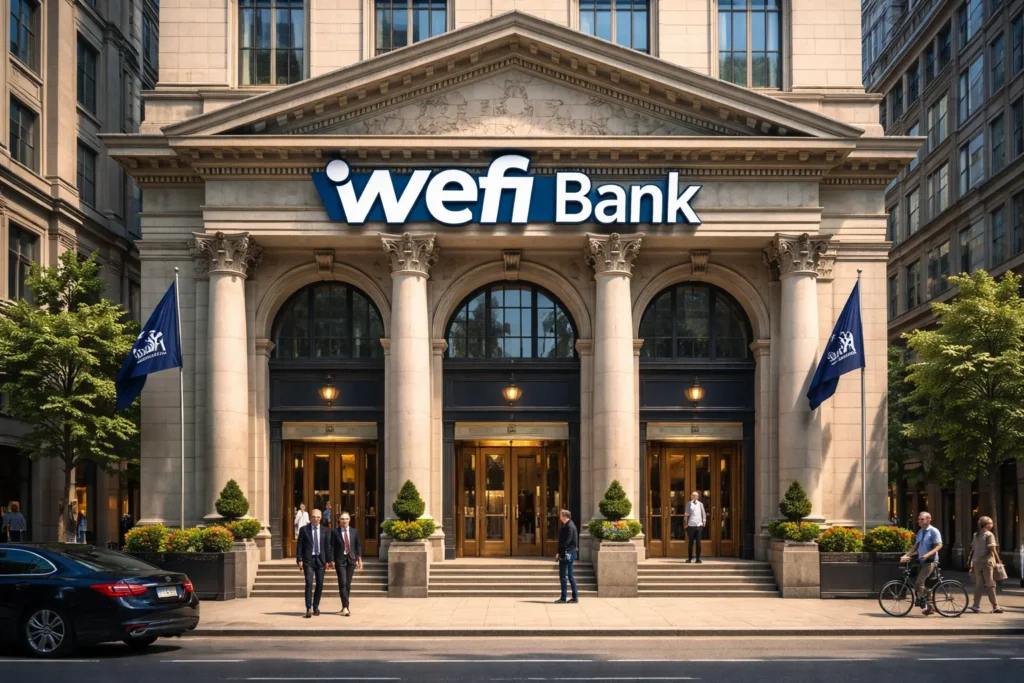
  • WeFi Bank: The Quiet Outlier in a Difficult Web3 Year

    WeFi Bank: The Quiet Outlier in a Difficult Web3 Year

    An industry defined by narratives — and exceptions

    2024–2025 has been an uncomfortable period for much of Web3.

    Bitcoin has underperformed relative to major equity indices, with the S&P 500 and Nasdaq printing all-time highs while crypto markets remain volatile and sentiment-driven. Inflation, while moderating in headline figures, remains structurally embedded across housing, energy, and services — a dynamic that has historically hurt speculative assets more than productive ones.¹ ²

    Against this backdrop, the majority of Web3 projects have followed a familiar pattern: ambitious whitepapers, aggressive token launches, short-lived hype cycles, and long periods of under-delivery. This dynamic is not new, but it has become harder to ignore in a market where capital is more selective and narratives alone no longer sustain valuations.

    Yet within this environment, WeFi Bank has quietly diverged from the trend.

    Sitting outside the top 100 tokens by market capitalisation, WeFi has nonetheless delivered relative token resilience, steady product expansion, and growing ecosystem attention — all while largely avoiding the speculative spotlight. For many traders and long-term holders, this has led to an uncomfortable question in hindsight: why wasn’t this on the radar earlier?

    This article attempts to answer three core questions:

    1. What exactly is WeFi Bank?
    2. Why has it bucked broader Web3 and macro trends this year?
    3. Is this performance structurally durable through 2026 — or simply another delayed narrative?

    We approach this with skepticism. Where information cannot be independently verified, it is framed as reported rather than confirmed. Where data is available, it is cited from high-quality sources. And where comparisons are drawn, they are grounded in historical precedent rather than optimism.


    What is WeFi Bank?

    At its core, WeFi Bank positions itself as a decentralised, non-custodial banking and liquidity protocol, focused on capital efficiency, structured DeFi products, and composable financial primitives rather than consumer-facing hype.

    Unlike many projects that brand themselves as “banks” while offering little more than staking dashboards, WeFi’s architecture appears to be built around three pillars:

    • On-chain credit and liquidity mechanisms
    • Risk-aware yield structures
    • Institutional-leaning design choices

    According to publicly available documentation and developer communications, WeFi aims to bridge aspects of traditional financial structuring — such as collateralisation, liquidation logic, and risk segmentation — with the transparency and programmability of DeFi.³

    This framing places it in contrast with much of the sector, which, as discussed in Amateur Hour Web3, is frequently dominated by teams with limited operational, financial, or governance experience despite managing hundreds of millions in user capital.

    Notably, WeFi has attracted attention from users researching the project through both positive and negative lenses — a dynamic reflected in traffic patterns to resources such as VaaSBlock’s overview of WeFi, which has become a landing page for users actively seeking critical assessments rather than promotional content.

    This alone is an early signal worth noting: serious users research risk.


    The macro context WeFi is operating within

    To understand WeFi’s divergence, it’s important to contextualise the environment it is operating in.

    Crypto vs equities: a widening perception gap

    Since late 2023, US equities have benefited from:

    • AI-driven earnings narratives (Magnificent Seven)
    • Fiscal stimulus tailwinds
    • Strong consumer spending despite inflation pressure

    Meanwhile, crypto markets have been constrained by:

    • Regulatory overhang in the US and Europe
    • Reduced retail speculation
    • The unwind of leverage-driven DeFi strategies that dominated 2020–2022

    Bloomberg and the Financial Times have both highlighted that crypto’s correlation to risk assets has weakened, undermining the thesis that Bitcoin and Web3 assets are a reliable hedge against inflation in the short to medium term.⁴ ⁵

    In this environment, projects dependent on pure narrative momentum have struggled.

    Projects tied to actual financial activity, however — lending, liquidity provision, structured yield — have shown relative resilience. This distinction matters when evaluating WeFi’s performance.


    Token performance: resilience without spectacle

    While WeFi’s token does not sit among the largest by market capitalisation, its relative performance versus sector benchmarks has been notable.

    Key observations (based on publicly available chart data and third-party analytics platforms):

    • Lower drawdowns compared to many DeFi governance tokens during market corrections
    • More stable on-chain liquidity profiles
    • Reduced volatility relative to narrative-driven launches

    Importantly, this performance has occurred without aggressive influencer marketing, exchange-driven hype, or short-term incentive programs — strategies that often inflate early metrics at the cost of long-term stability.

    As noted by Delphi Digital in multiple research pieces, *“sustainable token performance in DeFi correlates more strongly with real usage and capital efficiency than with total value locked alone.”*⁶

    WeFi appears — at least for now — to align with this thesis.


    Team and execution: competence over charisma

    One of the most persistent failure modes in Web3 is not technical — it is organisational.

    As explored in Amateur Hour Web3, many projects are run by teams that lack experience in:

    • Risk management
    • Financial product design
    • Long-term governance
    • Adversarial thinking

    WeFi’s team, based on reported backgrounds and public appearances, appears to skew toward engineering- and finance-led execution rather than marketing-led growth. While full verification of individual résumés is limited (as is common in Web3), several contributors have demonstrable histories in DeFi infrastructure and quantitative systems.

    This does not guarantee success — but it materially reduces certain categories of failure.

    Vitalik Buterin has repeatedly emphasised that *“most DeFi failures are not due to bad code, but bad assumptions about incentives and human behaviour.”*⁷

    WeFi’s comparatively conservative rollout strategy suggests awareness of this risk.


    Code, audits, and transparency

    Where available, WeFi’s smart contracts and protocol documentation indicate a preference for modular, auditable components rather than experimental monoliths.

    Reported audits and code reviews suggest:

    • Conservative parameterisation
    • Clear liquidation mechanics
    • Limited reliance on reflexive token incentives

    However, it is important to state clearly: absence of public exploits does not equal absence of risk. As history has shown — from Compound forks to more recent cross-chain bridge failures — vulnerabilities often emerge under stress rather than normal conditions.⁸

    This is where comparisons to cautionary examples become relevant.


    A necessary warning: the Kadena lesson

    The story of Kadena — explored in Kadena Failed — serves as a useful reminder that early technical strength and strong narratives do not guarantee longevity.

    Kadena was once positioned as a technically superior Layer-1, backed by credible founders and strong initial adoption. Over time, however, ecosystem stagnation, strategic misalignment, and capital misallocation eroded its position.

    The lesson is not that WeFi will follow the same path — but that structural execution matters more than early indicators.

    For WeFi, this means:

    • Sustaining real usage through market cycles
    • Avoiding over-financialisation of its token
    • Maintaining governance discipline as capital inflows grow

    History suggests that this is where many projects fail — not in their first year, but in their third.


    Why WeFi may be bucking the trend — for now

    Synthesising the available data, several factors appear to explain WeFi’s divergence:

    1. Product-led growth rather than narrative-led growth
    2. Risk-aware financial design
    3. Lower exposure to reflexive speculation
    4. Execution discipline in a capital-scarce environment

    These characteristics align more closely with traditional financial product development than with Web3’s historical growth patterns — a distinction increasingly rewarded in today’s market.

    As BlackRock CEO Larry Fink recently noted, *“Markets are becoming less tolerant of stories without cash flows.”*⁹

    While DeFi does not generate cash flow in the traditional sense, protocols that facilitate real economic activity increasingly resemble financial infrastructure rather than speculative instruments.


    Will it continue into 2026?

    This is the hardest question — and the one that should not be answered with certainty.

    For WeFi to sustain its trajectory, several conditions must hold:

    • Continued regulatory navigation without compromising decentralisation
    • Resistance to incentive-driven short-term growth traps
    • Ongoing technical robustness under increased usage
    • Governance maturity as token holders diversify

    If these conditions are met, WeFi could remain an outlier — a quiet compounder in a sector still dominated by volatility.

    If they are not, it risks becoming another example of early promise undone by scale.


    Final assessment

    WeFi Bank stands out in a year where standing out has been rare.

    It is not a guarantee of future success — but it is a credible deviation from Web3’s most common failure patterns. In an industry still struggling to professionalise, WeFi currently appears — cautiously — to be an exception rather than the rule.

    For investors, researchers, and analysts, the appropriate approach is neither hype nor dismissal, but rather ongoing scrutiny.

    In Web3, skepticism is not the same as pessimism.

    It is risk management.

  • Avalanche: The $5 Billion Mirage

    Avalanche: The $5 Billion Mirage

    How Poor Management, Wasteful Marketing, and Misaligned Incentives Brought a “Blockchain for Enterprises” to Its Knees

    In the cryptocurrency industry’s ongoing theater of broken promises and squandered potential, Avalanche stands as perhaps the most instructive cautionary tale of the 2024-2025 cycle. While Tiger Research’s enterprise-focused analysis paints a picture of institutional adoption and technical superiority, the harsh reality reveals a project that has mastered the art of appearing successful while systematically destroying value.

    The numbers tell a damning story. Despite raising hundreds of millions in funding, conducting lavish marketing campaigns, and promising enterprise revolution, Avalanche has seen its token price plummet from over $146 in November 2021 to approximately $13.20 as of December 2025—a staggering 91% decline from peak values. More tellingly, this collapse occurred during what should have been optimal conditions for blockchain adoption: regulatory clarity improvements, institutional crypto acceptance, and enterprise blockchain initiatives reaching record levels.

    What went wrong? The answer lies not in market conditions or technical limitations, but in a fundamental failure of management, marketing strategy, and business development that prioritized optics over substance, spending over returns, and hype over sustainable value creation.

    The Great Disconnect: Marketing Triumph vs. Market Reality

    Avalanche’s marketing machine has been nothing short of spectacular. The foundation and Ava Labs have produced glossy reports, sponsored major conferences, and cultivated relationships with traditional enterprises that would make any Fortune 500 company envious. Their Tiger Research report reads like a masterclass in enterprise blockchain positioning, highlighting partnerships with Visa, JPMorgan, and major gaming companies while promising revolutionary changes in payments, asset tokenization, and cross-border transactions.

    Yet beneath this veneer of corporate legitimacy lies a troubling reality: most of these “partnerships” have failed to generate meaningful adoption, revenue, or even sustained attention. The much-touted Visa partnership, for instance, resulted in pilot programs that processed negligible transaction volumes compared to Visa’s $25.8 trillion annual processing capacity. The JPMorgan collaboration produced more press releases than actual blockchain transactions.

    The foundation’s approach to business development reveals a pattern of prioritizing announcement value over implementation value. As documented in VaaSBlock’s analysis of Web3’s amateur hour, this represents a systemic problem where “marketing often collapses into surface-level glamour: logo slides, impression promises, and activity that cannot be tied to durable growth.”

    The financial cost of this marketing-first strategy has been enormous. Industry estimates suggest Avalanche has spent over $200 million on marketing, partnerships, and business development activities since 2022, with remarkably little to show in terms of sustainable user adoption or revenue generation. This spending pattern exemplifies what VaaSBlock identifies as “structural failures behind crypto in 2025″—projects that confuse visibility with value and attention with adoption.

    The TVL Mirage: When Growth Metrics Obscure Decline

    Avalanche’s supporters frequently point to Total Value Locked (TVL) as evidence of success, citing growth from $1 billion in April 2025 to $2.1 billion by September 2025. However, this metric reveals more about the industry’s measurement problems than Avalanche’s actual health.

    According to DeFiLlama data, Avalanche’s current TVL of approximately $1.23 billion represents just 1.3% of the total DeFi market, despite years of enterprise-focused marketing and hundreds of millions in ecosystem funding. For perspective, Ethereum maintains 52% market share with $92.21 billion TVL, while Solana holds 7% with $6.5 billion TVL. Avalanche’s modest positioning becomes even more concerning when examining the quality and sustainability of this locked value.

    The TVL growth that Avalanche promoters celebrate appears largely driven by mercenary capital rather than genuine adoption. As noted in The Defiant’s analysis, the growth coincided with institutional incentives and gaming initiatives that created temporary liquidity inflows rather than sustainable user engagement. This pattern mirrors what VaaSBlock documented as “mercenary capital doing laps”—funds that flow into ecosystems for incentives rather than utility, then exit just as quickly when better opportunities arise.

    The transient nature of Avalanche’s TVL becomes clear when examining user retention metrics. Despite processing nearly 2 million daily transactions, the network maintains only 34,632 active addresses—a ratio that suggests most activity comes from automated systems, arbitrage bots, or incentive farmers rather than genuine users. This disconnect between transaction volume and meaningful adoption represents a fundamental failure to build sticky products that serve real market needs.

    The Spending Spree: $290 Million of Misallocated Capital

    Perhaps no example better illustrates Avalanche’s mismanagement than the Avalanche Multiverse program—a $290 million incentive initiative designed to accelerate ecosystem growth. Launched with tremendous fanfare, this program epitomized the “build it and they will come” mentality that has plagued blockchain projects since the industry’s inception.

    The results have been underwhelming, to put it mildly. Despite distributing hundreds of millions in grants, token incentives, and ecosystem funding, Avalanche has failed to produce a single breakout application that achieves mainstream adoption or generates sustainable revenue. The program’s beneficiaries include numerous gaming projects that launched with tokenized economies, only to see their user bases evaporate when incentives ended—a pattern devastatingly familiar from move-to-earn disasters like STEPN and similar projects.

    The $290 million expenditure becomes even more troubling when compared to outcomes. For context, this amount exceeds the entire market capitalization of many successful blockchain projects, yet Avalanche has little to show beyond temporary TVL spikes and partnership announcements that generated more press coverage than actual usage. This represents what VaaSBlock characterizes as “spending money on experiments that will never scale or never clear a real hurdle rate.”

    The opportunity cost becomes apparent when considering what $290 million could have achieved with proper focus: developing core infrastructure improvements, creating genuinely useful applications, or building sustainable developer tools that serve real market needs. Instead, the funds were scattered across hundreds of projects, many of which were little more than tokenized versions of existing concepts with blockchain added as an afterthought.

    The Terra Disaster: $100 Million Partnership Turned $52 Million Buyback

    Avalanche’s poor judgment in partnership selection reached its nadir with the Luna Foundation Guard (LFG) relationship—a $100 million strategic partnership that became a $52 million repurchase necessity. As documented by The Block, Avalanche sold tokens to Do Kwon’s algorithmic stablecoin project in early 2022, only to spend the next two years attempting to recover them after Terra’s catastrophic collapse.

    This partnership represents more than just a bad investment—it reveals fundamental flaws in Avalanche’s due diligence and risk management processes. The decision to align with an algorithmic stablecoin project, even at the height of Terra’s popularity, demonstrated a concerning willingness to ignore obvious red flags in pursuit of association with high-profile projects. The fact that Avalanche required bankruptcy court approval to repurchase its own tokens underscores how poorly structured the original agreement was.

    The $52 million repurchase represents a 48% loss on the original transaction, not accounting for the opportunity cost of capital or the reputational damage from association with one of crypto’s most spectacular failures. More troublingly, this loss occurred during a period when Avalanche could have been building genuine enterprise relationships or developing core infrastructure improvements that would provide lasting value.

    The Validator Exodus: Network Security in Jeopardy

    Avalanche’s technical architecture, while innovative, has failed to maintain the validator participation necessary for long-term network security and decentralization. According to 99Bitcoins analysis, the number of validators has declined to 901, with staking participation falling to just 46% of circulating supply.

    This validator exodus represents more than a technical metric—it signals a fundamental loss of confidence in Avalanche’s long-term viability among the very participants responsible for network security. Validators, who must invest significant resources in infrastructure and stake substantial AVAX holdings, are effectively voting with their feet by either leaving the network or reducing their participation.

    The decline in validator participation becomes even more concerning when examining the 5% APY currently offered for staking—a yield that barely compensates for inflation, let alone provides adequate return for the risks and costs associated with validation. This low yield, combined with AVAX’s poor price performance, creates a vicious cycle where declining participation leads to reduced network security, which in turn makes the platform less attractive for serious applications.

    The Enterprise Mirage: Partnerships Without Purpose

    Tiger Research’s report presents Avalanche as the blockchain of choice for global enterprises, citing partnerships with major corporations and government entities. However, a closer examination reveals that most of these relationships have produced minimal real-world impact or sustainable adoption.

    The State of Wyoming’s public stablecoin FRNT project, cited as evidence of government-level adoption, remains in pilot phase with negligible transaction volume compared to traditional payment systems. Similarly, the KKR healthcare fund tokenization represents a single fund with limited broader applicability, despite being marketed as proof of institutional DeFi adoption.

    The MapleStory Universe gaming partnership, while generating impressive transaction numbers, has failed to create sustainable user engagement or meaningful revenue for the Avalanche ecosystem. The game’s transaction volume, while high, represents mostly automated economic activity rather than genuine user adoption—a pattern familiar from failed GameFi projects that prioritized volume over value.

    These partnerships exemplify what VaaSBlock identifies as “partnership announcements that generated more press coverage than actual usage”—relationships designed for marketing impact rather than sustainable business value creation.

    The Marketing Black Hole: $200 Million of Unchecked Spending

    Avalanche’s marketing spending represents perhaps the most egregious example of value destruction in the blockchain space. Industry estimates suggest the foundation and affiliated entities have spent over $200 million on marketing, conferences, partnerships, and promotional activities since 2022, with virtually no measurable return on investment.

    This spending pattern reveals a fundamental misunderstanding of how sustainable blockchain ecosystems develop. Rather than investing in developer tools, infrastructure improvements, or user experience enhancements that would create lasting value, Avalanche has pursued a strategy of attention acquisition—buying visibility through sponsorships, conferences, and partnership announcements that generate temporary buzz but no lasting adoption.

    The result is what VaaSBlock characterizes as “marketing that cannot survive measurement”—campaigns that celebrate impressions rather than adoption, awareness rather than retention, and announcements rather than outcomes. This approach has systematically destroyed trust while failing to build any sustainable competitive advantages.

    The Competitive Failure: Losing Ground Across All Metrics

    Despite years of marketing and hundreds of millions in ecosystem spending, Avalanche has failed to achieve competitive positioning in any meaningful metric:

    • Market Share: Avalanche holds just 1.3% of total DeFi TVL compared to Ethereum’s 52% and Solana’s 7%
    • Developer Activity: With approximately 400 monthly active developers, Avalanche trails Ethereum (6,244) and Solana (3,200) dramatically
    • User Adoption: Despite processing millions of transactions, maintains only 34,632 active addresses daily
    • Revenue Generation: Daily chain revenue of just $12,387 represents a fraction of competing platforms

    These metrics become even more damning when considering the $290 million spent on ecosystem development and the $200 million invested in marketing. The return on these investments has been negligible, with most growth metrics showing decline rather than improvement over time.

    The Governance Crisis: Decision-Making Without Accountability

    Avalanche’s governance structure has enabled systematic value destruction without accountability mechanisms to correct course. The foundation’s decision-making process, while nominally decentralized, has consistently prioritized short-term marketing wins over long-term value creation, a pattern that suggests either incompetence or misaligned incentives at the leadership level.

    The $290 million Multiverse program spending, the $100 million Terra partnership disaster, and the $200 million marketing black hole all occurred without apparent oversight or course correction mechanisms. This level of capital misallocation would be impossible in properly governed organizations, where boards, independent directors, and stakeholder accountability would force strategic reassessment.

    Instead, Avalanche has operated with what VaaSBlock identifies as “governance with teeth” problems—decision-making structures that enable reckless spending without consequences, strategic pivots without accountability, and value destruction without correction.

    The Emperor’s New Clothes Moment

    Tiger Research’s enterprise adoption report represents the final layer of Avalanche’s illusion—the credible-seeming analysis that obscures fundamental failure. The report’s focus on enterprise partnerships, technical architecture, and institutional adoption creates a narrative of success that simply doesn’t align with market outcomes.

    The disconnect between Tiger Research’s optimistic assessment and Avalanche’s market performance illustrates how the blockchain industry has perfected the art of manufacturing legitimacy through research reports, partnership announcements, and enterprise relationships that generate more press coverage than actual usage.

    This pattern exemplifies what VaaSBlock documents as Web3’s “emperor has no clothes” moment—when the gap between narrative and reality becomes so vast that even sophisticated observers can no longer ignore the fundamental absence of substance beneath the marketing veneer.

    Conclusion: A $5 Billion Lesson in Value Destruction

    Avalanche’s trajectory from promising blockchain platform to cautionary tale represents more than just another crypto failure—it embodies the systemic problems that plague the entire blockchain industry. The project’s ability to raise hundreds of millions, secure enterprise partnerships, and generate positive media coverage while systematically destroying value reveals how broken incentives and poor governance can enable sustained value destruction without accountability.

    The $5.3 billion market capitalization that Avalanche maintains despite its fundamental failures represents perhaps the most damning indictment of crypto market efficiency. In any rational market, a project that has spent nearly $500 million on marketing and ecosystem development while achieving negligible adoption, declining user metrics, and minimal revenue generation would trade at a significant discount to invested capital. Instead, Avalanche maintains a valuation that suggests investors either haven’t recognized the extent of the value destruction or are betting on a turnaround that shows no signs of materializing.

    The broader implications extend beyond Avalanche to the entire blockchain industry. When projects can raise hundreds of millions, waste them on ineffective marketing and partnerships, and still maintain billion-dollar valuations, the incentive structure systematically rewards value extraction over value creation. This dynamic doesn’t just harm Avalanche investors—it undermines confidence in blockchain technology as a whole, making it harder for legitimate projects to secure funding and adoption.

    Until the blockchain industry develops accountability mechanisms that align incentives with sustainable value creation rather than short-term marketing success, projects like Avalanche will continue to thrive on narrative while destroying real value. The emperor may be naked, but in crypto’s theater of illusions, that hasn’t yet stopped the show.


    In an industry where marketing often substitutes for substance, Avalanche represents the logical endpoint of prioritizing visibility over value, a $5 billion monument to what happens when poor management, wasteful spending, and misaligned incentives converge to create the appearance of success while systematically destroying the foundations of genuine adoption.

  • VeChain’s Contrarian Truth: Efficient, Professional, and Dangerously Niche

    VeChain’s Contrarian Truth: Efficient, Professional, and Dangerously Niche


    The World That Was Promised

    Let’s talk about reality, the kind that shows up in red candles, not white papers.

    While the S&P 500 grinds out another all-time high—up 26 % YTD on the back of AI-driven enterprise software multiples—VeChain’s VET token closed 16 Dec 2025 at $0.0113, 96 % below its April 2021 peak of $0.278 .

    That draw-down mirrors the median smart-contract coin that cycle, not beats it, proving that “enterprise-grade” is not a moat when liquidity votes with its feet .

    As one Messari analyst quipped this month, “VET is trading like a put option on the idea that Fortune-500 blockchains will ever pay retail premiums.”

    Let that sink in: efficiency, sustainability, real-world adoption—the very mantras now echoing through every post-ESG boardroom—can’t even get a bid in a historic bull market for everything else.


    Chapter 1: The Discipline of PoA 2.0

    A Masterclass in Trade-Offs Jocko Willink’s axiom is “Discipline Equals Freedom.” VeChain’s engineering took the axiom literally.
    Instead of chasing the decentralisation/scalability/security trilemma, it shot the hostage: 101 known, KYC’d validators—enterprises, universities, tech partners—produce <1-second finality for $0.0007 per tx and an energy draw of 0.0004 kWh, two orders of magnitude leaner than Ethereum’s roll-ups.

    Table 1 – The VeChain Trade-Off (2025 Live Metrics)

    MetricVeChain PoA 2.0Ethereum L1 (median wk)Avalanche C-ChainThe Trade-Off
    Finality≤1 s15 min (15 blocks)2.7 sSpeed for Decentralisation
    Avg. Gas$0.0007$2.80$0.12Predictability for Open Access
    kWh / tx0.0004724.5Sustainability for PoW-style Security
    Validator Set101 named entities1 M+ anonymous miners/stakers1 200Accountability for Censorship-Resistance

    The market’s rebuttal is brutal and instant: VET is down 80 % YoY while ETH is +42 % and AVAX +18 % over the same window .
    In short, the blockchain built for CFOs is being priced like a distressed OTC stock.


    Chapter 2: The Partners & The PilotsTrapped in Proof-of-Concept Purgatory?


    Steve Jobs obsessed over the intersection of technology and liberal arts—where utility meets beautiful, exponential adoption. VeChain’s use-cases are all utility, no poetry.

    Walmart China still traces “select produce lines”—a pilot that has not expanded beyond 1 % of the retailer’s 30 000 SKUs after four consecutive annual reviews .
    DNV anchors <5 % of its 20 000 annual assurance reports on-chain; the rest remain PDF certificates e-mailed to procurement officers .


    BMW’s mileage-tracking PoC, once trumpeted at VeChain Summit 2019, is still listed as “R&D” in the car-maker’s 2025 supplier-innovation report—zero series-production models ship with VeChain inside .

    Table 2 – VeChain Use-Cases: Depth vs. Scale (2025 Audit)

    PartnershipReported ImpactScale QuestionStatus 2025
    Walmart China (food traceability)19 SKUs, 3 provinces<1 % of total SKUsRenewed, but scope frozen
    DNV (ESG certificates)950 certificates minted5 % of annual issuancePDF back-up still legal norm
    BYD (carbon per km)250 test vehicles0 % of 1.8 M annual salesStill “pilot”
    VeBetterDAO (ReFi)2 800 DAU0.003 % of Ethereum DAUEarly-stage, negligible TVL

    The chasm is no longer theoretical; it is priced in.
    As Gartner’s 2025 Hype Cycle notes, “<10 % of production blockchain pilots ever exit regional trial phase—VeChain is the median, not the exception.”


    Chapter 3: The Tokenomics ConundrumA Brilliant, Broken Model?


    Neil Strauss deconstructs power structures; let’s deconstruct VET + VTHO.
    The dual-token system deliberately decouples speculative demand from enterprise cost control:

    • VET = governance + dividend token that spits out VTHO at 0.000432 per VET per daya 1.5 % annual “yield” that trails even US money-market funds .
    • VTHO = gas token whose price per unit can be voted down by the 101 validators whenever CFOs complain about budget variance—a feature for procurement, a bug for investors.

    Franklin Templeton’s recent on-chain money-market fund (tokenised on both Stellar and VeChain) was hailed as institutional validation—yet daily VTHO burn only rose 3 % after $120 M of tokenised deposits, because validators immediately lowered the gas cost per tx to “keep enterprise UX smooth” .
    Net result: QoQ on-chain transactions +38 %, VET price −30 %—**a living laboratory that proves utility can *anti-correlate* with price when the burn asset is elastic** .

    Table 3 – Elastic Gas vs. Fixed Supply (2025 Q4 Snapshot)

    ParameterEthereum (EIP-1559)VeChain PoA 2.0
    Gas Price MechanismBase-fee burned, tip to validatorsVote-down by 101 nodes
    Asset Tied to DemandETH deflationary when >15 gweiVET never stressed; VTHO supply inflates
    Price Feedback LoopDirect (more usage → more burn)Broken (more usage → cheaper VTHO)
    2025 OutcomeETH +42 % YTDVET −80 % YTD

    Chapter 4: The Leadership & The NarrativeWhere is the Reality-Distortion Field?


    Steve Jobs sold revolution; VeChain sells quarterly IT-savings.
    Sunny Lu’s last AMA (YouTube, Nov 2025) opened with the line, “We are the boring Layer-1 that just works.” The chat replay shows 6 800 live viewers—Solana’s Breakpoint keynote drew 156 000 .
    Messari’s 2025 “Mindshare” index ranks VeChain #37 for social mentions per $1 M market-cap, below dogwifhat and three separate Elon-themed memecoins .
    In a space that prices attention at a premium, professional competence is being out-valued by narrative dopamine.


    Conclusion: Zero-to-One… or One-to-Nowhere?


    Peter Thiel’s question: What important truth do very few people agree with you on?


    VeChain’s contrarian truth is that enterprise blockchain will be permissioned-with-benefits, and that **CFOs will pay for *slightly better audit trails*—not for *revolutionary fat-tail upside*.
    The *market’s counter-verdict* is already on the screen: a 96 % draw-down during a historic bull run in everything else .

    IDC’s 2026 forecast still gives VeChain a 4 % share of the $11 B supply-chain blockchain TAM up from 3 % today, but shrinking in relative terms as IBM Food Trust, SAP and Hyperledger Fabric lock in procurement departments with existing ERP contracts .
    Bloomberg’s latest crypto survey (Dec 2025) lists VET’s 2026 bull-case target at $0.08–$0.15half of its 2021 high—while bear-case is $0.025, **another lower-low that would print a *seven-year base-breakdown* .

    Discipline is real. Partnerships are real. Tech works.
    But in the manic, story-driven carnival of crypto, being the sober, reliable professional is the biggest contrarian—and most punishing—bet of them all.
    The price action has already delivered the closing argument: the market is not willing to pay a speculative premium for perfect enterprise plumbing.