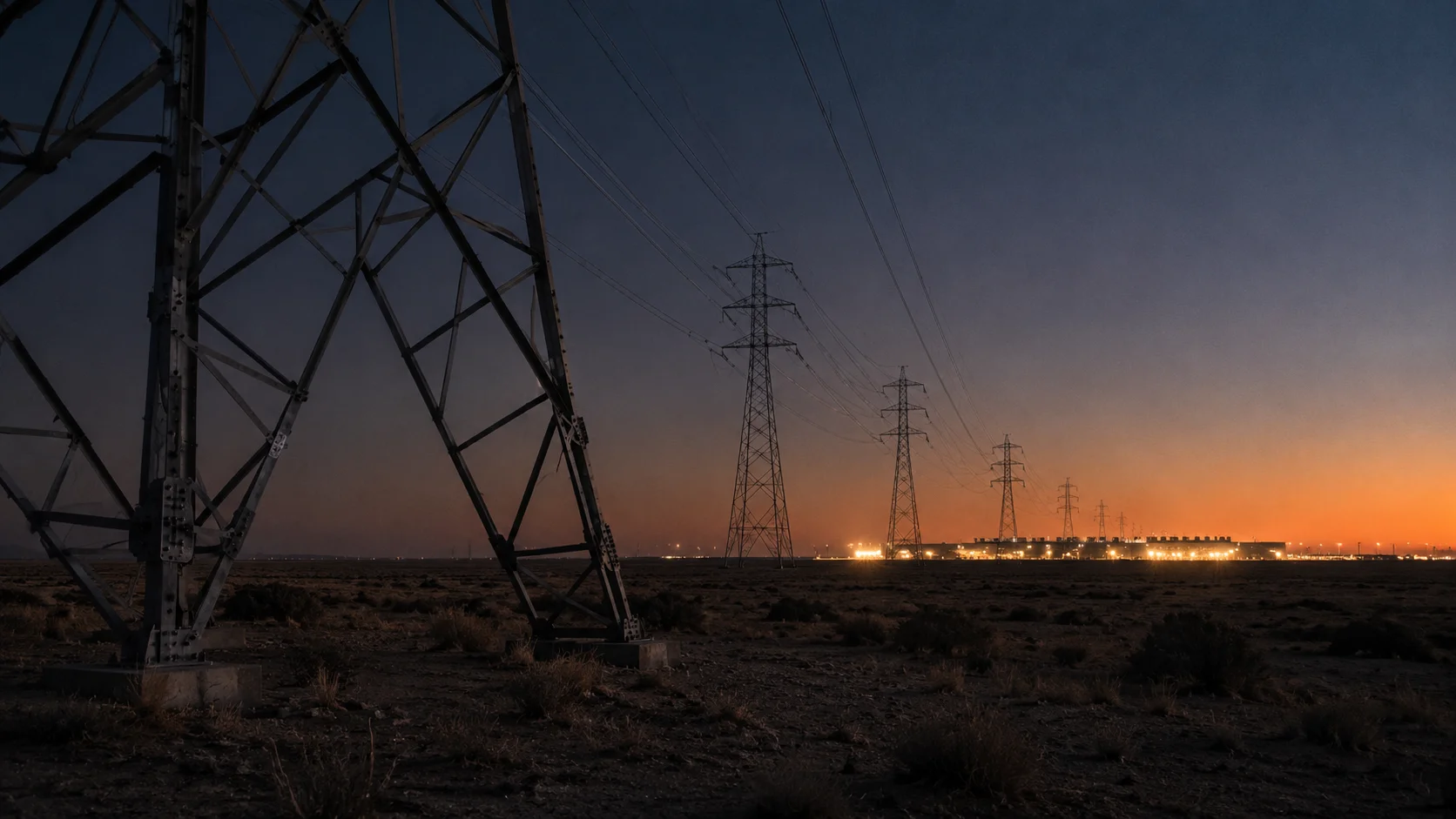
Goldman Sachs published a report this week identifying what it calls the binding constraint on AI’s growth — and it is not compute, it is not chips, and it is not software. It is watts. The United States faces a projected 45 gigawatt power shortfall for data centers by 2028, and nearly half of all data center capacity planned for 2026 — approximately 7 gigawatts out of 12 gigawatts of announced build — has already been canceled or delayed.
Ford’s CEO described the situation as a “full-blown crisis.” Goldman revised its data center power demand forecast to 220% growth by 2030 versus 2023 levels — up from an already alarming 165% forecast in 2024. The revision happened three times in 18 months. Each time, the number was higher than the time before.
This is the AI bottleneck that cannot be vibe-coded away. You can accelerate model training. You can optimize inference. You can compress weights. You cannot train a transformer model without electricity, and you cannot plug 72 gigawatts of new nuclear-equivalent power generation into the grid before 2030 regardless of what the models say you should do.
The Agentic Multiplier
The reason the forecasts keep getting revised upward is agentic AI. The power consumption numbers used in 2024 were based on standard chat-style inference: a user asks a question, the model generates a response, the session ends. That use pattern is efficient. A single chat interaction uses a defined, bounded number of tokens.
Agentic AI is different. Research published alongside Goldman’s report found that AI agents — systems that plan, act, check results, and iterate — use approximately four times more computing tokens than standard chat interactions. Multi-agent systems, where multiple AI models coordinate with each other to complete a task, use approximately 15 times more.
The entire enterprise AI build happening right now is oriented around agentic deployment. Companies are not building AI chat tools — they are building AI workflows: agents that process invoices, draft contracts, monitor inventory, manage customer interactions, and execute code. Every one of those deployments is running on an inference infrastructure that consumes significantly more power per task than the models that generated the original power demand forecasts.
When Goldman revised its forecast from 165% to 175% to 220%, the primary driver of each revision was the accelerating shift toward agentic and multi-agent architectures. The compute demand is scaling faster than the forecasters expected because the use case mix is shifting faster than anticipated.
7 Gigawatts Already Gone
The data center cancellations are the most concrete indicator of the crisis. Of the 12 gigawatts of U.S. data center capacity announced for 2026, approximately 7 GW — nearly 60% — has been canceled or delayed. The reasons are consistent across projects: power not available, grid interconnection queues too long, permitting timelines too extended.
A data center in the planning phase requires a power purchase agreement or utility commitment before construction begins. In markets where grid capacity is already strained — Virginia’s northern data center corridor, Phoenix, Dallas — utilities are putting projects on multi-year interconnection waitlists. Projects that went into the queue in 2023 expecting 18-month timelines are now being told they will not get grid access until 2027 or 2028.
The companies that had reserved land, hired architects, and begun permitting for 2026 delivery are either delaying or canceling. The 7 GW figure represents billions in planned infrastructure that is not being built on schedule. It is a direct constraint on AI capacity deployment for every hyperscaler and co-location provider that was counting on that supply.
Data center occupancy rates reflect the same squeeze. Occupancy was approximately 85% in 2023 — already high by historical standards. Goldman projects it will reach 95% or more in late 2026. At 95% occupancy, the data center market is effectively full. New AI deployments will compete for scarce existing capacity until new supply comes online.
The Grid Cannot Absorb What Is Coming
The power demand problem is not simply that data centers need more electricity — it is that the electrical grid was not designed to deliver power at the scale and density that AI data centers require.
A modern AI training cluster consumes power at a density that is incompatible with the distribution infrastructure most utilities have in place. Transformers, switchgear, and distribution lines in most U.S. markets were sized for industrial and commercial loads that look nothing like a 500-megawatt GPU cluster. Upgrading that infrastructure requires long-lead equipment — specifically high-voltage transformers — that have their own supply chain constraints.
Goldman’s research identifies five additional bottlenecks beyond power generation: grid infrastructure, high-voltage components, advanced cooling systems, fiber optic capacity for interconnection, and mission-critical facility services. All five are constrained simultaneously. This is not a single-point failure that one category of investment can resolve — it is a systemic infrastructure deficit across the entire stack that sits below AI compute.
The $720 billion figure Goldman cites for grid spending through 2030 is the estimated capital required to resolve the constraint — not the capital that has been committed. Current grid investment plans are running well below that figure. The gap between required and planned investment is itself a bottleneck.
760,000 Workers the U.S. Does Not Have
The power infrastructure problem has a workforce dimension that compounds the capital challenge. Goldman estimates approximately 760,000 additional power and grid workers will be needed by 2030, including 207,000 specialized transmission and distribution roles.
Those specialized roles require three to four years of training to fill. If those workers do not exist today — and Goldman’s analysis suggests the current pipeline does not produce them at the required rate — the gap cannot be closed by 2030 even if training programs are launched immediately.
This is the bottleneck that genuinely cannot be solved with money. Capital can commission new power plants and transmission lines. Capital can procure high-voltage transformers. Capital cannot compress a four-year electrician apprenticeship into one year without degrading the quality of the workers who maintain the grid. The workforce constraint is a hard physical limit that paces everything else.
The implication for AI deployment timelines is significant. Even if permitting were resolved tomorrow and utilities committed the required capacity, the ability to build, commission, and staff the grid infrastructure needed to deliver that power is constrained by a workforce training pipeline that runs on its own schedule, independent of market demand or capital availability.
Who Benefits From the Constraint
The power bottleneck is a problem for AI deployment broadly, but it creates specific winners and losers across the energy and infrastructure sectors.
Nuclear power is the most direct beneficiary. Nuclear plants provide the high-density, dispatchable, carbon-free baseload power that AI data centers require. The economics of nuclear are better than they have been in decades: demand is captive, power purchase agreements are long-duration, and the offtakers (hyperscalers) are investment grade credits. Amazon, Google, and Microsoft have all signed nuclear power purchase agreements or facility purchase agreements in the past 18 months. More will follow.
Natural gas generation is also benefiting, despite its carbon profile. Gas peakers and combined-cycle plants can be brought online faster than nuclear and can be sited closer to data center campuses. Several hyperscalers are exploring dedicated gas generation co-located with data centers — an approach that bypasses the utility interconnection queue entirely.
High-voltage transformer manufacturers are in a structural shortage. Lead times for large power transformers have extended from 12 months to 36-48 months. A handful of manufacturers produce the large power transformers required for grid interconnection — ABB, Hitachi, and Siemens Energy are the major players globally. Their order books are full for the foreseeable future.
Advanced cooling companies are seeing similar demand. Air cooling cannot efficiently manage the thermal density of modern GPU clusters. Liquid cooling — direct liquid cooling and immersion cooling in particular — is transitioning from specialized to standard. The companies building that cooling infrastructure are growing at rates that were not in their original business plans.
The AI Companies Know and Are Not Saying It Publicly
The hyperscalers are aware of the power constraint. Their capital expenditure plans reflect it — the reason Microsoft, Google, Meta, and Amazon are spending $700 billion on AI infrastructure in 2026 is partly that they understand the constraint is real and that the winners will be those who secured capacity before the shortage became acute.
The strategy is to move fast enough that when the grid catches up, you are already at scale and your competitors are still waiting for interconnection. This is an infrastructure land grab dressed in AI language.
What the hyperscalers do not discuss publicly is the degree to which their AI deployment timelines are constrained by power availability rather than model capability. The narrative around AI progress emphasizes model improvements — GPT-5, Gemini Ultra, Claude — as the pacing mechanism for AI deployment. The actual pacing mechanism, for enterprise deployments at scale, is increasingly whether the data center has power.
The Goldman report makes this explicit in a way that is unusual for mainstream financial analysis. The framing — AI’s constraint is physical, not digital — is correct and important for investors to understand. The companies building and deploying AI at the frontier are not constrained by their ability to write code. They are constrained by their ability to plug servers into functioning electrical infrastructure.
What This Means for AI Timelines
The power bottleneck does not stop AI progress — it changes the shape of it. The models will keep improving regardless of data center occupancy. What the power constraint affects is the rate at which those models can be deployed at scale, particularly for agentic workloads that consume the most resources.
Enterprise AI deployments planned for 2026 and 2027 will increasingly run into capacity constraints. Companies that secured data center capacity early — either through long-term co-location agreements or by building their own facilities — will have a structural advantage over those who assumed market-rate capacity would be available when they needed it.
The 45 gigawatt shortfall by 2028 means the constraint tightens for at least the next two years. Resolution requires a combination of new power generation, grid upgrades, permitting reform, and workforce development — all of which operate on timelines measured in years, not quarters.
Goldman’s forecast revision from 165% to 220% power demand growth is a signal that the market is underpricing the energy infrastructure buildout. The companies and investors who are positioned in power generation, grid infrastructure, and thermal management are likely to outperform the companies building on top of that infrastructure — at least until the supply/demand balance corrects.
The Product Question Goldman’s Power-Bottleneck Note Is Actually Asking
Strip the energy-infrastructure framing from the Goldman note and the product question underneath is the one every empowered product team should be asking right now. The question is: which AI products are dependent on compute capacity continuing to scale at the rate of the last three years, and which are not? Because the answer to that question determines which products survive a capacity-constrained 2027-2028 and which do not.
The capacity-dependent products are the ones whose unit economics only work when compute prices keep falling. Long-context conversational agents, real-time multimodal interaction, persistent memory across sessions — each of these features became unit-economically viable only as inference costs dropped. If the drop pauses or reverses for two years because of the energy bottleneck Goldman describes, these features become loss leaders the platforms will have to either price up or restrict access to. Users will notice.
The capacity-independent products — the ones whose value comes from the model’s reasoning, not from the inference volume — survive the bottleneck without changing pricing. The product teams that understand which category their roadmap sits in have a different planning horizon than the teams that assume compute will keep getting cheaper at the same rate. Goldman’s note is, for the right reader, a forcing function to do that categorisation honestly. The teams that do it early get to ship a 2027 product. The teams that do it late get to negotiate a 2027 price increase. The same dynamic applies to the coordinated $700B capex race — the spending buys options, not certainty.
FAQ
What is the AI power shortfall Goldman Sachs identified?
Goldman projects a 45 gigawatt power shortfall for U.S. data centers by 2028. Nearly 7 gigawatts of planned 2026 data center capacity has already been canceled or delayed due to power unavailability.
Why do AI agents use more power than chatbots?
AI agents plan, act, and iterate — consuming approximately 4x more compute tokens than standard chat interactions. Multi-agent systems where models coordinate with each other use approximately 15x more. Enterprise AI is shifting toward agentic deployments, which is why power demand forecasts keep getting revised upward.
How much grid investment does Goldman say is needed?
Approximately $720 billion in grid spending through 2030 — covering generation, transmission, distribution, and associated infrastructure. Current investment plans are running well below that figure.
Who benefits from the power bottleneck?
Nuclear power developers, natural gas generators that can bypass interconnection queues, high-voltage transformer manufacturers (ABB, Hitachi, Siemens Energy), and advanced cooling companies (liquid and immersion cooling). Companies that secured data center capacity early also benefit from the scarcity premium.
Can AI companies build their own power generation?
Several are exploring dedicated gas generation co-located with data centers to bypass utility interconnection queues. Amazon, Google, and Microsoft have signed nuclear power purchase agreements. This is becoming standard practice for hyperscalers rather than an exception.
How does this affect AI stock valuations?
It suggests the energy and infrastructure layer is underpriced relative to the software and model layer. AI model companies get most of the attention, but the binding constraint on AI deployment at scale is physical infrastructure — which means the infrastructure companies may have more durable pricing power than current valuations reflect.
Sources
- Fortune — Goldman sees an AI bottleneck that can’t be vibe-coded away
- Goldman Sachs — AI to drive 165% increase in data center power demand by 2030
- Tech Insider — U.S. AI Data Center Delays: 7 GW Capacity Crisis 2026
- Prism News — Goldman Sachs says AI infrastructure faces grid, optics and cooling bottlenecks
- AI Automation Global — Goldman Sachs: $527B AI Data Center Boom Reshapes 2026
Who Benefits From the Power-Scarcity Narrative
When Goldman Sachs publishes a research note arguing that AI infrastructure faces a severe power bottleneck, it is worth asking which investment positions would benefit from that framing taking hold. Goldman has significant infrastructure investment exposure — energy assets, grid infrastructure, data center real estate investment trusts. A widely-circulated narrative that AI power demand will outstrip grid capacity for the next decade increases the valuation of every energy and infrastructure asset that Goldman and its clients hold. The note may be analytically correct. The incentive alignment is also worth noting.
The specific bottleneck framing — 7 gigawatts already committed, 760,000 missing workers — carries the rhetorical structure of a crisis that can only be resolved by capital allocation at scale. That structure serves capital allocators. The nuclear energy solution, the grid upgrade mandate, the data center REIT expansion: each of these represents a multi-decade investment thesis that requires the power-scarcity narrative to remain credible. The analysis may be correct. But correct analysis and self-serving analysis are not mutually exclusive categories, and distinguishing between them requires examining what alternatives the note does not present.
The alternatives Goldman does not foreground: AI inference costs have fallen faster than most analysts predicted in 2023, and the nuclear and grid buildout that hyperscalers have already commissioned may resolve the constraint without the crisis the note implies. Efficiency gains at the model layer — smaller context windows, distillation, quantization — reduce power per inference unit in ways that the note’s demand projections do not fully model. That is not an argument that there is no power problem. It is an argument that the crisis framing is a specific reading of the evidence, not the only defensible one, and that the institutions doing the reading have a material interest in the outcome.
The power-bottleneck conclusion lands inside two adjacent capital-markets stories. On the demand side, Nvidia’s $81 billion Q1 and Blackwell record show how aggressively hyperscalers are still pulling chips off the line. On the workforce side, Cisco’s record-revenue layoffs and AI restructuring are the operational tax incumbents pay when capital re-routes into a capacity race the grid cannot yet absorb.