

An industry defined by narratives — and exceptions
2024–2025 has been an uncomfortable period for much of Web3.
Bitcoin has underperformed relative to major equity indices, with the S&P 500 and Nasdaq printing all-time highs while crypto markets remain volatile and sentiment-driven. Inflation, while moderating in headline figures, remains structurally embedded across housing, energy, and services — a dynamic that has historically hurt speculative assets more than productive ones.¹ ²
Against this backdrop, the majority of Web3 projects have followed a familiar pattern: ambitious whitepapers, aggressive token launches, short-lived hype cycles, and long periods of under-delivery. This dynamic is not new, but it has become harder to ignore in a market where capital is more selective and narratives alone no longer sustain valuations.
Yet within this environment, WeFi Bank has quietly diverged from the trend.
Sitting outside the top 100 tokens by market capitalisation, WeFi has nonetheless delivered relative token resilience, steady product expansion, and growing ecosystem attention — all while largely avoiding the speculative spotlight. For many traders and long-term holders, this has led to an uncomfortable question in hindsight: why wasn’t this on the radar earlier?
This article attempts to answer three core questions:
- What exactly is WeFi Bank?
- Why has it bucked broader Web3 and macro trends this year?
- Is this performance structurally durable through 2026 — or simply another delayed narrative?
We approach this with skepticism. Where information cannot be independently verified, it is framed as reported rather than confirmed. Where data is available, it is cited from high-quality sources. And where comparisons are drawn, they are grounded in historical precedent rather than optimism.
What is WeFi Bank?
At its core, WeFi Bank positions itself as a decentralised, non-custodial banking and liquidity protocol, focused on capital efficiency, structured DeFi products, and composable financial primitives rather than consumer-facing hype.
Unlike many projects that brand themselves as “banks” while offering little more than staking dashboards, WeFi’s architecture appears to be built around three pillars:
- On-chain credit and liquidity mechanisms
- Risk-aware yield structures
- Institutional-leaning design choices
According to publicly available documentation and developer communications, WeFi aims to bridge aspects of traditional financial structuring — such as collateralisation, liquidation logic, and risk segmentation — with the transparency and programmability of DeFi.³
This framing places it in contrast with much of the sector, which, as discussed in Amateur Hour Web3, is frequently dominated by teams with limited operational, financial, or governance experience despite managing hundreds of millions in user capital.
Notably, WeFi has attracted attention from users researching the project through both positive and negative lenses — a dynamic reflected in traffic patterns to resources such as VaaSBlock’s overview of WeFi, which has become a landing page for users actively seeking critical assessments rather than promotional content.
This alone is an early signal worth noting: serious users research risk.
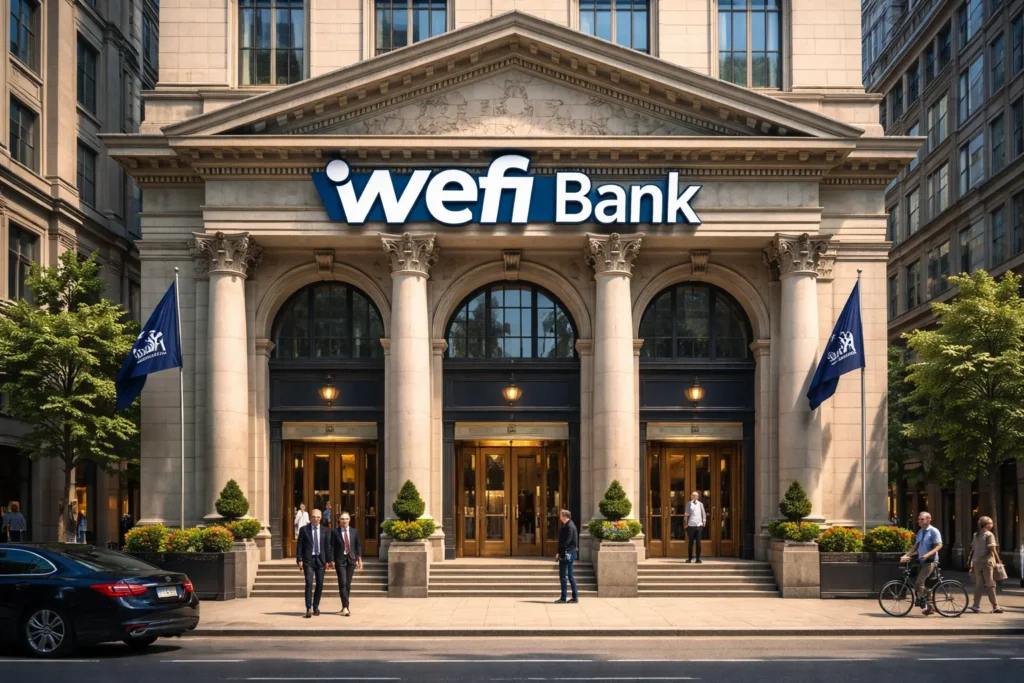
The macro context WeFi is operating within
To understand WeFi’s divergence, it’s important to contextualise the environment it is operating in.
Crypto vs equities: a widening perception gap
Since late 2023, US equities have benefited from:
- AI-driven earnings narratives (Magnificent Seven)
- Fiscal stimulus tailwinds
- Strong consumer spending despite inflation pressure
Meanwhile, crypto markets have been constrained by:
- Regulatory overhang in the US and Europe
- Reduced retail speculation
- The unwind of leverage-driven DeFi strategies that dominated 2020–2022
Bloomberg and the Financial Times have both highlighted that crypto’s correlation to risk assets has weakened, undermining the thesis that Bitcoin and Web3 assets are a reliable hedge against inflation in the short to medium term.⁴ ⁵
In this environment, projects dependent on pure narrative momentum have struggled.
Projects tied to actual financial activity, however — lending, liquidity provision, structured yield — have shown relative resilience. This distinction matters when evaluating WeFi’s performance.
Token performance: resilience without spectacle
While WeFi’s token does not sit among the largest by market capitalisation, its relative performance versus sector benchmarks has been notable.
Key observations (based on publicly available chart data and third-party analytics platforms):
- Lower drawdowns compared to many DeFi governance tokens during market corrections
- More stable on-chain liquidity profiles
- Reduced volatility relative to narrative-driven launches
Importantly, this performance has occurred without aggressive influencer marketing, exchange-driven hype, or short-term incentive programs — strategies that often inflate early metrics at the cost of long-term stability.
As noted by Delphi Digital in multiple research pieces, *“sustainable token performance in DeFi correlates more strongly with real usage and capital efficiency than with total value locked alone.”*⁶
WeFi appears — at least for now — to align with this thesis.
Team and execution: competence over charisma
One of the most persistent failure modes in Web3 is not technical — it is organisational.
As explored in Amateur Hour Web3, many projects are run by teams that lack experience in:
- Risk management
- Financial product design
- Long-term governance
- Adversarial thinking
WeFi’s team, based on reported backgrounds and public appearances, appears to skew toward engineering- and finance-led execution rather than marketing-led growth. While full verification of individual résumés is limited (as is common in Web3), several contributors have demonstrable histories in DeFi infrastructure and quantitative systems.
This does not guarantee success — but it materially reduces certain categories of failure.
Vitalik Buterin has repeatedly emphasised that *“most DeFi failures are not due to bad code, but bad assumptions about incentives and human behaviour.”*⁷
WeFi’s comparatively conservative rollout strategy suggests awareness of this risk.
Code, audits, and transparency
Where available, WeFi’s smart contracts and protocol documentation indicate a preference for modular, auditable components rather than experimental monoliths.
Reported audits and code reviews suggest:
- Conservative parameterisation
- Clear liquidation mechanics
- Limited reliance on reflexive token incentives
However, it is important to state clearly: absence of public exploits does not equal absence of risk. As history has shown — from Compound forks to more recent cross-chain bridge failures — vulnerabilities often emerge under stress rather than normal conditions.⁸
This is where comparisons to cautionary examples become relevant.
A necessary warning: the Kadena lesson
The story of Kadena — explored in Kadena Failed — serves as a useful reminder that early technical strength and strong narratives do not guarantee longevity.
Kadena was once positioned as a technically superior Layer-1, backed by credible founders and strong initial adoption. Over time, however, ecosystem stagnation, strategic misalignment, and capital misallocation eroded its position.
The lesson is not that WeFi will follow the same path — but that structural execution matters more than early indicators.
For WeFi, this means:
- Sustaining real usage through market cycles
- Avoiding over-financialisation of its token
- Maintaining governance discipline as capital inflows grow
History suggests that this is where many projects fail — not in their first year, but in their third.
Why WeFi may be bucking the trend — for now
Synthesising the available data, several factors appear to explain WeFi’s divergence:
- Product-led growth rather than narrative-led growth
- Risk-aware financial design
- Lower exposure to reflexive speculation
- Execution discipline in a capital-scarce environment
These characteristics align more closely with traditional financial product development than with Web3’s historical growth patterns — a distinction increasingly rewarded in today’s market.
As BlackRock CEO Larry Fink recently noted, *“Markets are becoming less tolerant of stories without cash flows.”*⁹
While DeFi does not generate cash flow in the traditional sense, protocols that facilitate real economic activity increasingly resemble financial infrastructure rather than speculative instruments.
Will it continue into 2026?
This is the hardest question — and the one that should not be answered with certainty.
For WeFi to sustain its trajectory, several conditions must hold:
- Continued regulatory navigation without compromising decentralisation
- Resistance to incentive-driven short-term growth traps
- Ongoing technical robustness under increased usage
- Governance maturity as token holders diversify
If these conditions are met, WeFi could remain an outlier — a quiet compounder in a sector still dominated by volatility.
If they are not, it risks becoming another example of early promise undone by scale.
Final assessment
WeFi Bank stands out in a year where standing out has been rare.
It is not a guarantee of future success — but it is a credible deviation from Web3’s most common failure patterns. In an industry still struggling to professionalise, WeFi currently appears — cautiously — to be an exception rather than the rule.
For investors, researchers, and analysts, the appropriate approach is neither hype nor dismissal, but rather ongoing scrutiny.
In Web3, skepticism is not the same as pessimism.
It is risk management.