Lucasfilm Is Already Killing the Sequel Trilogy. It Should Finish the Job — Then Step Back and Let Something New Win.
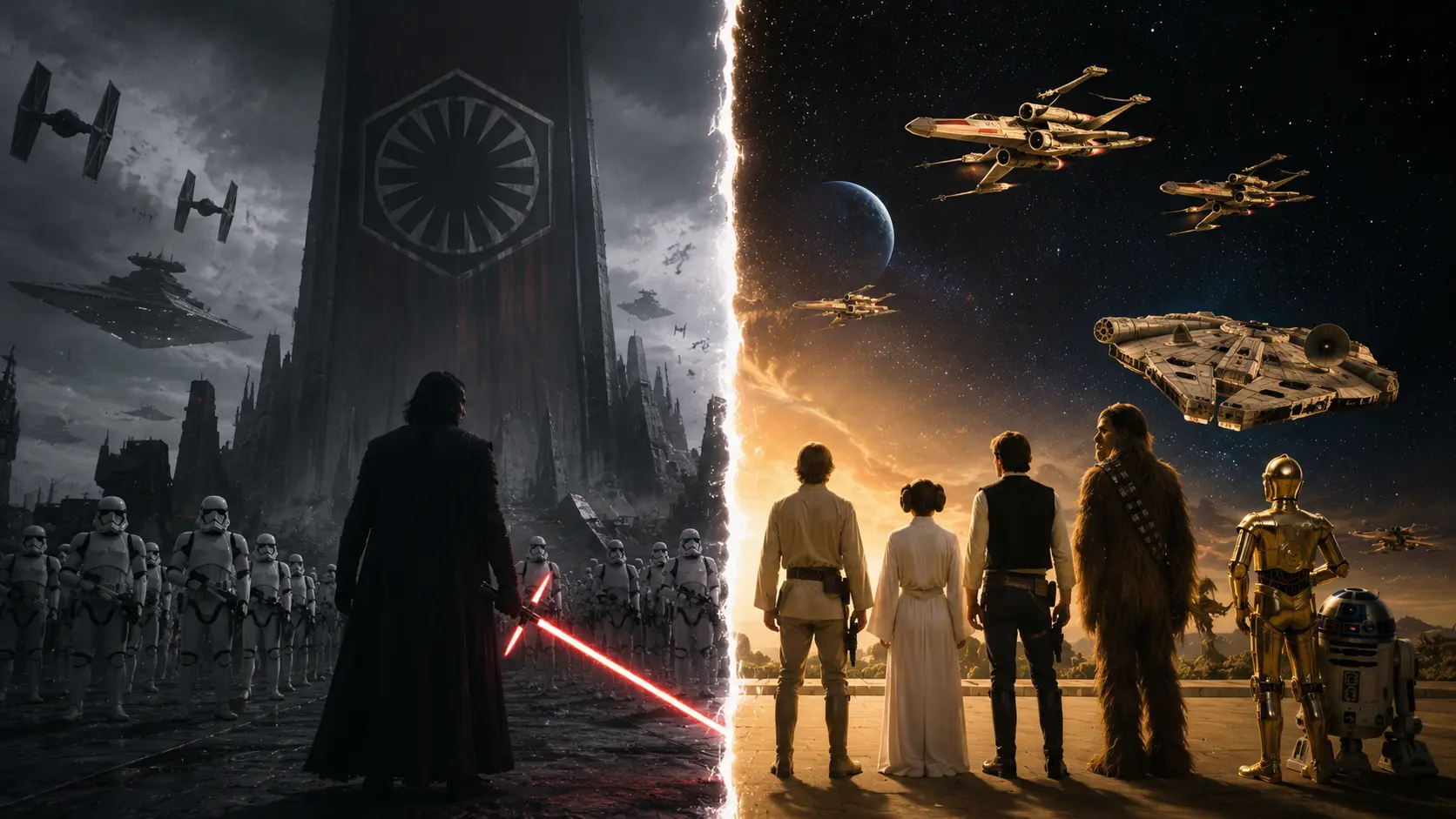
Kathleen Kennedy left Lucasfilm in January 2026 after nearly fourteen years as president, and the company she handed to Dave Filoni and Lynwen Brennan is already doing something it won’t say out loud: dismantling the sequel trilogy’s place at the centre of Star Wars canon. In the comics, a Han Solo miniseries quietly patched a plot hole in The Force Awakens that the film’s own creators never addressed. In the theme parks, Galaxy’s Edge at Disneyland was restructured from April 29, 2026 to bring in Luke Skywalker, Leia, Han Solo, and Darth Vader — characters who had been deliberately excluded from the land since 2019 because it was locked in the sequel-era First Order timeline. The Rey Skywalker film that was announced, given a release date, cycled through three writers, and then quietly had its December 2026 slot handed to Ice Age 6 is now widely understood to be dead. The Mandalorian — the streaming series that was the best thing to come out of the Disney era — has been cancelled, its conclusion moved to a theatrical film.
What’s happening is obvious. What’s missing is the honest acknowledgment of what it means, and the decisive creative choice that would actually complete the reset rather than leaving the franchise in a permanent state of half-retcon. Our position is straightforward: Lucasfilm should finish what it has started, formally sideline the sequel trilogy as a creative dead end, and then do something harder — step back, breathe, and allow the cultural space that Star Wars has occupied for nearly fifty years to open up for something genuinely new.
That second part is the argument most people aren’t making. The debate so far is about what to do with the sequel trilogy. The more interesting question is what the entertainment industry does with the cultural real estate that a legacy franchise has colonised for half a century, once the franchise finally admits it has run its course.
What the Sequel Trilogy Actually Was
The numbers on the sequel trilogy are worth stating cleanly because they contain the contradiction that explains everything. The Force Awakens grossed $2.07 billion worldwide. The Last Jedi grossed $1.33 billion. The Rise of Skywalker grossed $1.07 billion. Combined, the trilogy is the highest-grossing Star Wars trilogy ever made in nominal terms, clearing $4.4 billion. By the only metric that Hollywood typically uses to evaluate franchise decisions, the sequel trilogy was a success.
It was not a success. The box office is the wrong measurement.
The correct measurement is what the trilogy did to the audience that had been loyal to Star Wars for decades, and what it did to the creative universe. The Last Jedi arrived with a 91% critical score on Rotten Tomatoes and a 41% audience score — a split that is not a disagreement about quality but evidence of a fundamental breakdown between what the film was trying to do and what the audience needed it to do. Director Rian Johnson made a genuinely bold film that killed off the mystery box villain established in The Force Awakens, sidelined Luke Skywalker in ways that many longtime fans experienced as a character betrayal, and set up a third film that had no coherent path to follow from what he left.
J.J. Abrams’s response in The Rise of Skywalker was to spend $275 million — $600 million including marketing — largely undoing the previous film. “Somehow, Palpatine returned.” Rey’s parentage was reversed from what The Last Jedi had established. The result was a film with a 51% critical score and an 86% audience score — the inverse of The Last Jedi’s split — because audiences were rewarding it for not being The Last Jedi rather than for being good. Three films, three directors, no unified plan, each entry partly a reaction against the previous one. The result was $4.4 billion and a franchise that emerged from the trilogy worse positioned than it entered it.
Kennedy acknowledged the absence of a unified plan in her exit interview. The Marvel Cinematic Universe analogy — which Disney executives used to sell the sequel trilogy acquisition — required a Kevin Feige equivalent who held the creative map for the entire franchise and built each film as a chapter rather than a standalone. Star Wars never had that. The sequel trilogy was three separate filmmakers pointing in different directions, connected only by recurring characters and the fact that they all spent a lot of money.
The Case for a Clean Break
The argument for formally acknowledging that the sequel trilogy was a creative failure and sidelining it from the active canon has three parts: what it would do for the franchise, what it would do for the audience, and what it would allow to happen next.
For the franchise, the half-retcon Lucasfilm is currently executing is worse than either option it’s avoiding. Galaxy’s Edge adding original trilogy characters while nominally keeping the sequel timeline intact means the theme park is telling two contradictory stories simultaneously, which satisfies neither the people who loved the sequel era nor the people who never accepted it. Starfighter, the Ryan Gosling film arriving May 2027, is set five years after The Rise of Skywalker but features entirely new characters — which means it inherits the sequel trilogy’s continuity without any of its characters, carrying the baggage without the benefit. A clean acknowledgment that the sequel trilogy is being treated as a non-canonical branch — not deleted from existence, but moved out of the primary lineage — allows every future film to breathe without constantly navigating around the debris.
For the audience, what the half-retcon denies is closure. The fans who felt the sequel trilogy betrayed the original trilogy characters — and specifically, who felt that Luke Skywalker’s arc in The Last Jedi was an injustice to a character they had spent forty years with — don’t want the sequels erased from memory. They want the franchise to formally acknowledge that the direction was wrong and that a different direction is being chosen deliberately. The difference between a quiet repositioning and an honest creative reset is the difference between a company hoping no one notices it changing course and a company treating its audience as adults. Mark Hamill himself — Luke Skywalker — said in April 2026 he “can’t think of better hands” than Filoni’s for the franchise. That endorsement carries weight precisely because Hamill was publicly uncomfortable with what the sequel trilogy did to his character. His confidence in the new direction is implicit confirmation that the old direction needed changing.
Dave Filoni’s entire creative history is the counter-argument to everything the sequel trilogy represented. He learned storytelling from George Lucas directly on The Clone Wars. His current project — Maul: Shadow Lord, which premiered April 6, 2026 and holds a 98% critic score in its first season — is built on plans Lucas had discussed with him for years and never got to execute. Filoni’s ascension to Lucasfilm president is the institutional version of what the Galaxy’s Edge restructuring is doing in the theme parks: the Lucas-era creative DNA being restored, deliberately, by the people who were closest to it. A clean break from the sequel era formalises what Filoni’s appointment already means in practice.
What the Data Says About Franchise Fatigue
The Andor argument is the one that matters most for understanding what good Star Wars looks like and why the sequel era was structurally unable to produce it.
Andor Season 2 generated 7.4 billion minutes of viewing across its run in 2025, peaked at 931 million minutes in a single week to become the number one streaming show overall, and its final five episodes all received above 9.5 user ratings on IMDB — a standard that no other television series has achieved across multiple consecutive episodes. The show is set in the prequel era, features no sequel trilogy characters, and is built around themes of political resistance and moral complexity that have nothing to do with the Force as a mystical object. It succeeded not despite being Star Wars but because it trusted the audience enough to treat the Star Wars setting as a backdrop for genuine storytelling rather than a delivery mechanism for nostalgia callbacks.
The Acolyte, by contrast, peaked at 1.5 million views on its release day and lost viewers week over week until it was cancelled. Skeleton Crew failed to crack the top ten new originals. Variety’s 2024 Luminate Film and TV Report formally named Star Wars franchise fatigue as a measurable trend. The pattern is clear: Star Wars content that treats the IP as a content factory produces declining returns; Star Wars content that treats the IP as a setting for ambitious storytelling produces the best results the franchise has generated in years. The sequel trilogy was the content factory model at its most expensive. Andor was the antidote.
The Mandalorian and Grogu theatrical film arrives May 22, 2026 — the franchise’s first theatrical release in seven years. Tracking currently puts its Memorial Day four-day opening between $80 million and $100 million — potentially the lowest Star Wars theatrical opening on record, below even Solo: A Star Wars Story’s $103 million in 2018. That number, if it holds, is what seven years of franchise mismanagement and streaming oversaturation does to theatrical appetite. The film may be excellent. The audience trust it has to overcome is a structural problem, not a quality problem.
After the Retcon: The Case for Stepping Back
This is the argument that goes further than most commentary on this topic is willing to go.
Star Wars has occupied a specific position in popular culture since 1977 — it has been the default science fiction mythology for multiple generations of audiences, the reference point against which all other space operas are implicitly measured. That position has costs that are easy to overlook when the franchise is working and impossible to ignore when it isn’t. The sequel trilogy failed partly because of poor creative planning, but it also failed because the expectations placed on any Star Wars film are now so enormous, so loaded with decades of fan investment and cultural weight, that the creative space available inside those expectations is shrinking. Every new Star Wars story has to be simultaneously new enough to be interesting, reverential enough not to offend existing fans, and commercially accessible enough to justify nine-figure budgets. That is a near-impossible brief, and the sequel trilogy’s failure is partly evidence that no creative team can routinely meet it.
The honest answer to that problem is not a better creative team — though Filoni is clearly better positioned than Kennedy’s theatrical slate. The honest answer is a genuine rest period. Not cancellation. Not abandonment. A deliberate decision to let the IP breathe for five to seven years at theatrical scale — at a moment when streaming consolidation is reshaping who controls legacy IP altogether, to let streaming content do the quiet work of rebuilding trust the way Andor has, and to use that time to allow the cultural space Star Wars has dominated to open up to something new.
That something new does not exist yet, which is part of the argument. The reason no post-Star Wars science fiction mythology has emerged to claim the cultural space is partly that Star Wars never fully vacated it. The franchise’s continuous output — theatrical trilogies, streaming series, games, theme park expansions, merchandise — has maintained a presence in the cultural conversation large enough to crowd out the kind of slow-burn audience development that a new IP requires to build the same depth of fan investment. Dune is the closest thing to a genuine successor that has emerged in decades, and it has managed to do so precisely because its two Villeneuve films were given time and space to breathe without being squeezed by constant Star Wars content in adjacent lanes.
James Bond is the useful comparison here. The Daniel Craig era — which TechRadar has explicitly compared to the Star Wars sequel era, noting that Bond took the creative risks the sequels avoided — ended with No Time to Die in 2021 and the franchise has been silent since. That silence is not failure. It is the Eon Productions equivalent of what Lucasfilm should be doing: taking enough time between Bond eras to ensure that the next version means something rather than arriving as a content obligation. The Bond silence is creating the cultural appetite that will make the next Bond actor’s debut feel like an event rather than a product release cycle.
Star Wars has not been silent since 1977. It has not given audiences the opportunity to miss it. That is the underlying condition that the sequel trilogy exploited and exhausted, and it is the condition that no amount of creative talent can fix without a genuine pause.
What Good Looks Like After the Reset
The Filoni era already knows what it wants to be. Maul: Shadow Lord is building on Lucas’s original plans. Ahsoka Season 2 is in post-production. The Mandalorian and Grogu film represents the conclusion of the streaming-to-theatrical pipeline that Filoni and Favreau built. Starfighter, with Ryan Gosling and a cast that includes Matt Smith, Mia Goth, Amy Adams, and Aaron Pierre, is the first genuinely fresh theatrical take — new characters, new era, no sequel-era baggage — and it arrives May 2027 with a director (Shawn Levy) who understands how to make blockbusters with emotional stakes rather than franchise obligations.
The content that works — Andor, The Mandalorian, Maul: Shadow Lord — shares a specific characteristic: it treats the Star Wars universe as a setting rather than a product, and the people making it care about the stories they are telling more than about the franchise maintenance obligations they are fulfilling. That is the Filoni inheritance. The sequel trilogy represents the opposite: enormous budgets directed toward franchise maintenance at the expense of story, producing films that are simultaneously safe and unsatisfying.
Kill the sequel era formally. Let Filoni’s vision run its course across streaming. Give Starfighter the chance to establish a genuinely new theatrical Star Wars identity. And then — after whatever that produces — consider whether the most generous thing Lucasfilm can do for both its audience and the broader culture is to leave the galaxy far, far away alone long enough for something genuinely new to emerge in its wake.
The franchise that means the most to the most people is the one that earned that meaning slowly, over years, through stories that treated their audience as participants rather than consumers. Star Wars did that once. It can be the model for how it’s done again — by a different IP, in a different register, for a generation that deserves its own mythology rather than a perpetual sequel to someone else’s.
Three Conversations About Star Wars That Tell You What Lucasfilm Already Knows
I have had three conversations recently that, taken together, suggest Lucasfilm has internalised the sequel-trilogy problem more honestly than the marketing language admits. The first was with a long-time franchise screenwriter who said, off the record, that the room conversations about how to “address” the sequels had shifted from “rehabilitate” to “absorb” to “minimise” over an eighteen-month window. The vocabulary change is the data.
The second was with a theme-park designer involved in the Galaxy’s Edge expansion who described how the in-park content guidelines had quietly changed — the parts of the park that lean on sequel-trilogy characters get less new content investment than the parts anchored in the prequels and originals. Theme parks are an unusually honest signal because the investment decisions get made eighteen months ahead of the public-facing announcements and the dollars are not concealable.
The third was with someone who works in licensing, who explained that the toy and apparel mix has been quietly rebalancing toward original-trilogy IP for the better part of two years. Licensing follows demand, and the demand has spoken.
None of these people are speaking for the company. Each one is a small piece of evidence that the company has already made the decision the public coverage is only now considering. The “clean break” argument is not the analyst’s; it is the analyst noticing what Lucasfilm has been doing operationally without announcing. The next public statement will probably arrive shaped as something other than a clean break, because the language matters to fans in a way the operational reality does not. Both can be true.
Frequently Asked Questions
Is Lucasfilm actually retconning the sequel trilogy?
Lucasfilm has not formally announced a retcon, but multiple simultaneous actions point in that direction. A Han Solo Marvel Comics miniseries retroactively addressed a Force Awakens plot hole. Galaxy’s Edge at Disneyland was restructured in April 2026 to add original trilogy characters after seven years of being locked in the sequel-era First Order setting. The Rey Skywalker film is widely considered dead. The Mandalorian TV series has been cancelled, its conclusion moved to a theatrical film. Screen Rant and Inside the Magic have both characterised these moves as an official de-centring of the sequel trilogy from the franchise’s primary identity, even without a formal announcement.
What happened to Kathleen Kennedy and why did she leave?
Kennedy stepped down as Lucasfilm president in January 2026 after nearly fourteen years in the role, which she had held since Disney’s $4 billion acquisition of Lucasfilm in 2012. She had been discussing succession with Disney’s Bob Iger and Alan Bergman for two years. Dave Filoni (President and Chief Creative Officer) and Lynwen Brennan (Co-President, business) replaced her. Kennedy remains a producer on The Mandalorian and Grogu and Starfighter. Her tenure oversaw three theatrical trilogies and the full Disney+ streaming rollout — a commercially mixed record that ended with the franchise in a rebuilding phase.
What did the sequel trilogy make at the box office?
The Force Awakens (2015) grossed $2.07 billion worldwide. The Last Jedi (2017) grossed $1.33 billion. The Rise of Skywalker (2019) grossed $1.07 billion. Combined total: over $4.4 billion — the highest-grossing Star Wars trilogy in nominal terms. Despite the commercial performance, the trilogy is widely regarded as a creative failure due to the absence of a unified creative plan, three directors pointing in conflicting directions, and the critical/audience score split that peaked with The Last Jedi (91% critics / 41% audience on Rotten Tomatoes).
Who is Dave Filoni and why does his leadership matter?
Dave Filoni is the new President and Chief Creative Officer of Lucasfilm, and the most significant creative appointment the franchise has made since George Lucas himself. Filoni joined Lucasfilm to work directly under Lucas on The Clone Wars — the animated series that Lucas considered his most complete expression of the Star Wars mythology. Filoni has confirmed he is adapting and honouring Lucas’s original creative plans for characters like Maul and Ahsoka. Mark Hamill has described Filoni as the right person for the role, noting that “George was a mentor to Dave, so he knows George’s sensibility.” Filoni’s ascension represents the Lucas-era creative DNA being formally restored to institutional control.
What should come after Star Wars?
That is the right question, and the honest answer is that it doesn’t exist yet — in part because Star Wars has been too continuously present in the cultural conversation to allow a successor mythology to develop. Dune (Villeneuve’s two-film adaptation) is the closest thing to a post-Star Wars science fiction mythology to have emerged, and it achieved that position by being given time and space. The argument for a genuine Star Wars rest period at theatrical scale is not that the franchise should disappear, but that perpetual output is crowding out the cultural space in which the next generation’s mythology could develop. Star Wars did something extraordinary by earning that space over decades. The most generous thing it can do now is leave room for something new to earn it too.
Sources
- Hollywood Reporter: Kathleen Kennedy Steps Down, Dave Filoni Takes Over (January 2026)
- Deadline: Kathleen Kennedy Exit Interview (January 2026)
- Art Threat: Star Wars Sequel Trilogy Gets Official Retcon at Galaxy’s Edge Starting April 29
- Inside the Magic: Star Wars Confirms Rey Skywalker Will Not Return in Future Movie (January 2026)
- Inside the Magic: Star Wars Hits Reset, Quietly Retcons Sequels and Cancels The Mandalorian (January 2026)
- Collider: Rian Johnson Confirms His Star Wars Trilogy Is Effectively Dead (November 2025)
- Inside the Magic: Mark Hamill on Star Wars’ Future Under Dave Filoni (April 2026)
- Star Wars: Maul — Shadow Lord (Disney+, premiered April 6, 2026)
- Variety: Star Wars Fatigue Confirmed as Measurable Trend — 2024 Luminate Film & TV Report
- Deadline: The Mandalorian and Grogu Box Office Forecast — Possible Franchise Low (April 2026)
- TechRadar: Daniel Craig’s James Bond Movies Show Where the Star Wars Sequels Went Wrong
- GamesRadar: Kennedy’s Final Updates on Star Wars Films in Development Hell
- Deseret News: Jon Favreau on the Future of Star Wars (May 1, 2026)
- Media Play News: US Viewers Consumed 33 Billion Minutes of Star Wars Content in 2025
- Inside the Magic: Disney Spent $600 Million on Rise of Skywalker, Only to Remake It Six Years Later