Apple WWDC 2026: What Apple Intelligence 2.0 and iOS 20 Need to Prove About the On-Device AI Bet
Apple’s Worldwide Developers Conference opens June 9 in Cupertino with unusually high stakes. Apple Intelligence — the company’s on-device AI framework launched with iOS 18 in September 2024 and substantially expanded with iOS 18.1 through 18.3 — has had 20 months of real-world deployment. The market now has data to evaluate whether Apple’s structural bet on on-device AI processing is a genuine technical differentiator or a privacy narrative wrapped around hardware limitations.
The signals ahead of WWDC 2026 suggest Apple is ready to escalate its claims. The question is whether the product catches up to the pitch.
The On-Device Bet: What Apple Wagered
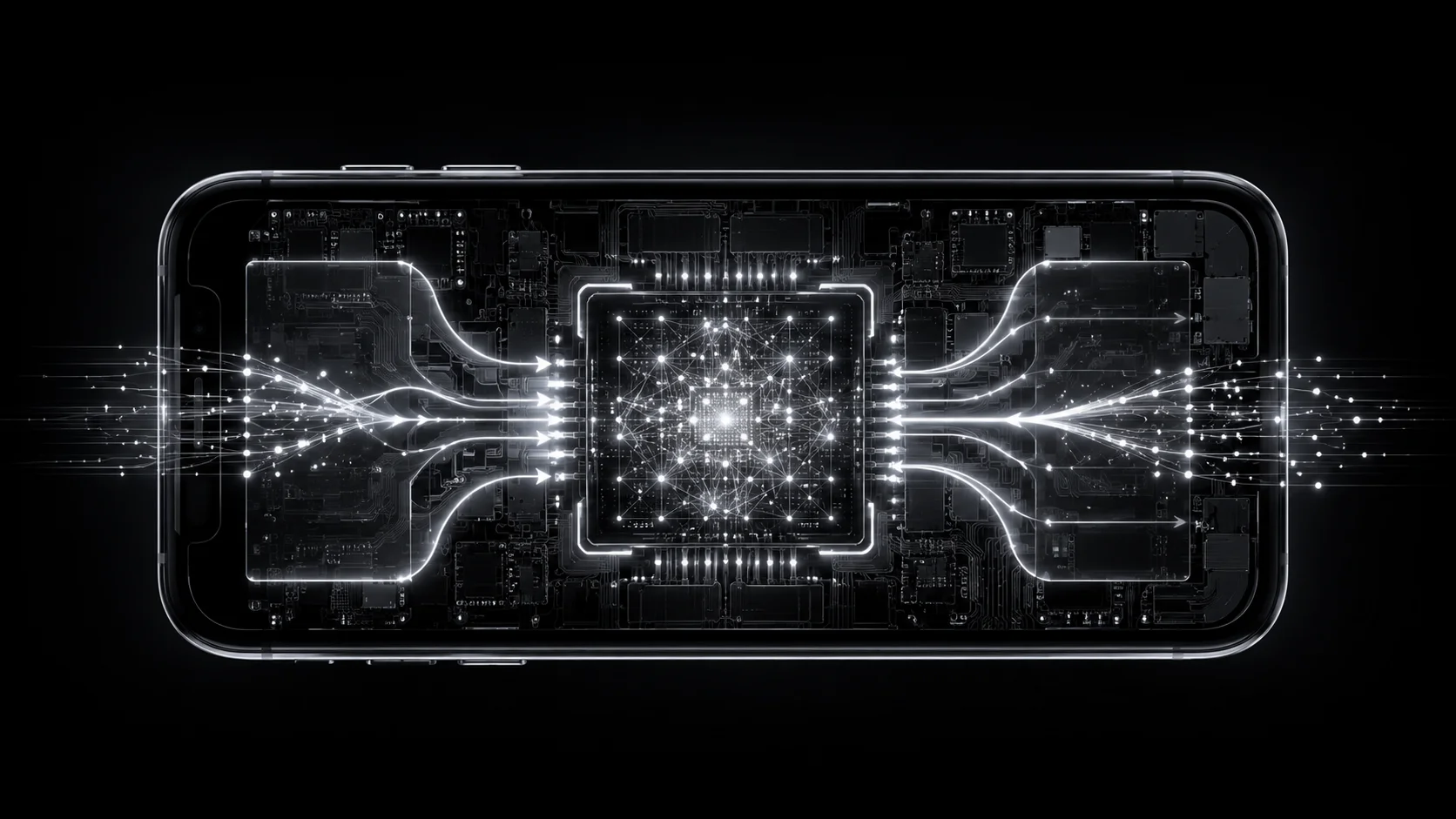
Apple’s strategic position on AI diverged sharply from competitors at the iOS 18 launch. Where OpenAI, Google, and Microsoft built cloud-first AI products that sent user data to remote servers for processing, Apple made the architectural choice to run the majority of Apple Intelligence tasks on the device itself — on the Neural Engine chips embedded in the A-series and M-series silicon.
The strategic logic had two components. First, a genuine privacy argument: processing data on-device means it never leaves the phone, which addresses a real and growing consumer concern about AI services accessing personal context. Second, a hardware differentiation argument: if AI capability is tied to the Neural Engine in Apple silicon, then upgrading to Apple Intelligence features requires upgrading your iPhone — a powerful upgrade cycle driver that cloud AI cannot replicate.
The execution caveat was that on-device processing imposes real capability constraints. The 3B-7B parameter models that fit comfortably on device are substantially less capable than the frontier models OpenAI, Anthropic, and Google run in their data centres. Apple’s workaround was Private Cloud Compute — a system where complex tasks that require larger models are sent to Apple-operated servers that process the request without logging it, using a cryptographic attestation system designed to prevent Apple’s own employees from accessing the data.
This architecture is genuinely novel. Apple hired a team of cryptographers and security engineers to design the Private Cloud Compute system, and independent audits have confirmed the technical claims. But whether consumers value the privacy architecture enough to choose it over more capable cloud competitors is an empirical question that 20 months of deployment data now helps answer.
What Apple Intelligence 1.x Delivered (and Didn’t)
The iOS 18 and 18.x versions of Apple Intelligence deployed a focused set of capabilities: text summarisation in Mail and Messages, priority notification ranking, image generation via Image Playground and Genmoji, an upgraded Siri with contextual awareness of on-screen content, and ChatGPT integration (via opt-in handoff) for queries requiring frontier model capability.
Consumer reception was mixed in ways that split neatly along demographics and use cases. Power users who work extensively in Apple’s productivity apps found the Mail summarisation and Priority Notifications genuinely useful — the reduction in notification-driven interruption scored highly in user research. The image generation features attracted enthusiastic use among younger demographics but received criticism for inconsistent quality and a tendency toward generic outputs.
The upgraded Siri disappointed. Despite two years of buildup and marketing positioning that implied Siri had been fundamentally rebuilt, real-world Siri remained inferior to Google Assistant, Gemini, and ChatGPT on factual queries, follow-up conversation, and complex multi-step requests. The on-screen context awareness was novel but the underlying reasoning quality remained bounded by the model size that fits on-device.
Apple’s response — acknowledged indirectly through product updates and development timelines that slipped from original announcements — was to sequence the rebuild over multiple releases rather than deliver a comprehensive Siri overhaul at once. WWDC 2026 is expected to be the moment where the rebuilt Siri architecture becomes visible to developers.
What WWDC 2026 Is Expected to Announce
Apple has maintained strict pre-announcement secrecy, but supplier chain signals, developer forum activity, and analyst research point to several anticipated announcements.
Apple Intelligence 2.0 — the framework brand for iOS 20’s AI capabilities — is expected to substantially expand the on-device model capability through architectural improvements in the A19 and M5 chip Neural Engines. The key claim expected is not raw benchmark improvement but a specific capability threshold: on-device models capable of handling conversation chains of the complexity currently requiring Private Cloud Compute handoff. If Apple can demonstrate that common agentic tasks run fully on-device with no cloud dependency, the privacy differentiation argument becomes significantly more concrete.
Siri with App Intents — the rebuilt Siri integration that allows third-party apps to expose structured actions to Siri — is expected to reach its full launch state. The developer framework was announced at WWDC 2024 but the first-party Siri capabilities required to make it compelling were not yet ready. WWDC 2026 should deliver the reasoning layer that allows Siri to understand complex cross-app tasks: “book me a table at the restaurant my friend messaged about and add it to my calendar” as a single coherent operation rather than a chain of explicit instructions.
iPhone mirroring and continuity intelligence — extending Apple Intelligence to share context seamlessly between iPhone, iPad, and Mac in a way that maintains on-device processing without duplicating data — is expected as an iOS 20 capability. The technical challenge is significant: maintaining private context across devices without cloud synchronisation requires either local device-to-device transfer protocols or a fundamentally new approach to distributed context management.
Developer APIs for on-device model access — allowing third-party developers to build applications that run directly against Apple’s on-device models — would be a significant ecosystem expansion. Currently, third-party AI applications use cloud APIs. Apple opening local model inference to developers would accelerate the development of privacy-preserving AI applications that function without internet connectivity, a feature set particularly valuable for enterprise and regulated-industry developers.
The Competitive Pressure Apple Is Responding To
Apple enters WWDC 2026 having lost ground in the AI narrative. The Google I/O 2026 conference in May demonstrated Gemini 2.0 capabilities that outperformed Apple Intelligence on most published benchmarks. Microsoft’s Copilot integration across Windows 11 and the Microsoft 365 ecosystem has created a credible enterprise AI story that Apple’s business-user base is watching. OpenAI’s expanded ChatGPT Plus features — including the memory system that builds persistent user context across conversations — represent a user experience that iCloud Keychain-integrated Apple Intelligence does not yet match.
The competitive disadvantage is real but also somewhat overstated by the benchmark-focused coverage. Apple’s addressable market is different from the addressable market that Google, Microsoft, and OpenAI are optimising for. The 1.2 billion active iPhone users include a very large population that has never used ChatGPT, does not have a Microsoft 365 subscription, and experiences AI entirely through the interface Apple ships. For that population, the relevant comparison is not “Apple Intelligence vs. Gemini 2.0” but “Apple Intelligence vs. no AI at all two years ago.”
The market share argument for Apple is therefore less about winning head-to-head AI benchmarks and more about converting the passive installed base into active AI feature users. Any improvement in Siri capability that meaningfully increases daily active use among the iPhone installed base is worth more in commercial terms than a benchmark win against a competitor with 5% of Apple’s user base.
The Hardware Dependency Loop
Apple Intelligence full feature set requires iPhone 15 Pro or later, or the base iPhone 16 and beyond. This hardware floor is explicit in Apple’s feature matrices and represents a deliberate strategic choice: tying AI capability to current-generation silicon creates upgrade pressure without requiring a separate subscription.
The upgrade cycle impact was visible in the iPhone 16 launch data. iPhone 16 sales in the four quarters post-launch were approximately 3% higher than the comparable iPhone 15 window, a modest but measurable acceleration attributed in analyst models to AI feature pull. The upgrade cycle hypothesis assumes the effect compounds as Apple Intelligence 2.0 features are restricted to even newer silicon — specifically capabilities requiring the A19’s Neural Engine improvements — putting further distance between current-generation iPhones and the AI feature set.
For Apple’s financial model, this matters. iPhone revenue represents approximately 48% of total company revenue. A structural improvement to the upgrade cycle — even a modest acceleration from 3.7-year average replacement cycles to 3.4 years — is meaningful at 1.2 billion active devices. The AI hardware tie-in is not just a product strategy; it is a revenue cycle management tool.
What Success Looks Like at WWDC 2026
Apple’s WWDC presentations are designed to move developer behaviour rather than consumer sentiment directly — the consumer marketing campaign follows in September at the iPhone 18 launch event. But the developer audience at WWDC functions as a proxy for whether the technical claims are credible.
Success at WWDC 2026 for Apple Intelligence looks like: a rebuilt Siri architecture that impresses developers with its cross-app reasoning capability, a Neural Engine performance specification that credibly supports the on-device inference claims, a developer API framework that makes building AI-native apps on Apple platforms structurally attractive, and a Private Cloud Compute expansion that extends the capability ceiling without compromising the privacy architecture.
What would fall short: incremental improvements to existing Apple Intelligence features without the Siri rebuild, a developer API that restricts access in ways that frustrate third-party AI builders, or a marketing narrative that outpaces actual capability in ways that generate the same disappointment response that iOS 18 Siri did.
The stakes are higher than a typical WWDC. Apple’s premium hardware business is defensible only as long as its software differentiation justifies the price. The era when iOS itself was the differentiation is over — Android has caught up on nearly every observable metric. The bet Apple has placed is that on-device AI, done with Apple’s quality bar and privacy architecture, becomes the next decade’s iOS. WWDC 2026 is the moment where that bet either becomes visible as a genuine platform or reveals itself as a marketing story in search of a product.
On-Device as Sustaining, Not Disruptive
Clayton Christensen’s disruption theory makes a distinction that Apple’s WWDC framing consistently elides. Sustaining innovations improve existing products for existing customers along the dimensions those customers already value. Disruptive innovations offer lower performance on existing metrics but unlock new customer segments or use cases that the incumbent cannot serve. Apple’s on-device AI argument — that Neural Engine processing is faster, more private, and more integrated than cloud inference — is a sustaining argument. It improves iPhone for the customer who already chose iPhone and values privacy and integration.
The structural risk for a sustaining innovator is that it becomes vulnerable to an attacker improving from below. Cloud-native AI services — ChatGPT, Gemini, Claude — offer their best capabilities to any device with a browser. They are not upgrade-cycle gated. They are not dependent on Neural Engine access. The user running ChatGPT on a four-year-old iPhone gets the same GPT-4o capabilities as the user on an iPhone 17 Pro. Apple’s on-device advantage disappears precisely where the cloud alternative is good enough for the task, and “good enough” is a bar that cloud AI is lowering with every model generation.
Christensen’s framework predicts how this resolves: the sustaining innovator wins the high end — the buyers who most value privacy, deep hardware integration, and offline capability — and loses the commoditising middle to cloud services that improve fast enough on the dimensions that casual AI users actually care about. For Apple, that middle is the user who wants a writing assistant and a search enhancement and does not particularly care whether the computation happens on Neural Engine silicon or in a data center in Iowa.
What WWDC 2026 needs to demonstrate is capability that cloud alternatives cannot replicate: things Siri or Apple Intelligence can do specifically because of persistent on-device memory, real-time sensor access, or deep OS integration — not just privacy parity. Apple already made the Gemini integration at WWDC its hedge against the capability gap. iOS 20’s job is to narrow that gap from the other direction.
Christensen’s disruption theory ultimately rewards the innovators who find use cases where the incumbent’s architecture is genuinely limiting, not just slower. On-device AI’s legitimate claim to disruption is not in general task performance — it is in the specific class of tasks where permanent cloud access cannot be assumed, where user data must not leave the device, and where latency is measured in frames rather than seconds. If WWDC 2026 demonstrates that class clearly, the on-device bet survives as a durable position. If it demonstrates only that on-device is fast and private, the cloud will catch up on speed and offer comparable privacy marketing.