
Author: Gabriel Mercadojr

  • Developers thought a viral Reddit post was about AI. It wasn’t. That’s the real problem.

    Developers thought a viral Reddit post was about AI. It wasn’t. That’s the real problem.

    A short Reddit post about SaaS churn has been shared tens of thousands of times over the past few months.

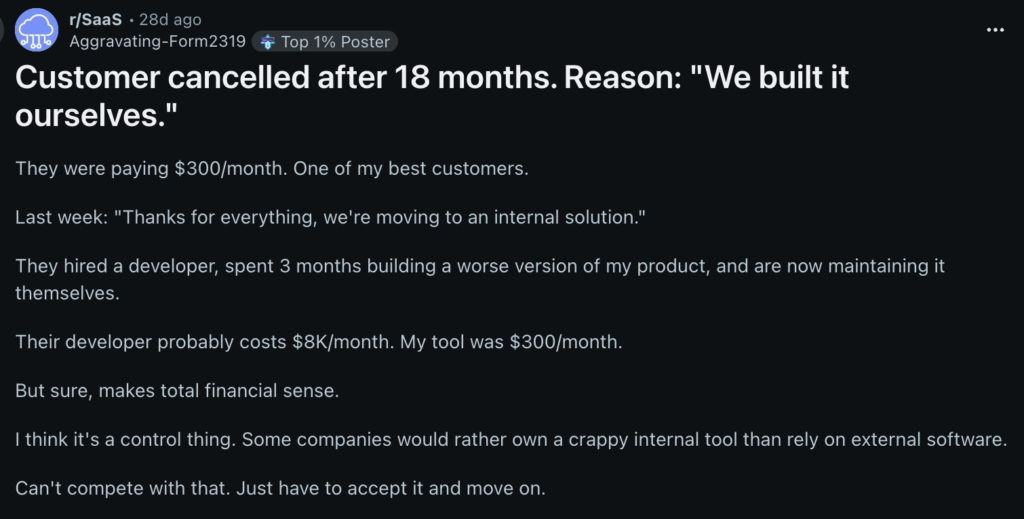
    The setup was simple. A SaaS founder said one of his “best customers” — paying $300 a month for 18 months — had canceled. The customer had built an internal version instead. And although the founder insisted the internal build was worse, the customer seemed happier with it.

    The internet reacted like it was a warning shot.

    Many developers and product managers framed it as another sign that AI is about to wipe out SaaS companies — and, eventually, engineers. It was quickly folded into a broader story about “vibe coding,” job insecurity, and the idea that software can now be built in a weekend with the right prompts.

    But the post didn’t mention AI. Not once.

    The customer didn’t claim they used ChatGPT. The founder didn’t say the tool was rebuilt overnight. The entire story was about ownership economics: a buyer deciding that rent wasn’t worth it anymore.

    That’s why the reaction matters.

    Because if tens of thousands of builders misread a 200-word post, it’s worth asking what else they’re misreading about the world they work in.

    Developers are supposed to be good at reading. That’s the job.

    We read code. We review tickets. We interpret logs. We obsess over edge cases. Yet this post — short, plain, and direct — became a kind of Rorschach test, where people saw what they feared instead of what was written.

    If you want a simpler explanation, it’s this: the post hit a nerve.

    It wasn’t about AI replacing engineers. It was about customers rejecting what engineers build when the value doesn’t match the price. And that is a more uncomfortable conversation, because it’s harder to blame.

    In the founder’s version, his customer was irrational. They paid a developer for three months just to rebuild something they already had — and ended up with something worse. He implied it didn’t make sense.

    But the customer’s decision probably wasn’t as irrational as it looked.

    If a company is willing to spend months building an internal workaround, it’s usually because something wasn’t working. The SaaS tool wasn’t integrating properly. It wasn’t tailored enough. It was harder to use than it should have been. Or it was simply overpriced relative to what they actually needed.

    This is the part that gets ignored too often in SaaS. Customers don’t buy your product. They buy a job it helps them do.

    If your product stops feeling like leverage and starts feeling like rent, churn becomes inevitable. And churn rarely comes without warning.

    That’s another detail that makes the founder’s framing hard to sympathize with.

    If this customer really was the “best,” how did they leave without being detected?

    In most mature SaaS businesses, churn is predictable. Usage declines. Engagement drops. Your champion disappears. Procurement starts asking questions. Customer health scores deteriorate. It may not feel dramatic, but it’s measurable.

    Which raises an uncomfortable possibility: the founder wasn’t as close to his customer as he believed. He didn’t know what they valued, what they used, or what was frustrating them.

    Or he did know, and didn’t want to confront it.

    Instead, he posted about it publicly. And in doing so, he accidentally revealed something about the culture many of us work inside: builder detachment has become normal.

    A lot of developers and product managers still treat customer contact as optional. Something for Sales. Something for Support. Something beneath the “real work.”

    That mindset survived because tech, for a long time, had the money to tolerate it.

    From around 2015 through 2022, software was a protected industry. Growth was assumed. Hiring was relentless. Compensation climbed fast. Perks became part of the recruiting arms race. Companies expanded headcount even when there wasn’t a clear need for it.

    The result was predictable: many builders became insulated from business reality.

    You could ship features no one used and still get promoted. You could stay deep in Jira and never speak to a customer. You could treat churn as “their fault” and still keep your job.

    That era is over.

    Tech layoffs have become a recurring feature of the economy. Big companies are pulling back perks. Smaller companies are tightening budgets. Teams are shrinking while expectations rise.

    And AI is adding a brutal new dynamic: output is getting cheaper.

    Code generation alone won’t replace developers tomorrow, but it changes the baseline. It raises the bar. It compresses the time needed to ship. It makes “I built it” less impressive.

    Which means the advantage shifts.

    What becomes valuable now isn’t only technical brilliance — it’s commercial literacy. It’s knowing what matters to a customer. It’s seeing churn signals early. It’s being able to explain the ROI of what you build in plain language.

    If you think customer conversations are beneath you or simply not your job, you’re already behind.

    Because technical skill alone is no longer rare enough to protect you. Not in a market that’s tightening. Not when teams are smaller. Not when AI makes output easier.

    The builders who survive will be the ones who stop treating customers like abstractions.

    The ones who understand that churn is not betrayal. It’s a signal.

    And the ones who can connect the work to outcomes, rather than hiding behind the comfort of shipping.

    A deeper breakdown of the original Reddit story — and what it reveals about developer culture — is available here:

    The bigger point is simpler.

    This wasn’t really an AI story. It was a mirror. And a lot of builders didn’t like what it showed.


  • Top 10 Destinations for Crypto Expats in 2026

    Top 10 Destinations for Crypto Expats in 2026

    By Gabriel, edited by Grok, with insights drawn from industry analysis on crypto-friendly jurisdictions by Swift Cargo Solutions

    TL;DR: In a volatile crypto market, relocating to a jurisdiction with favorable tax policies, clear regulations, and robust banking infrastructure can protect and optimize your holdings. This guide highlights the top 10 countries offering stability, accessibility, and quality of life for cryptocurrency holders planning an expatriation in 2026.

    It’s a challenging time in the crypto space. With Bitcoin under pressure while traditional assets like gold, silver, and equities perform strongly amid rising inflation, many long-term holders are feeling the strain. The memes capture the sentiment perfectly—despair turning diamond hands shaky. If you’ve managed to preserve some gains, now might be the strategic moment to relocate to a more supportive environment. These destinations offer crypto-friendly policies, easing the path for expats to secure their wealth and plan for the future. Drawing from comprehensive evaluations of tax treatment, regulatory clarity, residency options, banking access, and lifestyle factors, here’s a rundown of the top 10 places to consider bunkering down in 2026.

    1. Portugal: European Accessibility with Attractive Incentives

    Portugal stands out for its pathway to EU residency, including options like the D8 visa for passive income holders. Crypto gains face a straightforward tax regime, with banking integrated into the SEPA system for seamless operations. English is widely spoken, and the cost of living remains reasonable alongside high quality of life.

    2. United Arab Emirates (Dubai Focus): Zero-Tax Haven with Rapid Growth

    The UAE, particularly Dubai, offers no personal income tax on crypto gains and dedicated regulatory frameworks for virtual assets. Residency is accessible via investment or remote work programs, with expanding banking options and a cosmopolitan, English-speaking environment.

    3. Singapore: Regulated Excellence in Asia

    Known for its proactive and clear regulatory stance on digital assets, Singapore provides deep liquidity and reliable fiat on-ramps. Visa options for professionals and entrepreneurs abound, supported by universal English usage and exceptional infrastructure.

    4. Georgia: Low-Tax Emerging Option

    Georgia features zero tax on personal crypto gains for individuals, long visa-free entry periods, and improving banking infrastructure. It’s an affordable destination with diverse landscapes and growing expat appeal.

    5. Panama: Territorial Taxation and Dollarized Stability

    Panama’s territorial tax system exempts foreign-sourced income, including crypto, with a fully dollarized economy simplifying banking. Residency programs are established, offering a blend of urban and natural lifestyles.

    6. Spain: Vibrant EU Alternative

    Spain introduces digital nomad visas alongside traditional residency routes, with strong SEPA banking integration. English proficiency is high in major cities, complemented by cultural richness and moderate living costs.

    7. Germany: Structured Reliability

    Germany provides freelance and skilled worker visa options, backed by robust, compliant banking systems. High English proficiency and a thriving tech ecosystem in cities like Berlin make it a solid choice for long-term stability.

    Brandenburg Gate – Wikipedia

    8. Ireland: English-Speaking Tech Hub

    Ireland supports remote and skilled visas with strong banking rails for crypto activities. As an English-speaking EU member, it combines tech innovation in Dublin with scenic quality of life.

    Samuel Beckett Bridge – Wikipedia

    9. Switzerland: Premium Institutional Trust

    Switzerland’s mature crypto ecosystem includes advanced banking and unchanging regulatory predictability. Though residency requires higher commitment, it delivers unparalleled privacy and elite living standards.

    10. The Netherlands: Balanced Progressive Environment

    The Netherlands offers startup and employment-based residencies with reliable banking under careful oversight. Near-universal English and a high quality of life in cities like Amsterdam round out its appeal.

    In summary, these locations provide varying combinations of tax advantages, regulatory support, and expat-friendly features to weather market cycles. Research individual circumstances, including visa eligibility and compliance, before making a move. The crypto journey relies on resilience—position yourself in a jurisdiction that aligns with your long-term vision.

  • Kadena’s Collapse: When Brilliant Code Meets Broken Business Models

    Kadena’s Collapse: When Brilliant Code Meets Broken Business Models

    The blockchain industry has perfected the art of conflating technological sophistication with business viability. Kadena’s abrupt shutdown in October 2025 offers a masterclass in why this confusion costs investors billions—and why the crypto market keeps repeating the same expensive mistakes.

    When Kadena’s core organization announced it would cease all business operations, the market response was swift and brutal. KDA plummeted 55-60% within hours and now trades 99% below its peak. Major exchanges moved quickly to delist: Binance.US scheduled removal for October 28, KuCoin followed November 4, and Binance’s global platform completed the purge November 12. The message was unambiguous—without institutional support, even technically sophisticated blockchains become digital ghost towns.

    But here’s what makes Kadena’s failure particularly instructive: the blockchain itself still works perfectly. Miners continue validating transactions. Smart contracts still execute. The code that supposedly justified billions in market valuation remains functional. The problem was never technical—it was everything else that matters for sustainable business operations.

    The Engineering Mirage

    Kadena’s technical architecture represented genuine innovation in blockchain design. The Chainweb protocol offered parallelized proof-of-work throughput that addressed Bitcoin’s scaling limitations while maintaining security guarantees. The Pact programming language provided safer, more readable smart contracts than Ethereum’s Solidity. Multiple independent audits confirmed the protocol’s security posture.

    This engineering excellence created a compelling investment narrative that attracted significant capital during crypto’s speculative phases. Venture investors, retail traders, and institutional allocators bought into the story that superior technology would inevitably win market share from inferior alternatives. The assumption seemed reasonable—better code should produce better outcomes.

    Except that’s not how technology markets actually work. Superior engineering without sustainable business fundamentals creates the illusion of value while obscuring the reality that code alone cannot generate revenue, manage regulatory compliance, or maintain stakeholder confidence through market cycles. Kadena’s repositories show sustained technical effort right up until the shutdown announcement. The engineering team delivered exactly what they promised. They simply forgot that technology companies require viable business models.

    The Revenue Transparency Problem

    Kadena’s documentation and public communications focused extensively on technical specifications, consensus mechanisms, and scaling solutions. What remained conspicuously absent was any clear explanation of how the protocol would generate sustainable revenue beyond token appreciation. Market narratives centered on KDA price movements rather than operating fundamentals—always a red flag for investors who bother to look.

    This pattern repeats across failed crypto projects with depressing consistency. Teams can explain Byzantine fault tolerance and sharding architectures in exhaustive detail, yet struggle to articulate basic business mechanics: Who pays for the service? What problem justifies the cost? How does revenue scale with adoption? Without answers to these questions, even brilliant technology becomes a solution in search of a problem that may not exist at economically viable prices.

    The blockchain industry’s obsession with technical innovation has created a culture where business model validation is treated as an afterthought rather than the foundation of sustainable value creation. Kadena’s leadership presumably understood proof-of-work consensus mechanisms better than most, but they apparently never mastered cash flow management or stakeholder communication—skills that matter more for organizational survival.

    The Governance Vacuum

    Kadena’s shutdown followed what investors have come to recognize as the crypto collapse playbook: sudden cessation of communication, abrupt cessation of operations, and complete absence of transition planning. The organization provided no meaningful warning about financial difficulties, operational challenges, or strategic pivots. One day the ecosystem appeared active; the next day it was gone.

    This governance failure magnified investor losses by eliminating any opportunity for orderly exits or community-led transitions. When continuity assumptions vanish overnight, retail holders bear disproportionate losses because they lack the information access and trading infrastructure available to insiders. The damage extends beyond immediate financial harm to encompass the broader trust erosion that affects the entire crypto market.

    Professional investors have learned to evaluate traditional companies based on governance standards, transparency practices, and stakeholder communication protocols. Crypto projects too often operate with the opposite approach—maximizing technical complexity while minimizing operational disclosure. Kadena’s collapse demonstrates why this imbalance proves catastrophic when market conditions deteriorate.

    The Auditing Limitations

    Smart contract audits became the gold standard for crypto security during the industry’s explosive growth phase. Kadena underwent multiple security reviews that confirmed code integrity and identified potential vulnerabilities for remediation. These assessments provided investors with confidence that the protocol operated as designed and protected user funds from technical exploits.

    What auditing could not address—and what investors too often assumed was covered—was business viability risk. Security firms evaluate code quality, not revenue sustainability. They assess technical attack vectors, not market positioning. They verify smart contract logic, not management competence. This scope limitation becomes critical when projects fail for business rather than technical reasons, as Kadena did.

    The distinction between technical security and business risk explains why protocols can pass rigorous auditing processes while remaining fundamentally unsound as ongoing enterprises. Investors who treat code audits as comprehensive due diligence miss the governance, revenue, and operational factors that ultimately determine organizational survival.

    The Predictable Pattern

    Kadena’s failure surprised investors who focused on technical metrics while ignoring operational warning signs. But the collapse fits a recognizable pattern visible across blockchain projects that prioritize engineering over execution. Strong development activity masks weak business fundamentals until market conditions expose the underlying fragility.

    The crypto industry’s cyclical nature amplifies this dynamic by creating periods when speculative capital flows to projects with compelling narratives regardless of economic viability. During bull markets, technical innovation alone can justify extraordinary valuations because investors assume future adoption will solve revenue challenges. Bear markets reverse this calculus by forcing projects to demonstrate sustainable value creation or face extinction.

    Kadena’s timing proved particularly unfortunate because its shutdown coincided with broader crypto market stress that eliminated alternative funding sources. But the underlying weakness—brilliant technology without corresponding business sophistication—existed throughout the project’s lifecycle. Market conditions merely accelerated the inevitable reckoning.

    The Confidence Contagion

    The most damaging aspect of Kadena’s collapse extends beyond direct investor losses to encompass broader confidence erosion across blockchain markets. When technically sophisticated projects fail abruptly, they undermine faith in the entire sector’s maturity and reliability. This trust deficit affects even viable projects by making capital more expensive and adoption more difficult.

    Professional investors who witnessed Kadena’s technical capabilities but experienced its operational failures become more skeptical toward similar projects promising revolutionary advances without corresponding business fundamentals. The due diligence process becomes more rigorous, funding timelines extend, and valuation multiples compress across the industry.

    This confidence contagion explains why high-profile failures produce market-wide impacts disproportionate to their direct financial effects. Each collapse raises the bar for what constitutes credible projects while increasing scrutiny of operational practices that previously escaped notice. The sector’s reputation suffers collectively even when individual failures result from specific organizational shortcomings.

    What Credible Actually Looks Like

    Kadena’s collapse provides a useful template for evaluating blockchain projects across dimensions that matter more for investor protection than technical sophistication. Sustainable crypto ventures combine innovative technology with traditional business fundamentals that have governed successful companies across industries.

    Credible projects articulate clear revenue models that don’t depend primarily on token appreciation. They publish governance frameworks explaining decision-making processes and stakeholder rights. They maintain transparency about operational challenges and strategic pivots rather than presenting sanitized narratives during difficult periods. They adopt professional standards like SOC 2 compliance and ISO 27001 certification that signal organizational maturity.

    Most importantly, credible projects recognize that sustainable value creation requires balancing technical innovation with business execution. Code quality matters for blockchain projects, but revenue sustainability, governance transparency, and operational competence matter more for investor outcomes. Kadena’s failure demonstrates what happens when this balance tilts too far toward engineering at the expense of everything else.

    The blockchain industry will continue producing technically sophisticated projects that fail commercially until investors demand the same operational standards they expect from traditional companies. Kadena’s collapse suggests this learning process remains expensive—and entirely predictable.

  • Microsoft 2025 Happy Shareholders Angry Customers

    Microsoft 2025 Happy Shareholders Angry Customers

    The Halo Year: A Narrative of Unstoppable Triumph

    In the spring of 2025, Satya Nadella strode onto the Build stage in Seattle, the room electric with anticipation. “We are the company shipping AI at scale,” he declared, and the applause rolled like thunder. It was the culmination of a year that seemed, on the surface, flawless. Forbes named Microsoft the World’s Most Admired Company for the tenth time. Barron’s splashed “The AI Juggernaut” across its cover. The stock hovered near $480, analysts on CNBC calling it “unassailable.” Nadella was everywhere—podcasts, panels, the cover of Fortune—positioned as the steady, thoughtful steward guiding humanity into an AI-powered future.

    Fiscal 2025 delivered the numbers to match. Revenue reached $281 billion, up 15%. Azure grew 33%, the Intelligent Cloud segment alone generating billions in operating income. Over 70% of Fortune 500 companies were said to be using Copilot. The Work Trend Index painted pictures of productivity soaring, employees reclaiming hours lost to drudgery. Microsoft had threaded the needle: aggressive AI investment without the stumbles of rivals. Apple grappled with Vision Pro skepticism; Google faced antitrust fires. Microsoft? It was the adult in the shielding room.

    But in the fine print of earnings calls, a different story whispered. CFO Amy Hood, precise as always, noted in October that capex would “increase sequentially,” with FY26 growth potentially higher than FY25’s $62 billion. Demand was accelerating, she said, and Microsoft was building to meet it. Analysts nodded—AI required datacenters, GPUs, power. No one dwelled on the deceleration: Azure growth down from 51% two years prior. Or on the margins dipping under AI weight. The halo held.

    The year had been a PR masterclass. Nadella’s memos to employees spoke of “disciplined cost phase” even as profits soared. The OpenAI partnership was hailed as visionary. Copilot demos dazzled. And the stock climbed, buoyed by a market hungry for AI winners. Yet beneath the glow, the bills were mounting. The AI dream required billions in datacenters, power contracts, chips. And the returns? Still emerging.

    The Squeeze Montage: Four Moves in Nine Months

    Patterns emerge slowly, then all at once. Between July and December 2025, Microsoft executed four pricing maneuvers across its most loyal constituencies. Each was framed as “alignment” or “value.” Each landed quietly. Together, they formed a montage of extraction.

    1. Developers: GitHub self-hosted runners pricing backlash November 16: GitHub announces a $0.002 per-minute charge for self-hosted Actions runners—compute on users’ own hardware. The rationale: subsidizing infrastructure for all. The reaction: immediate fury. #GitHubGreed trended with 140k posts. Petitions surged past 50k signatures. December 17: postponed indefinitely. A reversal, yes—but the message lingered. Developers, already funding their own clouds, saw it as a tax on independence. The attempt exposed the blueprint: when capex bills hit, squeeze the locked-in base.
    2. Coders: IntelliCode discontinued 2025 December 12: VS Code 1.107 ships with a buried note—IntelliCode individual tier deprecated. For years, 60 million developers enjoyed free, local AI completions. Now: GitHub Copilot only, $10/month with limits. The email was clinical: “Aligning product investment with customer value.” Hacker News threads exploded—28k upvotes on “60M devs screwed.” Solo developers and open-source contributors began migrating to alternatives like Tabnine or Codeium. A free tool, euthanized to feed a subscription.
    3. Office workers: Microsoft 365 price hike 2026 December 4: Third hike in four years, effective July 2026—up to 16.7% on E5. Justification: over 1,100 new features, including Copilot integrations. But Microsoft’s own Work Trend Index buried the truth: Copilot active on just 1.8% of eligible seats. IT departments whispered about pilots stalling, trials of Google Workspace accelerating. And quietly, Skype consumer shut down in May—once a potential Slack killer, now a cost cut.
    4. Gamers: Game Pass Ultimate $30, Halo on PlayStation October 1: Ultimate jumps to $29.99/month. Phil Spencer tied it to Call of Duty. Then the kicker: Halo remake announced for PlayStation 2026, day-one. The crown jewel, no longer exclusive. Reddit raged—42k upvotes on “rent-seek scam.” Churn estimates spiked 8%. $30 for access, but the value proposition fracturing.

    Four constituencies. Four squeezes. All in 2025. All justified by “AI value” or “infrastructure costs.” The pattern was unmistakable: when growth slows, squeeze the installed base.

    The Money Beneath the Moves

    The numbers told the fuller story. FY25 closed strong—$281 billion revenue, Azure 33%. But deceleration was real: from 51% two years earlier. Capex? $62 billion, guiding higher for FY26 amid “accelerating demand.” Hood warned margins would dip—AI investments biting. Free cash flow flat despite revenue gains.

    Copilot adoption rate 2025: Microsoft boasted 70% Fortune 500 usage. Analysts saw different—attach rates below 2%, far from the $30/seat dream. Pilots abounded; paid seats lagged.

    Layoffs: over 15,000 in 2025—waves in May (6,000), June sprinkles, July (9,000+). Came after record quarters, followed by beats. Nadella: “Weighing heavily on me.” Yet margins expanded. Bloat correction, not transformation.

    The Precedents: When the Pattern Played Out Before

    History doesn’t repeat, but it rhymes.

    IBM, late 1980s–early 1990s: Mainframe king. Hiked maintenance fees aggressively as client-server loomed. Killed cheaper tiers. 1993: 60,000 layoffs in one year. Revenue flatlined for a decade. Stock lost hundreds of billions in today’s dollars.

    BlackBerry, 2010–2013: Enterprise darling. Raised BIS/BES fees as iPhone rose. Axed affordable models. Thousands cut. Growth from 50% to single digits. Stock down 95%.

    Intel, 2018–2024: CPU monopoly. Squeezed OEMs with hikes, shifted tools to subscriptions. 15,000 layoffs in 2024 amid AI pivot. Capex ballooned. Revenue stalled, stock halved.

    Cisco, 2001 and 2011–2016: Network ruler. Raised support prices twice. 14,000 cuts. Growth evaporated.

    Each was admired. Each squeezed. Each faced a cliff.

    The Frog

    In 1869, Friedrich Goltz removed frogs’ brains, raised heat gradually—they stayed until cooked. The myth endures: slow changes go unnoticed.

    Microsoft’s investors sit in warming water. Stock near highs. Analysts “Buy.” But four constituencies just paid more for less. Capex outruns revenue. Copilot lags. Layoffs prove bloat. Precedents warn.

    2026: the year the temperature hits critical. Azure dips below 25%. Copilot misses targets. Churn accelerates.

    The frog notices steam. The question: does it jump?

  • Avalanche: The $5 Billion Mirage

    Avalanche: The $5 Billion Mirage

    How Poor Management, Wasteful Marketing, and Misaligned Incentives Brought a “Blockchain for Enterprises” to Its Knees

    In the cryptocurrency industry’s ongoing theater of broken promises and squandered potential, Avalanche stands as perhaps the most instructive cautionary tale of the 2024-2025 cycle. While Tiger Research’s enterprise-focused analysis paints a picture of institutional adoption and technical superiority, the harsh reality reveals a project that has mastered the art of appearing successful while systematically destroying value.

    The numbers tell a damning story. Despite raising hundreds of millions in funding, conducting lavish marketing campaigns, and promising enterprise revolution, Avalanche has seen its token price plummet from over $146 in November 2021 to approximately $13.20 as of December 2025—a staggering 91% decline from peak values. More tellingly, this collapse occurred during what should have been optimal conditions for blockchain adoption: regulatory clarity improvements, institutional crypto acceptance, and enterprise blockchain initiatives reaching record levels.

    What went wrong? The answer lies not in market conditions or technical limitations, but in a fundamental failure of management, marketing strategy, and business development that prioritized optics over substance, spending over returns, and hype over sustainable value creation.

    The Great Disconnect: Marketing Triumph vs. Market Reality

    Avalanche’s marketing machine has been nothing short of spectacular. The foundation and Ava Labs have produced glossy reports, sponsored major conferences, and cultivated relationships with traditional enterprises that would make any Fortune 500 company envious. Their Tiger Research report reads like a masterclass in enterprise blockchain positioning, highlighting partnerships with Visa, JPMorgan, and major gaming companies while promising revolutionary changes in payments, asset tokenization, and cross-border transactions.

    Yet beneath this veneer of corporate legitimacy lies a troubling reality: most of these “partnerships” have failed to generate meaningful adoption, revenue, or even sustained attention. The much-touted Visa partnership, for instance, resulted in pilot programs that processed negligible transaction volumes compared to Visa’s $25.8 trillion annual processing capacity. The JPMorgan collaboration produced more press releases than actual blockchain transactions.

    The foundation’s approach to business development reveals a pattern of prioritizing announcement value over implementation value. As documented in VaaSBlock’s analysis of Web3’s amateur hour, this represents a systemic problem where “marketing often collapses into surface-level glamour: logo slides, impression promises, and activity that cannot be tied to durable growth.”

    The financial cost of this marketing-first strategy has been enormous. Industry estimates suggest Avalanche has spent over $200 million on marketing, partnerships, and business development activities since 2022, with remarkably little to show in terms of sustainable user adoption or revenue generation. This spending pattern exemplifies what VaaSBlock identifies as “structural failures behind crypto in 2025″—projects that confuse visibility with value and attention with adoption.

    The TVL Mirage: When Growth Metrics Obscure Decline

    Avalanche’s supporters frequently point to Total Value Locked (TVL) as evidence of success, citing growth from $1 billion in April 2025 to $2.1 billion by September 2025. However, this metric reveals more about the industry’s measurement problems than Avalanche’s actual health.

    According to DeFiLlama data, Avalanche’s current TVL of approximately $1.23 billion represents just 1.3% of the total DeFi market, despite years of enterprise-focused marketing and hundreds of millions in ecosystem funding. For perspective, Ethereum maintains 52% market share with $92.21 billion TVL, while Solana holds 7% with $6.5 billion TVL. Avalanche’s modest positioning becomes even more concerning when examining the quality and sustainability of this locked value.

    The TVL growth that Avalanche promoters celebrate appears largely driven by mercenary capital rather than genuine adoption. As noted in The Defiant’s analysis, the growth coincided with institutional incentives and gaming initiatives that created temporary liquidity inflows rather than sustainable user engagement. This pattern mirrors what VaaSBlock documented as “mercenary capital doing laps”—funds that flow into ecosystems for incentives rather than utility, then exit just as quickly when better opportunities arise.

    The transient nature of Avalanche’s TVL becomes clear when examining user retention metrics. Despite processing nearly 2 million daily transactions, the network maintains only 34,632 active addresses—a ratio that suggests most activity comes from automated systems, arbitrage bots, or incentive farmers rather than genuine users. This disconnect between transaction volume and meaningful adoption represents a fundamental failure to build sticky products that serve real market needs.

    The Spending Spree: $290 Million of Misallocated Capital

    Perhaps no example better illustrates Avalanche’s mismanagement than the Avalanche Multiverse program—a $290 million incentive initiative designed to accelerate ecosystem growth. Launched with tremendous fanfare, this program epitomized the “build it and they will come” mentality that has plagued blockchain projects since the industry’s inception.

    The results have been underwhelming, to put it mildly. Despite distributing hundreds of millions in grants, token incentives, and ecosystem funding, Avalanche has failed to produce a single breakout application that achieves mainstream adoption or generates sustainable revenue. The program’s beneficiaries include numerous gaming projects that launched with tokenized economies, only to see their user bases evaporate when incentives ended—a pattern devastatingly familiar from move-to-earn disasters like STEPN and similar projects.

    The $290 million expenditure becomes even more troubling when compared to outcomes. For context, this amount exceeds the entire market capitalization of many successful blockchain projects, yet Avalanche has little to show beyond temporary TVL spikes and partnership announcements that generated more press coverage than actual usage. This represents what VaaSBlock characterizes as “spending money on experiments that will never scale or never clear a real hurdle rate.”

    The opportunity cost becomes apparent when considering what $290 million could have achieved with proper focus: developing core infrastructure improvements, creating genuinely useful applications, or building sustainable developer tools that serve real market needs. Instead, the funds were scattered across hundreds of projects, many of which were little more than tokenized versions of existing concepts with blockchain added as an afterthought.

    The Terra Disaster: $100 Million Partnership Turned $52 Million Buyback

    Avalanche’s poor judgment in partnership selection reached its nadir with the Luna Foundation Guard (LFG) relationship—a $100 million strategic partnership that became a $52 million repurchase necessity. As documented by The Block, Avalanche sold tokens to Do Kwon’s algorithmic stablecoin project in early 2022, only to spend the next two years attempting to recover them after Terra’s catastrophic collapse.

    This partnership represents more than just a bad investment—it reveals fundamental flaws in Avalanche’s due diligence and risk management processes. The decision to align with an algorithmic stablecoin project, even at the height of Terra’s popularity, demonstrated a concerning willingness to ignore obvious red flags in pursuit of association with high-profile projects. The fact that Avalanche required bankruptcy court approval to repurchase its own tokens underscores how poorly structured the original agreement was.

    The $52 million repurchase represents a 48% loss on the original transaction, not accounting for the opportunity cost of capital or the reputational damage from association with one of crypto’s most spectacular failures. More troublingly, this loss occurred during a period when Avalanche could have been building genuine enterprise relationships or developing core infrastructure improvements that would provide lasting value.

    The Validator Exodus: Network Security in Jeopardy

    Avalanche’s technical architecture, while innovative, has failed to maintain the validator participation necessary for long-term network security and decentralization. According to 99Bitcoins analysis, the number of validators has declined to 901, with staking participation falling to just 46% of circulating supply.

    This validator exodus represents more than a technical metric—it signals a fundamental loss of confidence in Avalanche’s long-term viability among the very participants responsible for network security. Validators, who must invest significant resources in infrastructure and stake substantial AVAX holdings, are effectively voting with their feet by either leaving the network or reducing their participation.

    The decline in validator participation becomes even more concerning when examining the 5% APY currently offered for staking—a yield that barely compensates for inflation, let alone provides adequate return for the risks and costs associated with validation. This low yield, combined with AVAX’s poor price performance, creates a vicious cycle where declining participation leads to reduced network security, which in turn makes the platform less attractive for serious applications.

    The Enterprise Mirage: Partnerships Without Purpose

    Tiger Research’s report presents Avalanche as the blockchain of choice for global enterprises, citing partnerships with major corporations and government entities. However, a closer examination reveals that most of these relationships have produced minimal real-world impact or sustainable adoption.

    The State of Wyoming’s public stablecoin FRNT project, cited as evidence of government-level adoption, remains in pilot phase with negligible transaction volume compared to traditional payment systems. Similarly, the KKR healthcare fund tokenization represents a single fund with limited broader applicability, despite being marketed as proof of institutional DeFi adoption.

    The MapleStory Universe gaming partnership, while generating impressive transaction numbers, has failed to create sustainable user engagement or meaningful revenue for the Avalanche ecosystem. The game’s transaction volume, while high, represents mostly automated economic activity rather than genuine user adoption—a pattern familiar from failed GameFi projects that prioritized volume over value.

    These partnerships exemplify what VaaSBlock identifies as “partnership announcements that generated more press coverage than actual usage”—relationships designed for marketing impact rather than sustainable business value creation.

    The Marketing Black Hole: $200 Million of Unchecked Spending

    Avalanche’s marketing spending represents perhaps the most egregious example of value destruction in the blockchain space. Industry estimates suggest the foundation and affiliated entities have spent over $200 million on marketing, conferences, partnerships, and promotional activities since 2022, with virtually no measurable return on investment.

    This spending pattern reveals a fundamental misunderstanding of how sustainable blockchain ecosystems develop. Rather than investing in developer tools, infrastructure improvements, or user experience enhancements that would create lasting value, Avalanche has pursued a strategy of attention acquisition—buying visibility through sponsorships, conferences, and partnership announcements that generate temporary buzz but no lasting adoption.

    The result is what VaaSBlock characterizes as “marketing that cannot survive measurement”—campaigns that celebrate impressions rather than adoption, awareness rather than retention, and announcements rather than outcomes. This approach has systematically destroyed trust while failing to build any sustainable competitive advantages.

    The Competitive Failure: Losing Ground Across All Metrics

    Despite years of marketing and hundreds of millions in ecosystem spending, Avalanche has failed to achieve competitive positioning in any meaningful metric:

    • Market Share: Avalanche holds just 1.3% of total DeFi TVL compared to Ethereum’s 52% and Solana’s 7%
    • Developer Activity: With approximately 400 monthly active developers, Avalanche trails Ethereum (6,244) and Solana (3,200) dramatically
    • User Adoption: Despite processing millions of transactions, maintains only 34,632 active addresses daily
    • Revenue Generation: Daily chain revenue of just $12,387 represents a fraction of competing platforms

    These metrics become even more damning when considering the $290 million spent on ecosystem development and the $200 million invested in marketing. The return on these investments has been negligible, with most growth metrics showing decline rather than improvement over time.

    The Governance Crisis: Decision-Making Without Accountability

    Avalanche’s governance structure has enabled systematic value destruction without accountability mechanisms to correct course. The foundation’s decision-making process, while nominally decentralized, has consistently prioritized short-term marketing wins over long-term value creation, a pattern that suggests either incompetence or misaligned incentives at the leadership level.

    The $290 million Multiverse program spending, the $100 million Terra partnership disaster, and the $200 million marketing black hole all occurred without apparent oversight or course correction mechanisms. This level of capital misallocation would be impossible in properly governed organizations, where boards, independent directors, and stakeholder accountability would force strategic reassessment.

    Instead, Avalanche has operated with what VaaSBlock identifies as “governance with teeth” problems—decision-making structures that enable reckless spending without consequences, strategic pivots without accountability, and value destruction without correction.

    The Emperor’s New Clothes Moment

    Tiger Research’s enterprise adoption report represents the final layer of Avalanche’s illusion—the credible-seeming analysis that obscures fundamental failure. The report’s focus on enterprise partnerships, technical architecture, and institutional adoption creates a narrative of success that simply doesn’t align with market outcomes.

    The disconnect between Tiger Research’s optimistic assessment and Avalanche’s market performance illustrates how the blockchain industry has perfected the art of manufacturing legitimacy through research reports, partnership announcements, and enterprise relationships that generate more press coverage than actual usage.

    This pattern exemplifies what VaaSBlock documents as Web3’s “emperor has no clothes” moment—when the gap between narrative and reality becomes so vast that even sophisticated observers can no longer ignore the fundamental absence of substance beneath the marketing veneer.

    Conclusion: A $5 Billion Lesson in Value Destruction

    Avalanche’s trajectory from promising blockchain platform to cautionary tale represents more than just another crypto failure—it embodies the systemic problems that plague the entire blockchain industry. The project’s ability to raise hundreds of millions, secure enterprise partnerships, and generate positive media coverage while systematically destroying value reveals how broken incentives and poor governance can enable sustained value destruction without accountability.

    The $5.3 billion market capitalization that Avalanche maintains despite its fundamental failures represents perhaps the most damning indictment of crypto market efficiency. In any rational market, a project that has spent nearly $500 million on marketing and ecosystem development while achieving negligible adoption, declining user metrics, and minimal revenue generation would trade at a significant discount to invested capital. Instead, Avalanche maintains a valuation that suggests investors either haven’t recognized the extent of the value destruction or are betting on a turnaround that shows no signs of materializing.

    The broader implications extend beyond Avalanche to the entire blockchain industry. When projects can raise hundreds of millions, waste them on ineffective marketing and partnerships, and still maintain billion-dollar valuations, the incentive structure systematically rewards value extraction over value creation. This dynamic doesn’t just harm Avalanche investors—it undermines confidence in blockchain technology as a whole, making it harder for legitimate projects to secure funding and adoption.

    Until the blockchain industry develops accountability mechanisms that align incentives with sustainable value creation rather than short-term marketing success, projects like Avalanche will continue to thrive on narrative while destroying real value. The emperor may be naked, but in crypto’s theater of illusions, that hasn’t yet stopped the show.


    In an industry where marketing often substitutes for substance, Avalanche represents the logical endpoint of prioritizing visibility over value, a $5 billion monument to what happens when poor management, wasteful spending, and misaligned incentives converge to create the appearance of success while systematically destroying the foundations of genuine adoption.

  • VeChain’s Contrarian Truth: Efficient, Professional, and Dangerously Niche

    VeChain’s Contrarian Truth: Efficient, Professional, and Dangerously Niche


    The World That Was Promised

    Let’s talk about reality, the kind that shows up in red candles, not white papers.

    While the S&P 500 grinds out another all-time high—up 26 % YTD on the back of AI-driven enterprise software multiples—VeChain’s VET token closed 16 Dec 2025 at $0.0113, 96 % below its April 2021 peak of $0.278 .

    That draw-down mirrors the median smart-contract coin that cycle, not beats it, proving that “enterprise-grade” is not a moat when liquidity votes with its feet .

    As one Messari analyst quipped this month, “VET is trading like a put option on the idea that Fortune-500 blockchains will ever pay retail premiums.”

    Let that sink in: efficiency, sustainability, real-world adoption—the very mantras now echoing through every post-ESG boardroom—can’t even get a bid in a historic bull market for everything else.


    Chapter 1: The Discipline of PoA 2.0

    A Masterclass in Trade-Offs Jocko Willink’s axiom is “Discipline Equals Freedom.” VeChain’s engineering took the axiom literally.
    Instead of chasing the decentralisation/scalability/security trilemma, it shot the hostage: 101 known, KYC’d validators—enterprises, universities, tech partners—produce <1-second finality for $0.0007 per tx and an energy draw of 0.0004 kWh, two orders of magnitude leaner than Ethereum’s roll-ups.

    Table 1 – The VeChain Trade-Off (2025 Live Metrics)

    MetricVeChain PoA 2.0Ethereum L1 (median wk)Avalanche C-ChainThe Trade-Off
    Finality≤1 s15 min (15 blocks)2.7 sSpeed for Decentralisation
    Avg. Gas$0.0007$2.80$0.12Predictability for Open Access
    kWh / tx0.0004724.5Sustainability for PoW-style Security
    Validator Set101 named entities1 M+ anonymous miners/stakers1 200Accountability for Censorship-Resistance

    The market’s rebuttal is brutal and instant: VET is down 80 % YoY while ETH is +42 % and AVAX +18 % over the same window .
    In short, the blockchain built for CFOs is being priced like a distressed OTC stock.


    Chapter 2: The Partners & The PilotsTrapped in Proof-of-Concept Purgatory?


    Steve Jobs obsessed over the intersection of technology and liberal arts—where utility meets beautiful, exponential adoption. VeChain’s use-cases are all utility, no poetry.

    Walmart China still traces “select produce lines”—a pilot that has not expanded beyond 1 % of the retailer’s 30 000 SKUs after four consecutive annual reviews .
    DNV anchors <5 % of its 20 000 annual assurance reports on-chain; the rest remain PDF certificates e-mailed to procurement officers .


    BMW’s mileage-tracking PoC, once trumpeted at VeChain Summit 2019, is still listed as “R&D” in the car-maker’s 2025 supplier-innovation report—zero series-production models ship with VeChain inside .

    Table 2 – VeChain Use-Cases: Depth vs. Scale (2025 Audit)

    PartnershipReported ImpactScale QuestionStatus 2025
    Walmart China (food traceability)19 SKUs, 3 provinces<1 % of total SKUsRenewed, but scope frozen
    DNV (ESG certificates)950 certificates minted5 % of annual issuancePDF back-up still legal norm
    BYD (carbon per km)250 test vehicles0 % of 1.8 M annual salesStill “pilot”
    VeBetterDAO (ReFi)2 800 DAU0.003 % of Ethereum DAUEarly-stage, negligible TVL

    The chasm is no longer theoretical; it is priced in.
    As Gartner’s 2025 Hype Cycle notes, “<10 % of production blockchain pilots ever exit regional trial phase—VeChain is the median, not the exception.”


    Chapter 3: The Tokenomics ConundrumA Brilliant, Broken Model?


    Neil Strauss deconstructs power structures; let’s deconstruct VET + VTHO.
    The dual-token system deliberately decouples speculative demand from enterprise cost control:

    • VET = governance + dividend token that spits out VTHO at 0.000432 per VET per daya 1.5 % annual “yield” that trails even US money-market funds .
    • VTHO = gas token whose price per unit can be voted down by the 101 validators whenever CFOs complain about budget variance—a feature for procurement, a bug for investors.

    Franklin Templeton’s recent on-chain money-market fund (tokenised on both Stellar and VeChain) was hailed as institutional validation—yet daily VTHO burn only rose 3 % after $120 M of tokenised deposits, because validators immediately lowered the gas cost per tx to “keep enterprise UX smooth” .
    Net result: QoQ on-chain transactions +38 %, VET price −30 %—**a living laboratory that proves utility can *anti-correlate* with price when the burn asset is elastic** .

    Table 3 – Elastic Gas vs. Fixed Supply (2025 Q4 Snapshot)

    ParameterEthereum (EIP-1559)VeChain PoA 2.0
    Gas Price MechanismBase-fee burned, tip to validatorsVote-down by 101 nodes
    Asset Tied to DemandETH deflationary when >15 gweiVET never stressed; VTHO supply inflates
    Price Feedback LoopDirect (more usage → more burn)Broken (more usage → cheaper VTHO)
    2025 OutcomeETH +42 % YTDVET −80 % YTD

    Chapter 4: The Leadership & The NarrativeWhere is the Reality-Distortion Field?


    Steve Jobs sold revolution; VeChain sells quarterly IT-savings.
    Sunny Lu’s last AMA (YouTube, Nov 2025) opened with the line, “We are the boring Layer-1 that just works.” The chat replay shows 6 800 live viewers—Solana’s Breakpoint keynote drew 156 000 .
    Messari’s 2025 “Mindshare” index ranks VeChain #37 for social mentions per $1 M market-cap, below dogwifhat and three separate Elon-themed memecoins .
    In a space that prices attention at a premium, professional competence is being out-valued by narrative dopamine.


    Conclusion: Zero-to-One… or One-to-Nowhere?


    Peter Thiel’s question: What important truth do very few people agree with you on?


    VeChain’s contrarian truth is that enterprise blockchain will be permissioned-with-benefits, and that **CFOs will pay for *slightly better audit trails*—not for *revolutionary fat-tail upside*.
    The *market’s counter-verdict* is already on the screen: a 96 % draw-down during a historic bull run in everything else .

    IDC’s 2026 forecast still gives VeChain a 4 % share of the $11 B supply-chain blockchain TAM up from 3 % today, but shrinking in relative terms as IBM Food Trust, SAP and Hyperledger Fabric lock in procurement departments with existing ERP contracts .
    Bloomberg’s latest crypto survey (Dec 2025) lists VET’s 2026 bull-case target at $0.08–$0.15half of its 2021 high—while bear-case is $0.025, **another lower-low that would print a *seven-year base-breakdown* .

    Discipline is real. Partnerships are real. Tech works.
    But in the manic, story-driven carnival of crypto, being the sober, reliable professional is the biggest contrarian—and most punishing—bet of them all.
    The price action has already delivered the closing argument: the market is not willing to pay a speculative premium for perfect enterprise plumbing.