Trump Promised to Free Ships in the Strait of Hormuz. Oil Fell Anyway. Here’s What the Market Knows.
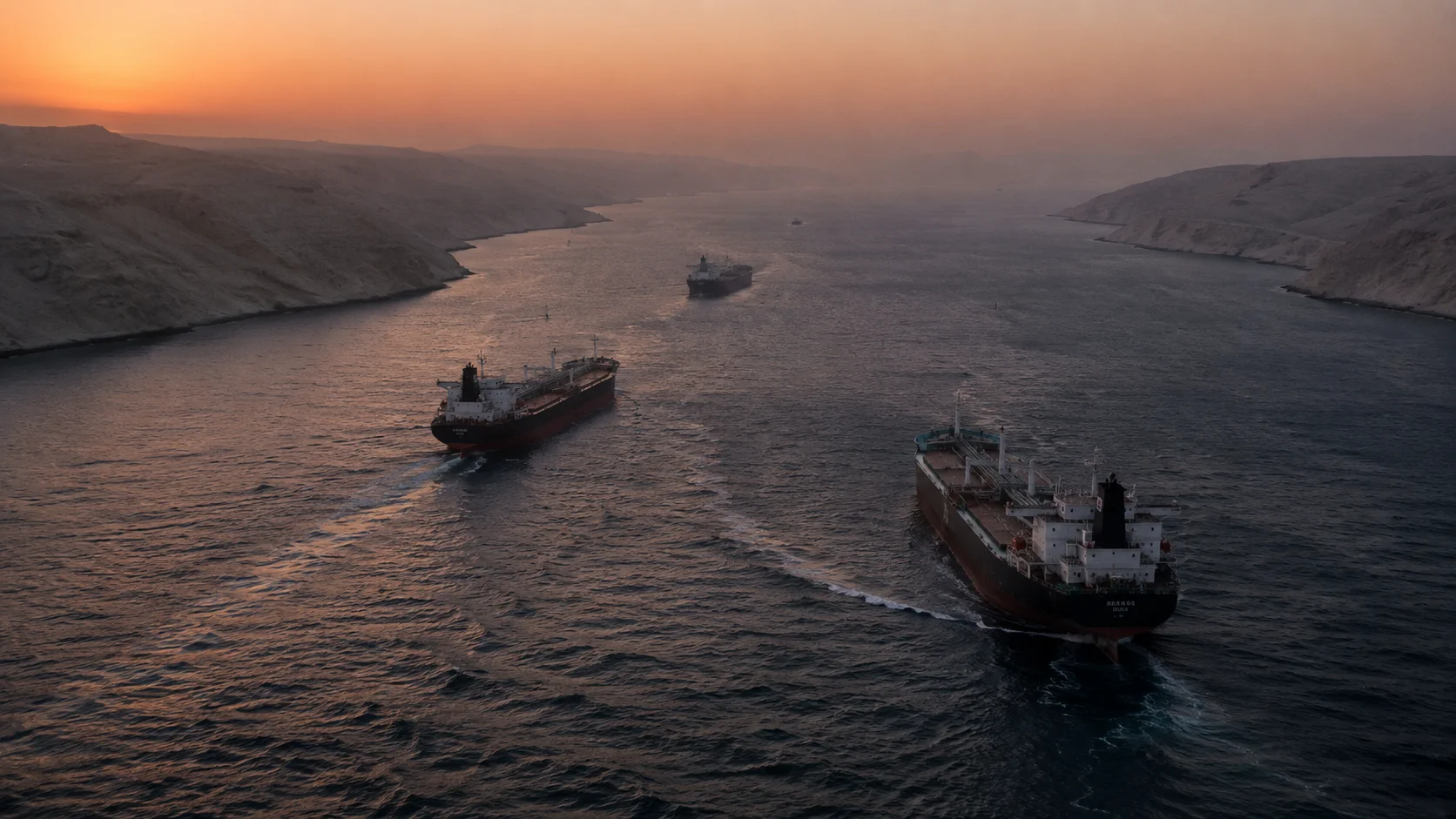
On Sunday, Donald Trump announced that the United States would deploy guided-missile destroyers, over a hundred land and sea-based aircraft, multi-domain unmanned platforms, and 15,000 service members to escort civilian cargo ships out of the Strait of Hormuz. He called it Project Freedom. He said the US would “free” the ships that have been stranded since Iran declared the strait closed on March 4.
Oil fell.
That single market reaction tells you more about the Hormuz crisis than any government press briefing. When a major military power commits 15,000 troops and a carrier group equivalent of assets to a crisis in the world’s most critical oil chokepoint — and the price of oil goes down — the market is saying something specific and important: this announcement does not resolve the problem, and the market already knew it wouldn’t.
What the Hormuz Crisis Actually Is
On March 4, 2026, Iran formally declared the Strait of Hormuz closed. This was not a blockade in the traditional military sense — it was a declaration backed by credible threat of force against any vessel attempting to transit the waterway. Tanker traffic dropped approximately 70% in the days that followed. Over 150 cargo ships anchored outside the strait rather than risk transit.
The Strait of Hormuz is the single most consequential chokepoint in global energy logistics. Approximately 20 million barrels of oil per day — roughly 20% of global supply — transits the strait under normal conditions. Closing it even partially does not just raise oil prices. It restructures the global energy market in real time, forcing buyers to seek alternative sources, rerouting tanker traffic, and repricing every energy contract that assumed Hormuz access.
Brent crude has responded accordingly, trading around $107–109 per barrel. WTI sits near $102–103. These are not panic prices — the market has had two months to reprice the disruption, and it has done so in an orderly way that reflects partial closure, not complete severance. Some traffic has continued through high-risk corridors. Some nations have been granted implicit exemptions. The closure has been managed rather than absolute.
Project Freedom does not change that calculus materially, which is why oil fell on the announcement rather than rising in anticipation of a resolution.
Why the Market Priced Project Freedom Down, Not Up
There are three reasons the market responded with skepticism to an announcement backed by substantial military force.
First, the mission scope is limited. Project Freedom is explicitly focused on escorting civilian ships from countries not affiliated with the US-Iran conflict. It is not a declaration that the US will force the strait open against Iranian opposition. Escorting a Norwegian tanker out of anchorage is different from guaranteeing safe transit for Saudi crude exports. The former is achievable. The latter is what would actually move the oil supply picture.
Second, Iran’s closure mechanism is resilient to convoy operations. Iran’s strategic posture in the Gulf depends on its ability to threaten ships with a combination of mines, anti-ship missiles, fast-attack vessels, and proxy forces across the waterway and its adjacent coastlines. A convoy escorted by US destroyers is harder to target directly — but the escort does not neutralize the threat infrastructure that makes the closure credible. As long as the threat infrastructure exists, the effective closure persists for commercial traffic that isn’t under US military protection.
Third, the announcement signals negotiation, not escalation. When a military power announces an escort mission rather than a forced reopening, it is signaling that it is managing a crisis rather than ending one. The market reads this correctly: Project Freedom is a face-saving operation that gives stranded ships a path out, buys time for diplomatic channels, and avoids direct confrontation with Iranian assets in the strait. It does not reopen the strait to the 20 million barrels per day that was flowing through it before March 4.
The Oil Price Picture for the Rest of 2026
The Hormuz closure creates a structural oil price floor that is independent of demand conditions. OPEC+ has announced production increases, but Goldman Sachs and other commodity analysts have noted that those increases are largely “on paper” — the additional barrels cannot reach global markets at normal cost while the strait remains functionally closed. Pipeline alternatives from Saudi Arabia and the UAE exist but are limited in capacity and were not designed to replace full strait throughput.
The market’s base case, priced into current Brent levels around $107–109, appears to assume:
Partial closure persists through Q2 2026. Some traffic continues through high-risk corridors. Escort operations like Project Freedom remove some of the stranded civilian ship backlog without reopening the strait commercially. Diplomatic progress is possible but not imminent.
The upside scenario for oil prices — Brent at $130 or above — requires either an Iranian escalation that moves beyond threats to direct attacks on US-escorted vessels, or a complete severance of remaining partial traffic. Neither is the base case but both are non-trivial tail risks given the active US-Iran conflict backdrop.
The downside scenario for oil — Brent back below $90 — requires a genuine diplomatic resolution that includes Iranian verification measures credible enough for commercial shipping insurers to reinstate normal transit coverage. That is not in sight in the current negotiating environment.
The most likely trajectory is rangebound crude between $95 and $115 through the summer, with volatility driven by individual military incidents rather than macro demand shifts. That’s an unusual energy market — one where geopolitical risk premium dominates the price signal — and it creates specific problems for every sector that treats energy costs as a stable input.
What This Means for Stock Market Investors
The Hormuz crisis is the most significant macro tail risk for equity markets in 2026, and it is consistently underweighted in portfolio risk discussions that focus on AI disruption, earnings growth, and trade policy.
Energy stocks are the obvious direct play, and they have performed accordingly. But the second-order effects are more significant for diversified equity portfolios.
Transportation and logistics companies face persistent cost uncertainty. Airlines, which hedge fuel costs on quarterly windows, have limited ability to manage a sustained high-oil-price environment that extends beyond their hedge books. Shipping companies face the dual burden of higher fuel costs and route disruption — many major shipping routes that passed through Hormuz are now operating on extended alternatives that add cost and transit time.
Manufacturing and industrials face input cost pressure that was not modeled into Q1 earnings guidance. Companies that gave Q2 forward guidance in January did so against a pre-crisis oil price assumption. A dozen companies across sectors will quietly revise those assumptions downward in Q2 earnings calls.
Consumer-facing businesses — particularly in markets where petrol and energy costs are passed through to consumers — face a demand headwind that compounds the macro uncertainty from tariffs and AI disruption repricing in tech. The consumer is absorbing multiple simultaneous shocks, and the Hormuz premium on energy prices is one of the least reported among them.
The Geopolitical Bet No One Wants to Make
The honest assessment of the Hormuz situation is that its resolution depends on a US-Iran negotiation that neither party has strong short-term incentives to conclude. Iran’s closure of the strait is its primary remaining leverage in the broader conflict. Giving it up in exchange for a deal requires the deal to be comprehensive enough that Iran doesn’t need the leverage anymore. That’s a high bar.
The US has strong incentives to manage the crisis without escalating to direct military confrontation. Project Freedom is exactly that: force projection that demonstrates capability without requiring a kinetic test of that capability against Iranian assets. It gives stranded ships a path out. It does not force Iran’s hand.
For investors trying to model duration of the Hormuz premium, the key variables to watch are not military announcements — those have already been priced as insufficient to resolve the crisis. The variables that move the needle are diplomatic: back-channel negotiations between US and Iranian officials, third-party mediation (likely involving Oman or Qatar), and any signal that Iran’s domestic political situation creates pressure for a face-saving resolution.
None of those variables are currently signaling imminent resolution. Until they do, oil at $100+ is the base case, and every sector that depends on energy cost stability is operating with a structural headwind that doesn’t appear in Q1 earnings but will be visible in Q2 and Q3.
The Crypto Angle
Bitcoin’s behaviour since March 4 has been notably different from its behaviour in previous geopolitical shocks. In both the 2022 Ukraine invasion and the 2024 Red Sea disruption, Bitcoin sold off sharply alongside equities as institutions reduced risk exposure broadly. In the current Hormuz crisis, Bitcoin has traded in a roughly $75,000–$83,000 range across the same two-month period — narrower and less directionally correlated with equity markets than either prior episode. The S&P 500 has moved more violently in both directions during the same window. For context on how Strategy’s Bitcoin treasury is positioned inside this environment, see our analysis of Saylor’s second buying pause of 2026.
The pattern supports the emerging institutional case that Bitcoin functions as a partial hedge against geopolitical instability — particularly in scenarios involving sanctions-adjacent financial disruption, where the question of which assets remain liquid and which get frozen becomes relevant. A Hormuz closure is precisely that kind of scenario: it disrupts dollar-denominated energy flows, raises inflation across import-dependent economies, and creates demand for assets that sit outside the disrupted settlement infrastructure.
Whether that thesis holds as the crisis extends beyond 60 days is the test that hasn’t fully run. If Brent at $109 becomes Brent at $130 and consumer inflation forces central banks to tighten into a slowdown, the pressure on all risk assets — including crypto — may override the geopolitical hedge narrative. The correlation data from two months is suggestive, not conclusive.
Reconstructing The First 72 Hours Of The Hormuz Response
In the seventy-two hours between the initial naval incident and the market’s verdict on Project Freedom, several specific things happened that the headline narrative either compressed or omitted. The communications cadence from the administration ran roughly six hours behind the Defense Department’s operational tempo, which produced a sequence of statements that were technically accurate but consistently lagged the situation on the water. The market’s first reaction priced this lag, not the underlying military posture.
The bond market moved first. The oil futures curve followed. The equity market — slowest to repricing geopolitical events at this scale — completed its read by the close of the second trading day. The order of the responses tells you which market participants had the best information and which were taking cues from the others. The headline-reading retail trader had the worst information by a wide margin and traded second-to-last, behind only the technical-strategy funds that wait for confirmation.
What the postmortem will likely show, when it is written, is that the administration was operating on a faster decision tempo than its public communications suggested, and the gap between the two was the actual story. The oil price did not fall because the operation failed. It fell because the market had time to read the gap and price it before the administration closed it. The lesson for any market participant — including the crypto traders attempting to treat Bitcoin as a geopolitical hedge — is that headlines about the event are downstream of how the responding institution actually operated. The institutional behaviour leads the price. The headline follows.
Frequently Asked Questions
What is Project Freedom?
Project Freedom is a US military operation announced by President Trump to escort civilian cargo ships stranded in and around the Strait of Hormuz since Iran declared the waterway closed in March 2026. The operation involves guided-missile destroyers, over 100 aircraft, unmanned platforms, and approximately 15,000 service members. It is focused on neutral-country civilian vessels rather than forcing a general reopening of the strait.
Why did oil prices fall on the Project Freedom announcement?
Markets interpreted Project Freedom as a crisis management operation rather than a resolution. The mission scope — escorting some civilian ships — does not restore the 20 million barrels per day of oil flow that transited the strait before the March closure. The market correctly priced this as insufficient to change the structural oil supply disruption.
How long has the Strait of Hormuz been closed?
Iran declared the strait closed on March 4, 2026. As of early May, approximately two months of partial closure have reduced tanker traffic by roughly 70% and left over 150 ships anchored outside the waterway. Some partial traffic has continued through high-risk corridors.
What is the oil price outlook for the rest of 2026?
Analysts broadly expect Brent crude to remain rangebound between $95 and $115 through Q2 and Q3 2026, barring either an escalation to direct US-Iranian military confrontation (upside to $130+) or a diplomatic breakthrough enabling commercial shipping insurers to restore normal transit coverage (downside toward $90).
How does the Hormuz crisis affect equity markets?
Energy stocks have benefited directly. Transportation, logistics, airlines, manufacturing, and consumer-facing businesses face second-order headwinds from sustained high energy costs. Companies that gave Q2 forward guidance before the crisis opened will face downward revision pressure in upcoming earnings calls.
Sources
- CNBC: Oil prices mixed as Trump plans to free ships stranded due to Mideast conflict
- Yahoo Finance: Oil slips after Trump says US will help free ships stranded in Strait of Hormuz
- Euronews: Oil markets lower as Trump vows to help ships leave Strait of Hormuz
- Wikipedia: 2026 Strait of Hormuz Crisis
- DefiCryptoNews: The Kaia Conundrum — Crypto in a Disrupted Market
- VaaSBlock — Web3 risk and governance analysis