RAIN$0.0144▼ 1.61%ETH$2,016.38▲ 0.36%SOL$82.35▲ 0.34%HYPE$66.81▲ 7.42%USDS$0.9995▼ 0.00%TRX$0.3434▲ 0.50%XAG$75.88▲ 0.30%XLM$0.2457▲ 16.95%BTC$73,552.00▼ 0.02%XRP$1.34▲ 1.73%ADA$0.2349▲ 0.20%DOGE$0.1007▲ 1.13%LEO$10.06▲ 1.24%ZEC$519.93▼ 3.60%WTI$87.36▼ 1.73%BNB$674.19▲ 5.58%BRENT$91.12▼ 2.76%XAU$4,593.00▲ 2.08%FIGR_HELOC$1.03▲ 0.00%NATGAS$3.29▲ 0.15%RAIN$0.0144▼ 1.61%ETH$2,016.38▲ 0.36%SOL$82.35▲ 0.34%HYPE$66.81▲ 7.42%USDS$0.9995▼ 0.00%TRX$0.3434▲ 0.50%XAG$75.88▲ 0.30%XLM$0.2457▲ 16.95%BTC$73,552.00▼ 0.02%XRP$1.34▲ 1.73%ADA$0.2349▲ 0.20%DOGE$0.1007▲ 1.13%LEO$10.06▲ 1.24%ZEC$519.93▼ 3.60%WTI$87.36▼ 1.73%BNB$674.19▲ 5.58%BRENT$91.12▼ 2.76%XAU$4,593.00▲ 2.08%FIGR_HELOC$1.03▲ 0.00%NATGAS$3.29▲ 0.15%
Prices as of 10:57 UTC

Author: Rhys Donnelly

  • Cisco Just Posted Record Revenue, Watched Its Stock Jump 15%, Then Cut 4,000 Jobs. The CFO Called It a Reallocation.

    Cisco Just Posted Record Revenue, Watched Its Stock Jump 15%, Then Cut 4,000 Jobs. The CFO Called It a Reallocation.

    Cisco reported record quarterly revenue on May 14, 2026. Its stock jumped 15%. Then it announced it was cutting nearly 4,000 jobs — less than 5% of its global workforce — effective immediately, with notifications beginning the same day.

    Cisco Just Posted Record Revenue, Watched Its Stock Jump 15%, Then Cut 4,000 Jobs. The CFO Called It a Reallocation.

    The CFO, Mark Patterson, was explicit about what this is. “This was really not a savings-driven restructure,” he said. It is a reallocation. The headcount is coming out of the parts of Cisco that serve legacy networking. The capital is going into silicon, optics, cybersecurity, and AI data center infrastructure. The company received $5.3 billion in AI-related infrastructure orders so far this fiscal year and expects that total to reach $9 billion by year end.

    Cisco joins a growing list of companies running the same playbook: strong results, rising AI demand, immediate headcount reduction, explicit pivot narrative. What makes Cisco different is that unlike Meta’s 2023 “year of efficiency” or Microsoft’s OpenAI-driven restructuring, Cisco is a network infrastructure company. It does not build AI models. It builds the pipes that AI runs through. The fact that it is doing this says something specific about where the AI infrastructure buildout is headed.

    What the $9 Billion AI Order Number Actually Means

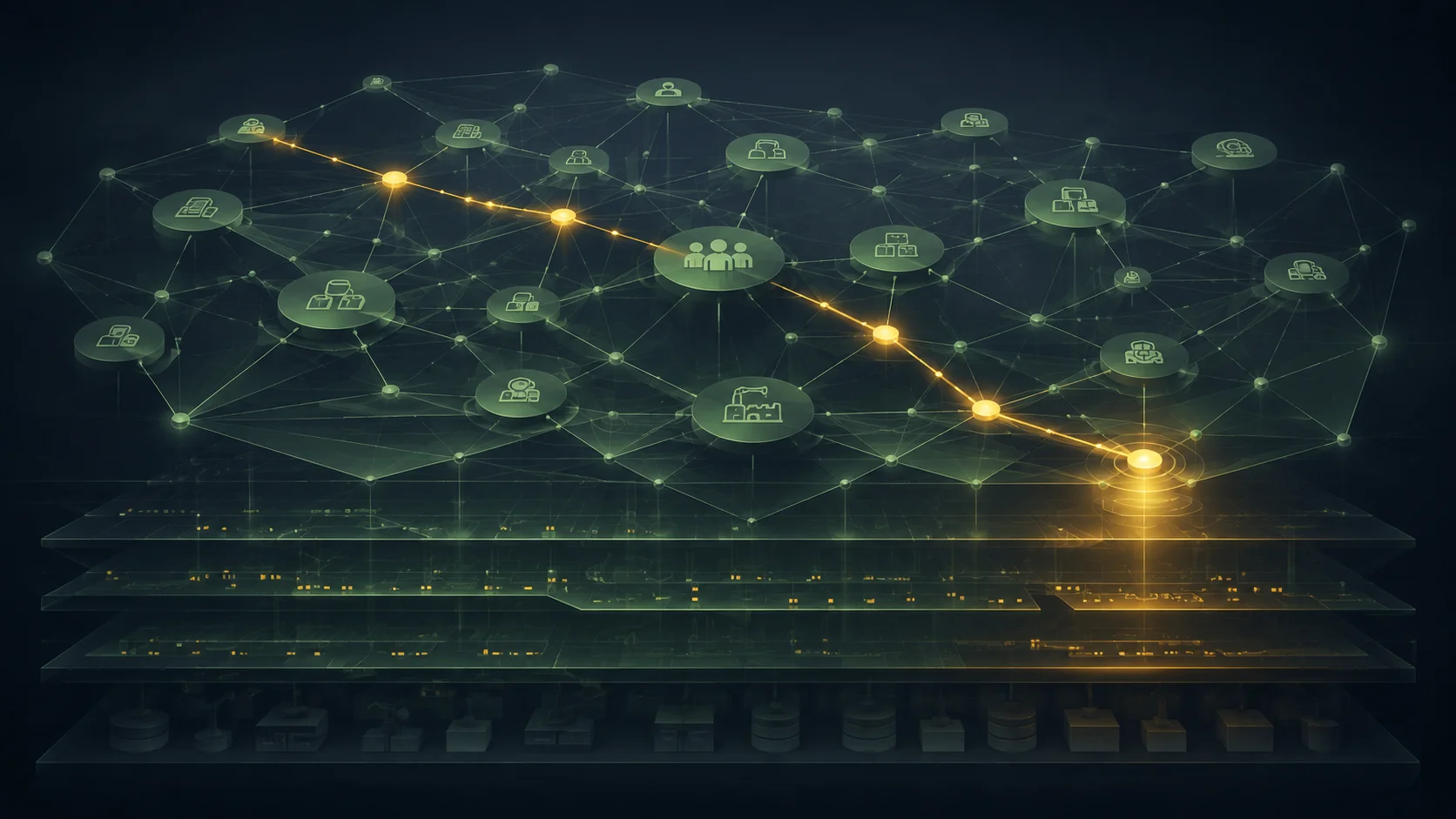
    Cisco’s fiscal year AI infrastructure orders — $5.3 billion year-to-date, projected at $9 billion by year end — are for networking equipment, silicon, and optics that go inside AI data centers. Not the GPUs. Not the storage. The interconnect: the high-speed networking that allows thousands of GPUs to communicate with each other fast enough to function as a single training cluster.

    This is the part of data center infrastructure that is hardest to visualize but most critical to performance. A GPU cluster without adequate interconnect is like a ten-lane highway that feeds into a one-lane road. The compute sits idle waiting for data. The AI training run takes three times as long. The inference latency is unpredictable. The interconnect is what allows the cluster to perform as specified.

    Cisco’s networking equipment — specifically its high-speed Ethernet switching and its silicon products for AI data centers — is competing with InfiniBand from Nvidia in the high-performance interconnect market. The $9 billion order trajectory suggests Cisco is winning a meaningful share of that market, which has historically been InfiniBand-dominated for AI training workloads.

    The significance: if AI training is increasingly being deployed on Ethernet rather than InfiniBand, it changes the competitive dynamics of the entire AI infrastructure stack. Ethernet is more interoperable, more widely understood by data center operators, and cheaper at scale. Cisco is the dominant Ethernet switching vendor. A shift toward Ethernet interconnect for AI is structurally positive for Cisco in a way that the headline revenue numbers do not fully capture.

    Record Revenue, Immediate Layoffs: The Optics and the Logic

    The juxtaposition is designed to create headlines, but the logic is straightforward. Cisco’s record revenue is coming from a specific part of the business — AI data center networking — that is growing fast. The parts of Cisco that are not growing fast are the legacy enterprise networking business: traditional campus switches, WAN routers, and the on-premise infrastructure that serves companies that have not yet migrated significant workloads to the cloud.

    The 4,000 jobs being cut are concentrated in those legacy businesses. The company is not shrinking — it is changing shape. The headcount going out managed legacy product lines. The headcount coming in (through reallocation of payroll, not net new hiring) will work on silicon design, optics engineering, AI data center architecture, and cybersecurity product development.

    The 15% stock jump on the day confirms the market agrees with the strategic logic. A network equipment company that reoriented toward AI data centers three years ago and is now booking $9 billion in AI orders is not the same company it was. The market is repricing that transformation.

    The employees receiving notification letters are experiencing the other side of the same transaction. The CFO’s “reallocation, not savings” framing is accurate as a description of corporate intent. It does not change what the experience is for the 4,000 people in the affected roles.

    Silicon and Optics: The Bet Inside the Bet

    Patterson specifically named “silicon, optics, security and AI” as the investment destinations. Silicon and optics are worth unpacking.

    Silicon refers to Cisco’s custom chip design capability. Cisco has been building its own application-specific integrated circuits — ASICs — for switching and routing for over a decade. The move toward AI data centers creates a market for custom silicon that is specialized for AI interconnect workloads: very high bandwidth, very low latency, deterministic performance under heavy load. Cisco’s Silicon One architecture was designed with these requirements in mind.

    Optics refers to the high-speed optical transceiver market. Every high-bandwidth network connection in a data center runs over fiber, and every fiber connection requires optical transceivers at both ends. AI data centers are extremely dense fiber environments — the number of transceiver ports per rack is dramatically higher than in traditional enterprise networks. Cisco’s optics business is a direct beneficiary of that density increase.

    Both silicon and optics have significant lead times, supply chain complexity, and engineering specialization requirements. By investing now — before the data center buildout peaks — Cisco is positioning to be the preferred supplier when hyperscalers are expanding capacity most aggressively. The $720 billion in grid spending Goldman identified creates a corresponding demand surge for everything that goes inside data centers, including Cisco’s core products.

    The Cybersecurity Integration Story

    The fourth investment area Patterson named is cybersecurity. Cisco has been building a cybersecurity business through acquisition for the past several years — the $28 billion acquisition of Splunk in 2024 being the most significant — and is now positioning that business as integral to AI infrastructure rather than adjacent to it.

    The logic: as AI agents and automated systems take on more consequential tasks — financial decisions, code deployment, customer data handling — the security requirements around AI infrastructure become correspondingly more stringent. A network equipment vendor that can offer integrated security at the network layer, rather than requiring a separate security product bolted on top, has a structural advantage in the AI data center market.

    This positions Cisco against a different competitive set than its traditional networking rivals. In the AI security space, Cisco’s competition is companies like CrowdStrike, Palo Alto Networks, and the emerging AI-native security vendors — not Arista Networks or Juniper. The restructuring is designed to give Cisco the engineering and go-to-market resources to compete on that wider front.

    The Broader Restructuring Pattern

    Cisco is the latest in a pattern that is becoming readable across the enterprise technology sector. The pattern: strong AI-related demand creates the financial headroom to fund a restructuring that would otherwise require cost discipline. The restructuring reallocates resources from legacy businesses to AI-adjacent ones. The market rewards the strategic pivot with a stock premium that funds future M&A or R&D.

    Microsoft ran this playbook in 2023 when it cut 10,000 jobs while simultaneously announcing its expanded OpenAI partnership and Azure AI investment. Meta ran it with its “year of efficiency” — 20,000 job cuts that freed capital for the AI infrastructure spending that produced Llama and the Meta AI integration across its products. Google ran it with the 12,000-person cut in January 2023, followed by the Gemini push.

    Cisco is running the same playbook but from a different starting position. It is not a consumer-facing AI company. It is infrastructure. Its restructuring is a bet that the infrastructure layer of the AI buildout is as durable as the application layer — and that the companies that own the physical network through which AI runs will have pricing power for as long as data center construction continues at this pace.

    The timing is deliberate. Cisco is restructuring now, while its networking business is still generating record revenue from AI orders. A company that waits until revenue declines to restructure does so from a position of weakness. Cisco is restructuring from strength — using the AI order tailwind to fund the transformation rather than relying on balance sheet or debt capacity.

    What the Employees Are Getting

    The 4,000 affected employees — or “nearly 4,000,” as Cisco characterized it — will receive pro-rated fiscal year 2026 bonuses, severance support, and access to the company’s placement services program. Notifications began May 14 globally, with the process carried out in accordance with local laws and regulations in each jurisdiction.

    Cisco’s severance packages are historically above-market — a function of its union relationships in some jurisdictions and its culture of treating exits with more transparency than most tech companies. The $1 billion in restructuring charges, of which approximately $450 million will be recognized in the following quarter, includes severance and transition costs.

    The engineering and product roles being eliminated are primarily in legacy networking areas: campus switching, traditional WAN, and on-premise infrastructure management. These are roles for which there is still demand in the broader market — enterprise companies that are not migrating to cloud-native architectures still need networking engineers who understand traditional Cisco infrastructure. The displaced employees have transferable skills in a sector that, even in its legacy form, is not disappearing.

    What This Means for the Network Infrastructure Market

    Cisco’s restructuring signals a directional shift in where the enterprise networking market is heading. Legacy networking — the campus LAN, the enterprise WAN, the on-premise data center — is not growing. AI data center networking is growing faster than any other segment in the sector’s history.

    Arista Networks, which has been focused on data center networking longer than Cisco, is experiencing the same demand surge. Juniper, now part of HPE, is also repositioning. The network equipment market is converging on AI data centers as the primary growth driver, and the companies that can supply the high-speed, low-latency interconnect that AI clusters require will command premium margins.

    The $9 billion AI order trajectory puts Cisco in a strong position for the next two to three years of data center construction. The risk is that AI training workloads consolidate further on a smaller number of hyperscaler-operated data centers, each of which has enough scale to develop proprietary networking solutions. If Google, Microsoft, and Amazon all develop custom interconnect silicon — as each is exploring — the addressable market for third-party networking equipment shrinks.

    Cisco’s silicon investment is partly a hedge against that scenario. By owning silicon IP rather than just assembling commodity components, Cisco can compete in the custom chip market even if hyperscalers build their own networking ASICs. The bet is that the market remains large enough for a third-party networking vendor even in a world where the largest buyers have proprietary silicon.

    The Cisco Restructure In Platform-Strategy Terms

    Cisco’s record-revenue-plus-layoffs pattern is the canonical late-cycle platform move. The legacy revenue layer (networking hardware) is still strong enough to fund a multi-year reinvention, and the company is using that strength to fund a transition into the AI-infrastructure layer where the next decade of margin actually lives. The layoffs are not a contradiction of the record revenue. They are the operational tax that pays for the reinvention. Every prior platform transition in computing has worked the same way — the company that absorbs the labour cost upfront earns the right to ship the new platform; the company that defers it discovers the budget pressure landed anyway, just twelve months later and with worse optics.

    What makes this case interesting is the specific bet under the bet. Cisco has chosen to compete in silicon and optics rather than in pure-software AI infrastructure, which is a strategically different position from the obvious comparison set. It is closer to NVIDIA’s position than to Microsoft’s. The bet is that the AI buildout produces persistent demand for high-end networking and interconnect hardware, and that the customer who has paid Cisco for that hardware for thirty years will continue to be the most likely buyer of the next-generation version.

    The comparison set worth tracking is not other networking vendors. It is the other platform incumbents currently negotiating the same transition under different terms — Microsoft’s customer-squeeze cycle for the platform-monetisation extraction pattern, and the early bank-and-cloud partnerships like Anchorage Digital with Google Cloud for the infrastructure-stack repositioning pattern. Each is a different theory of how the AI buildout converts into durable per-customer margin. Cisco’s theory is the most hardware-direct of the three. The next four quarters of customer-AI-order conversion will tell whether the theory is correct.

    FAQ

    Why did Cisco cut jobs if it just posted record revenue?
    The record revenue is coming from AI data center networking. The layoffs are concentrated in legacy networking businesses (campus, enterprise WAN) that are not growing. The company is reallocating capital and headcount toward silicon, optics, and AI infrastructure — where demand is accelerating.

    How many AI orders has Cisco received?
    $5.3 billion in AI-related infrastructure orders so far this fiscal year, with an expected total of approximately $9 billion by fiscal year end.

    What is Silicon One?
    Cisco’s custom ASIC architecture designed for high-performance switching and routing. It is increasingly being marketed for AI data center interconnect — the high-speed networking that allows GPU clusters to communicate efficiently.

    Is Cisco competing with Nvidia in AI?
    Not directly. Cisco competes in the networking layer — specifically high-speed Ethernet switching — which is an alternative to Nvidia’s InfiniBand for AI cluster interconnect. The two companies serve different parts of the data center stack, but there is a market-level competition between Ethernet and InfiniBand for AI training workloads.

    What happened to Cisco’s stock on the earnings day?
    Cisco stock jumped approximately 15% on the combination of record quarterly revenue, the $9 billion AI order outlook, and the restructuring announcement — which the market interpreted as a strategic acceleration rather than a sign of weakness.

    How does this compare to other tech layoffs?
    It follows the same pattern as Microsoft (2023), Meta (2023), and Google (2023) — strong AI-related demand creating financial headroom to fund a restructuring that reorients the company toward AI. Cisco is unusual in that it is an infrastructure company rather than an AI application company, which signals that the restructuring wave has reached the physical network layer.

    Sources

  • The Global Semiconductor Industry Is on Track to Hit $1 Trillion This Year. The Race Is Now About Whether the Market Has Already Priced It.

    The Global Semiconductor Industry Is on Track to Hit $1 Trillion This Year. The Race Is Now About Whether the Market Has Already Priced It.

    The Global Semiconductor Industry Is on Track to Hit $1 Trillion This Year. The Race Is Now About Whether the Market Has Already Priced It.

    Global semiconductor sales reached $298.5 billion in Q1 2026 — up 25% from the previous quarter — and the Semiconductor Industry Association says the full-year total is on track to exceed $1 trillion for the first time in history. Memory chips are the defining story: spending is forecast to jump from $216 billion last year to $633 billion in 2026, driven by AI inference infrastructure requirements. Amazon’s AI chip backlog alone sits at $225 billion. The Philadelphia Semiconductor Index is up 66% year-to-date. And a Goldman Sachs analyst is publicly warning the sector resembles 1999 — with a 25-30% correction risk embedded in current valuations. The question is whether the $1 trillion milestone marks a genuine structural shift in the semiconductor industry’s size, or whether Wall Street has simply front-run a demand cycle that hasn’t fully arrived yet.

    The Numbers Behind the $1 Trillion Forecast

    The $298.5 billion Q1 2026 figure from the Semiconductor Industry Association is the most concrete evidence that the $1 trillion full-year forecast isn’t just analyst optimism. Tom’s Hardware reported the SIA data showing a 25% quarter-over-quarter increase — a pace that, if sustained, would push full-year revenue well above the $1 trillion threshold even accounting for typical second-half seasonality.

    The composition of that growth matters. Memory — DRAM and NAND flash — is driving the acceleration. Gartner’s latest forecast puts memory chip spending at $633 billion for 2026, up from $216 billion in 2025 — nearly a 3x increase in a single year. The driver is AI inference infrastructure: the model serving clusters that hyperscalers are building require enormous amounts of high-bandwidth memory (HBM) attached to each GPU, and HBM is the fastest-growing and highest-margin segment of the memory market.

    Micron has been the most visible beneficiary. The company’s stock is up over 750% in the past year, which reflects both genuine HBM demand and the market’s willingness to price in multi-year infrastructure build requirements. AMD’s CEO noted that “agents are really driving tremendous demand in the overall AI adoption cycle” — confirmation that the demand signal comes from AI agent deployment infrastructure, not just training workloads.

    Amazon’s $225 Billion AI Chip Backlog

    Amazon’s disclosure of a $225 billion AI chip backlog is the single most striking data point in the current semiconductor cycle. Motley Fool reported that Amazon’s custom chip business — primarily Trainium 2 and Inferentia chips designed for AI training and inference — is growing at triple-digit year-over-year percentages, with a current annual revenue run rate above $20 billion and nearly 40% quarter-over-quarter growth in Q1.

    The $225 billion backlog has two implications. First, it confirms that the hyperscaler custom chip programs — Amazon Trainium, Google TPUs, Meta’s MTIA — are scaling far faster than Wall Street was modeling a year ago. Second, it suggests that the custom silicon investment is not displacing Nvidia GPU demand but supplementing it: the total compute requirements for AI agent deployment are large enough that hyperscalers are buying every chip they can produce, whether Nvidia H100s, their own custom ASICs, or AMD MI300X accelerators.

    For Nvidia’s upcoming May 20 earnings report, this context is important. The custom chip backlog at Amazon doesn’t mean Nvidia is losing share — it means the overall addressable market for AI compute is larger than the Nvidia-centric view of the semiconductor cycle suggested. That’s bullish for the entire semiconductor supply chain, including memory, networking silicon, and power management chips.

    The “Changing of the Guard” in AI Chips

    While Nvidia has dominated the AI chip narrative since 2023, CNBC reported that Wall Street is increasingly moving to Intel, AMD, and Micron as the AI chip trade rotates. Goldman Sachs and Bernstein both upgraded AMD to buy ratings in May, citing CPU tailwinds as AI agents require more general-purpose compute alongside GPU acceleration.

    The narrative shift reflects something real about AI workload composition. Training large models is GPU-dominated and Nvidia-centric. But inference — serving those models to users and agents at scale — has a different compute profile. Inference workloads run on a mix of GPUs, CPUs, and custom ASICs depending on latency and throughput requirements, and AMD’s Instinct accelerators and Intel’s Gaudi 3 are competitive in inference at a meaningfully lower price point than Nvidia’s H100/H200 stack.

    The inference market shift is already visible in design wins — AMD’s MI300X has taken meaningful market share in inference-optimized data centers, and Intel’s Gaudi 3 is the choice for cost-sensitive inference deployments where Nvidia’s premium isn’t justified. As the AI infrastructure market matures from “build training clusters” to “scale inference economically,” the competitive dynamics favor a broader set of chip vendors than the training-era market did.

    The Valuation Warning Nobody Wants to Hear

    Set against the demand data is an analyst warning that the Philadelphia Semiconductor Index — up 66% year-to-date — is pricing in a perfection scenario that history suggests is dangerous. The specific comparison is to 1999: a period when genuine technological transformation (the internet) intersected with speculative excess to create a valuation overhang that took years to unwind.

    The analyst case for caution runs as follows. Semiconductor cycles are inherently cyclical — demand surges create supply investment, supply investment creates overcapacity, overcapacity creates pricing pressure and margin compression. The $725 billion in hyperscaler AI capex committed for 2026 represents a massive pull-forward in chip demand. When that infrastructure is built, the incremental demand signal weakens — and stocks priced for perpetual growth derate sharply.

    The 25-30% correction risk estimate for the PHLX isn’t a prediction that AI infrastructure demand is fake. It’s a prediction that stocks up 66% YTD are priced for a scenario where nothing goes wrong: no macro slowdown, no trade restriction escalation affecting TSMC, no Nvidia supply shortfall, no custom silicon displacing GPU demand faster than expected. Any one of those variables moving adversely is enough to trigger the kind of valuation reset the 1999 comparison implies.

    TSMC and the Concentration Risk

    The $1 trillion semiconductor forecast depends heavily on TSMC’s ability to produce leading-edge chips at scale. TSMC manufactures over 90% of the world’s most advanced semiconductors — the chips that power Nvidia’s H100s, AMD’s Instinct accelerators, Apple’s M-series, and Amazon’s Trainium. This concentration creates a single-point fragility that the semiconductor trade is pricing through, rather than pricing in.

    The Taiwan geopolitical risk isn’t new information, but it becomes materially more relevant as the stakes of the semiconductor cycle increase. A $1 trillion industry with 90%+ of advanced production at a single fab cluster in Taiwan creates a supply security vulnerability that no amount of CHIPS Act investment in U.S. domestic fabs has yet resolved. TSMC’s Arizona fab is operating, but advanced node production at U.S. scale is years away from providing meaningful supply redundancy.

    For investors pricing the semiconductor supercycle, TSMC concentration risk is the asymmetric downside that doesn’t appear in the earnings models but sits behind every bullish forecast. The demand is real; the question is whether the supply infrastructure can consistently deliver it from a geography that multiple governments consider a strategic risk.

    Crypto and Web3 Mining Implications

    A $1 trillion semiconductor industry has specific implications for the crypto mining and on-chain compute ecosystem. The HBM supply crunch that’s driving Micron’s stock up 750% is the same supply chain that affects the availability and pricing of consumer and enterprise GPUs — the hardware that runs Ethereum validator nodes, ZK proof generation, and decentralized compute networks.

    As HBM allocation prioritizes hyperscaler AI clusters, the availability of high-performance memory for non-AI applications tightens. This creates a secondary market dynamic for mining and decentralized compute: operators running Bittensor (TAO), io.net, and Akash Network infrastructure are competing for GPU hardware against the largest companies in the world, which are buying in hundred-thousand-unit quantities with multi-year contracts.

    ZK proof computation — the compute-intensive cryptographic foundation of Ethereum Layer 2 scaling — is directly affected by the inference chip market. zkSync, StarkNet, and Polygon zkEVM all run proof generation on GPU clusters that are subject to the same supply and pricing dynamics as AI inference hardware. A semiconductor supercycle that concentrates the best chips at hyperscalers isn’t neutral for ZK infrastructure — it raises the hardware cost of decentralized proof generation relative to centralized alternatives.

    The flip side is that the custom ASIC trend — Amazon Trainium, Google TPUs — accelerates the development of application-specific proof generation hardware. As ZK proof workloads scale, dedicated ZK ASICs become economically viable. Several teams are already building ZK-specific accelerators, and the semiconductor supercycle is making the investment case for that specialization stronger, not weaker.

    The Mental Model Worth Carrying Into A $1 Trillion Industry

    The right frame for any forecast that hits a trillion-dollar industry milestone is to ask which part of the forecast is mechanical and which part is reflexive. The mechanical part is the demand math — orders, capacity, lead times, the parts you can verify with primary sources. The reflexive part is the price-and-narrative loop, where strong demand drives high valuations, high valuations drive more capacity announcements, capacity announcements drive more narrative, and narrative pulls in capital that flatters the demand math.

    The current semiconductor cycle has both layers running. The mechanical layer is genuinely strong — Amazon’s $225 billion backlog is not a narrative. The reflexive layer is also running, which is why valuation warnings keep appearing in the same coverage as bullish demand forecasts. Both are correct simultaneously, which is what makes the cycle hard to read.

    The mental model worth carrying is to separately track the mechanical and reflexive signals rather than collapsing them into a single bullish or bearish call. Strong demand + stretched valuations is not a contradiction. It is the standard texture of every late-cycle commodity boom, and the question is not whether both are true (they are) but which one breaks first when stress arrives. The mechanical layer usually compresses last and recovers fastest. The reflexive layer usually breaks first and recovers slowest. Anyone planning capacity or capital deployment against this cycle should be planning against the reflexive break, not the mechanical one.

    FAQ

    Why are global semiconductor sales on track to hit $1 trillion in 2026?
    The primary driver is AI infrastructure investment. The Magnificent Seven and other hyperscalers have committed approximately $725 billion in capital expenditure for 2026, a significant portion of which goes to semiconductor procurement — GPUs, custom AI chips, high-bandwidth memory, and networking silicon. Q1 2026 semiconductor sales of $298.5 billion already represent a 25% quarter-over-quarter increase, and memory chip spending alone is forecast to jump from $216 billion in 2025 to $633 billion in 2026 — nearly a 3x increase driven by HBM requirements for AI model serving. The combination of AI training, inference, and the broader digital infrastructure build creates demand across virtually every semiconductor category simultaneously.

    What is Amazon’s $225 billion AI chip backlog?
    Amazon’s AI chip backlog refers to committed future orders for its custom AI chips — primarily Trainium 2 training chips and Inferentia inference chips — developed through Amazon Web Services. The $225 billion figure represents the value of forward orders and deployment commitments from AWS customers who have pre-committed to AI compute capacity. Amazon’s custom chip business is growing at triple-digit year-over-year rates with an annual revenue run rate above $20 billion. The backlog is significant because it confirms that custom silicon programs are scaling faster than Wall Street models anticipated — and that total AI compute demand is large enough to support both Nvidia GPU procurement and hyperscaler custom chip deployment simultaneously.

    Is the Philadelphia Semiconductor Index overvalued at up 66% YTD?
    A Goldman Sachs analyst has publicly compared the current semiconductor index valuation to 1999 and warned of a 25-30% correction risk. The concern isn’t that AI demand is fake — it’s that stocks up 66% YTD are priced for perfect execution: sustained demand, no supply disruptions, no macro headwinds, no faster-than-expected displacement of GPU demand by custom silicon. Semiconductor cycles are historically cyclical, and a demand surge of this magnitude typically creates supply investment that eventually produces overcapacity and margin compression. Whether 2026 marks the peak of the current cycle or a midpoint in a multi-year supercycle is the central debate in semiconductor investing.

    What does the memory chip shortage mean for AI infrastructure?
    High-bandwidth memory (HBM) — the specialized memory attached to AI accelerator chips — is in severe supply constraint. Each Nvidia H100 GPU requires approximately 80GB of HBM3e memory, and data center clusters running thousands of GPUs require enormous HBM allocation. Gartner’s forecast of $633 billion in 2026 memory chip spending, up from $216 billion, reflects the compounding of HBM demand with standard DRAM and NAND requirements from the broader AI infrastructure build. Micron, SK Hynix, and Samsung are the primary HBM suppliers, and their production capacity is fully committed through 2026 and into 2027 — meaning any demand shortfall in AI infrastructure could create inventory build and price pressure in the memory market.

    How does the semiconductor supercycle affect crypto and Web3 infrastructure?
    The semiconductor supercycle has three main effects on crypto and Web3. First, GPU supply prioritization for hyperscaler AI clusters tightens availability and raises costs for decentralized compute networks (Bittensor, io.net, Akash) and mining operations that depend on the same hardware. Second, ZK proof generation — the compute foundation of Ethereum L2 scaling — runs on GPU infrastructure subject to the same supply dynamics, raising the cost of decentralized proof generation relative to centralized alternatives. Third, the custom ASIC trend accelerating through the AI cycle is creating the economic conditions for ZK-specific accelerator chips, which would dramatically reduce the cost of proof generation at scale and benefit the entire Ethereum Layer 2 ecosystem.

    Sources

  • Big Tech Is Cutting 100,000 Workers to Fund Its $725 Billion AI Bet. Zuckerberg Said the Quiet Part Out Loud.

    Big Tech Is Cutting 100,000 Workers to Fund Its $725 Billion AI Bet. Zuckerberg Said the Quiet Part Out Loud.

    Big Tech Is Cutting 100,000 Workers to Fund Its $725 Billion AI Bet. Zuckerberg Said the Quiet Part Out Loud.

    Mark Zuckerberg told Meta employees in April that the 8,000 job cuts effective May 20 are a “direct consequence” of the company’s AI infrastructure budget — they chose GPUs over payroll. He’s not alone. Amazon has cut 30,000 corporate roles since October, Microsoft has offered buyouts to 8,750 U.S. employees, and Alphabet is mid-way through 1,500 reductions. The combined total across Big Tech in 2026 exceeds 100,000 workers. Over the same period, Meta, Amazon, Microsoft, and Alphabet have committed a collective $725 billion in AI capital expenditure — up 77% year-over-year. The trade is explicit: human labor is the only balance-sheet cost flexible enough to partially offset a compute build-out of this scale, and the companies making it don’t appear to be apologizing for the arithmetic.

    The Numbers That Define the Trade

    Start with the scale of what’s being cut. According to Invezz’s analysis, 81,747 tech workers lost jobs in Q1 2026 alone — the highest quarterly figure in at least two years. April added another 83,387 announced cuts, up 38% from March’s 60,620. Layoff trackers now put the 2026 year-to-date figure above 100,000, with some estimates approaching 150,000 when counting voluntary departures.

    Now set against it what’s being bought. Microsoft’s calendar-year 2026 capex sits at $190 billion. Amazon committed $200 billion. Meta raised full-year guidance to $125–145 billion. Alphabet’s Q1 2026 capex print was $36 billion — up 107% year-over-year — against a Google Cloud backlog of $462 billion, nearly doubled sequentially. All of it is earmarked for data centers, GPUs, custom chips, and the power infrastructure required to run them.

    The arithmetic is stark. A senior software engineer at a U.S. tech company costs $200,000–$350,000 annually in total compensation. Even at the high end, cutting 100,000 engineers saves roughly $35 billion per year — less than 5% of the combined capex commitment. The layoffs don’t fund the AI build-out. What they do is demonstrate to capital markets that the companies making the largest infrastructure bets in corporate history are maintaining cost discipline on every controllable line item, even as fixed infrastructure costs explode.

    What Gets Cut, What Gets Hired

    The 100,000 cuts are not evenly distributed across job functions. CNBC’s analysis of the 2026 layoff data shows the roles being eliminated concentrate in customer support, quality assurance, content moderation, and middle management — the functions AI systems have made partially redundant or that organizational flattening has eliminated. The roles going unfilled or being backfilled at dramatically lower headcount with AI tooling include document processing, data labeling (now largely automated), first-line technical support, and repetitive coding tasks.

    Meanwhile, 275,000 AI-related job postings were sitting open in the United States at the same moment Q1’s record cuts were announced. Machine learning engineers, AI safety researchers, data infrastructure specialists, and MLOps practitioners are in acute shortage. The tech industry isn’t replacing workers with AI — it’s replacing certain types of workers while aggressively bidding for a different, much smaller cohort of workers whose output determines how well the AI systems function.

    Zuckerberg’s framing is the most candid version of this dynamic. Meta’s AI infrastructure spending required a trade-off between compute and headcount — the company chose compute. For Meta’s specific business model, where AI-driven ad targeting efficiency is the primary revenue driver, that trade makes sense: a better Advantage+ model generates more ad revenue per dollar than a larger content moderation team. The logic is harder to defend when the cuts hit people whose work isn’t being automated — it’s being eliminated because the GPU bill needs to be partially offset somewhere.

    Microsoft: 125,000 Departures and a $190 Billion Bet

    Microsoft’s situation is the most complex. The 8,750 voluntary buyout offers to U.S. employees are part of a broader pattern: Microsoft has overseen roughly 125,000 total departures through a combination of layoffs, voluntary exits, and performance-driven separations since early 2025. This is a company that employed approximately 221,000 people at its 2023 peak — it has reduced its workforce by more than half while committing $190 billion to AI infrastructure for 2026 alone.

    The stated plan is to increase total AI capacity by over 80% in 2026 and roughly double the data center footprint over the next two years. Azure’s commercial revenue backlog of $392 billion — up 51% year-over-year — provides the demand signal that justifies the infrastructure investment. The workforce reduction is the supply-side adjustment: Microsoft is rebuilding itself as a smaller, more AI-intensive organization where each remaining employee operates with dramatically higher AI leverage.

    The practical consequence is visible in product velocity. Microsoft Copilot has been integrated across the entire Microsoft 365 suite at a pace that would have required a much larger engineering team to sustain five years ago. The same AI tools being used to cut headcount are enabling the surviving engineers to ship faster — which is the intended flywheel, even if the transition is brutal for the workers caught in the middle.

    Amazon’s 30,000: The Corporate Function Contraction

    Amazon’s cuts are concentrated in corporate and technology roles rather than its warehouse and logistics workforce. The 30,000 corporate cuts since October represent roughly 10% of Amazon’s white-collar workforce — a significant contraction for a company that added hundreds of thousands of employees during the pandemic expansion.

    AWS’s $200 billion capex commitment sits alongside these cuts as the clearest illustration of where Amazon is allocating resources. The cloud infrastructure investment is a bet that enterprise AI demand will drive AWS revenue growth for years — and that the corporate functions being eliminated are less valuable than the data center capacity being added. Amazon CEO Andy Jassy has been direct that AI is changing what roles are needed inside the company, not just what services it offers externally.

    The Skills Mismatch and What It Means for Tech Labor Markets

    The 275,000 open AI job postings running alongside 100,000+ cuts defines the central problem in tech labor markets in 2026: the skills the industry is shedding don’t match the skills it needs. A content moderator, a mid-level program manager, or a first-line support engineer cannot retrain into an MLOps role or an AI safety researcher position in a year. The gap is structural, not bridgeable through upskilling programs at the scale and speed required.

    For workers caught in this mismatch, the options are limited. A subset will move into adjacent roles where AI augments rather than replaces — a content moderator who becomes a trust and safety policy analyst reviewing AI system outputs, for example. Others will move to smaller companies or industries where AI has not yet penetrated as deeply. The remainder face a genuinely difficult labor market transition that no amount of official optimism about AI creating new job categories changes on a five-year timeline.

    The Washington Post noted that layoffs at Amazon, Meta, and Microsoft aren’t all about AI — some reflect post-pandemic over-hiring corrections and organizational restructuring that would have happened regardless of AI. That’s true, but it doesn’t change the net outcome: the biggest technology companies in the world are simultaneously running the largest hiring sprees in AI-specific roles in history and the largest general headcount reductions in a decade.

    Crypto and Web3 Implications

    The mass displacement of tech workers from Big Tech is generating a wave of skilled engineers, product managers, and researchers who are available to Web3 and crypto-native organizations for the first time. Historically, the salary premium at Google, Meta, Amazon, and Microsoft priced most Web3 projects out of competing for these candidates. When those workers are on the market following involuntary exits, the competitive landscape changes.

    Decentralized compute is directly relevant to the AI infrastructure story. Akash Network, which provides decentralized GPU compute, and io.net, which aggregates distributed computing capacity for AI inference workloads, offer alternatives to the hyperscaler infrastructure being built with $725 billion in capex. As Big Tech’s compute build-out concentrates AI infrastructure power, on-chain alternatives to centralized GPU clusters become a more important part of the ecosystem for developers who don’t want to depend on AWS, Azure, or Google Cloud.

    Render Network (RNDR) similarly provides decentralized GPU rendering that overlaps with AI inference use cases. These aren’t direct competitors to hyperscaler infrastructure at enterprise scale today — but the displacement of 100,000 tech workers into an economy where AI compute is increasingly centralized creates both the talent pool and the ideological motivation for building decentralized alternatives. Crypto AI infrastructure investment is accelerating precisely because the centralization trend in foundation model compute is legible and concerning to crypto-native builders.

    DAOs and decentralized protocol teams are also absorbing some of the displaced talent — not at the volume to offset the numbers, but enough to meaningfully upgrade the technical quality of crypto-native development teams. The irony is that Big Tech’s AI-driven workforce contraction is, in part, staffing the decentralized alternatives to Big Tech’s AI infrastructure.

    The Disruptor’s Dilemma Hiding Inside The Layoff Trade

    The $725B-for-100,000-jobs trade looks, at first reading, like routine cost discipline. The Innovator’s Dilemma frame reveals something more uncomfortable. Each of the firms making these cuts is the incumbent of the prior platform era — the cloud era for Microsoft and Amazon, the search era for Google, the social era for Meta. The cuts are not random. They are concentrated in the corporate functions that supported the prior platform’s go-to-market motion, and the hiring (where it exists) is concentrated in the AI infrastructure and product roles that the new platform requires. This is the textbook pattern of an incumbent attempting to fund a discontinuous transition by harvesting the cost base of the predecessor business.

    The historical base rate on this is uncomfortable. Of the Fortune 50 incumbents that attempted similar mid-platform pivots in prior tech transitions, roughly 30% successfully reorganised around the new platform and earned its margins, 40% reorganised but lost meaningful market share to entrants that did not carry the same cost legacy, and 30% never successfully transitioned and ceded the new platform to entrants entirely. None of the current Mag7 firms know which third they will end up in. The capex commits buy them the option to compete; they do not guarantee the outcome.

    The category to watch is not the layoffs. It is the entrant companies whose cost base is native to the AI platform. Those entrants are not yet visible at scale because they are still in their early-stage funding cycle. They will be visible in five years, and the question is whether the incumbent reorganisations completed in time. The same dynamic is visible in the coordinated $700B capacity race — incumbents spending to avoid being outspent, while the structural threat sits in the still-unfunded entrants.

    FAQ

    How many tech workers have been laid off in 2026 so far?
    Layoff trackers put the 2026 year-to-date figure above 100,000 as of early May, with some estimates approaching 150,000 when including voluntary departures and quiet attrition. The largest contributors include Amazon (approximately 30,000 corporate cuts since October), Meta (8,000 cuts effective May 20), Microsoft (8,750 voluntary buyout offers plus prior layoffs totaling roughly 125,000 departures since 2025), and Alphabet (approximately 1,500 ongoing reductions). Q1 2026 alone saw 81,747 confirmed job losses — the highest quarterly figure in at least two years — and April added a further 83,387 announced cuts.

    Is AI directly responsible for the tech layoffs?
    AI is a contributing factor but not the sole cause. Some of the 2026 cuts are corrections to post-pandemic over-hiring that inflated headcount at companies like Amazon and Meta beyond sustainable levels. However, Zuckerberg explicitly stated that Meta’s May cuts are a “direct consequence” of the AI infrastructure budget — framing the trade as GPUs versus payroll. CNBC’s analysis shows the roles being cut — content moderation, QA, first-line support, middle management — are precisely those most displaced by AI automation. The honest answer is that AI automation and organizational restructuring are both operating simultaneously, and the workers most vulnerable to AI replacement are also the ones most exposed to headcount reduction.

    What roles are actually being hired in tech despite the layoffs?
    275,000 AI-specific job postings were open in the U.S. at the same time as Q1’s record cuts. The high-demand roles are machine learning engineers, AI safety researchers, data infrastructure specialists, MLOps practitioners, and AI product managers. These roles require deep technical expertise that cannot be quickly acquired through retraining, which is why the tech industry faces acute talent shortages in AI even as it cuts aggressively in other functions. The structural problem is that the supply of workers capable of filling AI specialist roles is far smaller than the 275,000 open positions, while the workers being laid off generally don’t have the profiles to fill them.

    What is the total AI capital expenditure commitment from Big Tech in 2026?
    Meta, Amazon, Microsoft, and Alphabet have collectively committed approximately $725 billion in capital expenditure for 2026, up roughly 77% year-over-year. Microsoft leads at $190 billion, Amazon committed $200 billion, Meta raised guidance to $125–145 billion, and Alphabet printed $36 billion in Q1 capex alone — up 107% year-over-year — against a Google Cloud backlog of $462 billion. This spending covers data center construction, GPU and custom chip procurement, networking infrastructure, and power systems. It represents the largest infrastructure investment in corporate history, executed simultaneously by multiple companies in a single calendar year.

    How are displaced tech workers connecting to crypto and Web3?
    The displacement of high-skill tech workers from Big Tech is creating a talent pipeline into Web3 and crypto-native organizations that historically couldn’t compete with Big Tech compensation packages. Decentralized compute networks like Akash Network, io.net, and Render Network are attracting developers and researchers who left Big Tech during layoffs and are ideologically motivated to build alternatives to the centralized AI infrastructure being funded by $725 billion in hyperscaler capex. DAOs and protocol teams are also recruiting from the displaced cohort. The numbers are small relative to total layoffs, but the quality of talent entering Web3 from Big Tech exits is meaningfully upgrading crypto-native development teams.

    Sources

  • The Magnificent Seven Committed $700 Billion to AI in 2026. The Market Is Already Deciding Who Spent It Right.

    The Magnificent Seven Committed $700 Billion to AI in 2026. The Market Is Already Deciding Who Spent It Right.

    The Magnificent Seven Committed $700 Billion to AI in 2026. The Market Is Already Deciding Who Spent It Right.

    The Magnificent Seven collectively committed between $650 billion and $700 billion in AI capital expenditure for 2026 — nearly double the prior year — and their Q1 earnings just told the market which bets are paying off. The verdict isn’t uniform: Alphabet gained 10% on earnings day while Meta fell 8%, Google Cloud grew 63% year-on-year while Azure held at 40%, and Apple is projecting 17% revenue growth on $3.3 billion in AI-driven developer spend. With Nvidia’s Q1 report still to come on May 20, the semiconductor cycle that underpins all of this is unresolved. What’s clear from the data already in: the market is repricing AI infrastructure investment from a faith-based story to a returns-accountability story — and some of the Magnificent Seven are winning that test more convincingly than others.

    The Capex Numbers That Defined the Quarter

    The combined AI capital expenditure figure of $650–700 billion for 2026 is the single most important data point from this earnings season. To calibrate it: the entire U.S. semiconductor industry generated roughly $290 billion in revenue in 2025. The Magnificent Seven are collectively spending more than twice that on AI infrastructure in a single year — chips, data centers, networking, and the power infrastructure to run all of it.

    The breakdown by company reveals the conviction levels. Alphabet committed $75 billion for the full year, front-loaded into Q1, which is why Google Cloud’s infrastructure capacity expanded faster than Azure or AWS this quarter. Meta’s capex guidance came in at $64–72 billion — and the market sold it off 8% on earnings day because the revenue acceleration that would justify that spending hasn’t materialized at the scale the multiple implied. Microsoft held its capex guidance steady while flagging that Azure capacity constraints are easing, which investors read as a signal that the hyperscale arms race is approaching a consolidation point.

    Apple’s position is strategically different. Its $3.3 billion AI developer infrastructure spend is smaller in absolute terms but carries higher margin implications — Apple Intelligence is a software and services differentiator, not a cloud infrastructure play. The 17% revenue growth projection tied to AI feature adoption is the most direct link between AI investment and consumer revenue growth in the Magnificent Seven.

    Google Cloud at 63%: The Infrastructure Bet Paying Off

    Google Cloud’s 63% year-on-year growth in Q1 2026 is the standout number from this earnings cycle. For context, Azure grew 40% over the same period — itself a strong result — and AWS continues to hold the largest cloud market share position while growing at a slower rate. Google has been the structural underdog in enterprise cloud for years; a 63% growth rate against Azure at 40% is a meaningful shift in competitive momentum.

    The driver is Gemini. Enterprise customers are increasingly selecting cloud infrastructure based on the native AI model available, and Google’s ability to bundle Gemini 2.0 Pro into Google Cloud Workspace, BigQuery, and Vertex AI has converted AI model preference into cloud switching. The companies that standardized on Gemini for enterprise AI applications are, in many cases, also migrating workloads to Google Cloud to reduce latency and simplify billing.

    Alphabet CEO Sundar Pichai framed the Q1 result explicitly as a return on the $75 billion capex commitment — infrastructure built in 2024 and early 2025 is now generating cloud revenue in 2026. That’s a roughly 18-month lag between data center investment and recognizable revenue, which is an important benchmark for evaluating whether Meta’s 2026 capex will generate comparable returns by late 2027.

    Meta’s 8% Drop: When the Market Asks for Revenue to Match the Story

    Meta’s Q1 earnings were, by most operational metrics, good. Revenue grew, ad revenue held up, user numbers were stable. The 8% post-earnings drop wasn’t a reaction to weak results — it was a market repricing of the gap between Meta’s AI capex commitment ($64–72 billion for the year) and the revenue model that justifies it.

    Meta’s AI investment thesis runs through two vectors: AI-driven ad targeting efficiency and the long-term Reality Labs / metaverse infrastructure play. The first is already working — Meta’s Advantage+ AI ad system continues to improve ROAS for advertisers, and that’s reflected in CPM pricing. But the incremental revenue lift from AI ad optimization isn’t growing fast enough to justify the capex multiple that was priced in before earnings.

    The Reality Labs losses continue — over $4 billion in Q1 alone — and the path from AI infrastructure investment to Reality Labs revenue remains a multi-year story that institutional investors are discounting heavily. The market isn’t questioning Meta’s AI execution; it’s questioning the pace at which that execution converts to earnings per share. At a P/E multiple built on AI growth expectations, that pace matters more than it would for a value stock.

    The Semiconductor Cycle and Nvidia’s May 20 Report

    Everything in this earnings cycle points toward Nvidia’s Q1 report on May 20 as the next major data point for the AI infrastructure trade. The Philadelphia Semiconductor Index (PHLX) is up approximately 50% year-to-date — a run built on the assumption that $650–700 billion in hyperscaler capex translates directly into GPU orders. Nvidia’s results will tell the market whether that assumption is accurate or whether the capex is being allocated more broadly (custom silicon, networking, power infrastructure) than the semiconductor index pricing implies.

    The custom silicon subplot is material. Both Google (TPUs) and Amazon (Trainium/Inferentia) have been scaling their own AI chip programs specifically to reduce Nvidia dependency. AMD and Intel are also competing aggressively on inference workloads where Nvidia’s H100/H200 premium is harder to justify than on training runs. If Nvidia’s Q1 data center revenue growth has decelerated even slightly from the trajectory the market is pricing, the semiconductor index has significant downside from current levels.

    Conversely, if Nvidia’s data center revenue comes in above consensus — which it has in every prior quarter since 2023 — the AI infrastructure trade gets another leg, and the hyperscaler capex numbers become a forward indicator for continued GPU orders through the back half of 2026.

    Microsoft Azure at 40%: Capacity Constraints Easing

    Microsoft’s Azure growth at 40% year-on-year would have been celebrated in any prior quarter. In the context of this earnings cycle it reads as slight underperformance relative to Google Cloud, which was amplified by Microsoft’s disclosure that Azure capacity constraints — which suppressed growth through 2024 and early 2025 — are now easing.

    The capacity constraint narrative is actually a positive signal for the medium term. Microsoft built aggressively through 2024, and the new data center capacity is coming online in 2026. As that capacity becomes available, Azure growth should accelerate in Q2 and Q3 — which is why Satya Nadella’s forward guidance was more bullish than the headline 40% number implied.

    The OpenAI relationship remains Microsoft’s clearest AI differentiator. Azure OpenAI Service — GPT-4o, DALL-E 3, and Whisper available via Azure enterprise agreements — continues to drive enterprise AI adoption that routes through Azure rather than Google Cloud or AWS. The question is whether that advantage holds as Google’s Gemini enterprise integrations mature and as AWS’s model marketplace broadens.

    Crypto and Web3 Infrastructure Implications

    The Magnificent Seven’s AI capex cycle has direct implications for the crypto and Web3 infrastructure stack. The $650–700 billion being deployed into data centers, GPU clusters, and AI networking infrastructure is the same physical infrastructure that runs the cloud services crypto protocols depend on — and the same chips that blockchain validators and ZK proof generators run on.

    More specifically, the AI inference acceleration being built into hyperscaler infrastructure is directly relevant to zero-knowledge proof computation. ZK proofs — the cryptographic foundation of Ethereum L2s like zkSync, StarkNet, and Polygon zkEVM — are computationally intensive, and faster GPU/TPU infrastructure reduces proof generation time and cost. As hyperscaler AI investment drives GPU performance improvements, ZK proof costs decline in parallel.

    The stablecoin and tokenization narrative also runs through this infrastructure layer. As stablecoin legislation advances, the institutional payment infrastructure being built on bank stablecoins will run on the same cloud layers these companies are expanding. Google Cloud’s Anchorage partnership for agentic banking is one example — the 63% growth in Google Cloud isn’t just AI model inference; it’s the broader enterprise migration to cloud-native financial infrastructure that includes crypto settlement rails.

    Chainlink and Pyth Network as oracle infrastructure, Ethereum as the settlement layer for institutional tokenization, and Solana as the high-throughput chain for stablecoin payments all sit within the infrastructure ecosystem the Magnificent Seven are expanding. The AI capex cycle is, indirectly, a bullish tailwind for the on-chain infrastructure that runs alongside it.

    Who Won and Who Still Has to Prove It

    The Q1 2026 Magnificent Seven earnings sorted into three groups. Alphabet won on execution — 63% cloud growth, Gemini traction, capex beginning to convert to revenue. Apple won on product monetization — 17% revenue growth from AI features without betting the balance sheet on infrastructure. Microsoft held position — Azure growth solid, capacity coming, OpenAI relationship intact.

    Meta is on notice — the market wants to see the AI capex turn into earnings acceleration faster than the current trajectory implies, and the Reality Labs losses are a recurring drag that the AI ad story has to outrun. Amazon’s AWS didn’t feature as dramatically in the Q1 narrative, which is itself a signal — for a company that invented cloud infrastructure, steady growth without a breakout moment is a form of competitive pressure.

    The Nvidia report on May 20 closes the first chapter of the 2026 AI capex story. If data center revenue confirms the trajectory the semiconductor index is pricing, the Magnificent Seven’s $700 billion bet looks increasingly well-calibrated. If it disappoints, the market will revise how much of that capex is generating near-term GPU demand versus being allocated to custom silicon and infrastructure categories that don’t flow through Nvidia’s income statement.

    The Platform-Strategy Read On The $700 Billion AI Capex

    The Magnificent Seven AI capex number is best read not as seven independent investment decisions but as a single coordinated platform bet by an oligopoly whose competitive positions are increasingly correlated. Each individual company can articulate its own AI strategy. The aggregate behaviour reveals that the strategies have converged, and the convergence is the data.

    The convergence happens because the same constraint is binding on each of them. The constraint is that the AI buildout has shifted from a “differentiated capability” race to an “infrastructure capacity” race, and capacity races reward absolute spend more than they reward strategic creativity. Whichever firm spends the most on compute infrastructure ends up with the most attractive AI products, not because the spend itself is the differentiator but because the spend buys the option to differentiate downstream once the infrastructure is in place. Each Mag7 firm understands this and is unwilling to underspend relative to peers. The result is a $700 billion capex commitment that none of them would choose individually but all of them prefer to the alternative of being outspent.

    This is the classic platform-strategy condition that produces overbuilt markets followed by sustained consolidation. The 1990s telecom buildout, the 2010s public-cloud capex race, even the original PC era’s component-margin compression all followed the same shape. Spend now to avoid being left out. Discover later that the market segmented in ways the original capex plan did not anticipate. Consolidate the winners. The same dynamic worth tracking against the Cisco restructure and Microsoft’s customer-squeeze cycle — three different cuts at the same underlying platform-buildout pattern, each working through it on its own timeline.

    FAQ

    How much are the Magnificent Seven spending on AI in 2026?
    The Magnificent Seven — Apple, Microsoft, Alphabet, Amazon, Meta, Nvidia, and Tesla — collectively committed between $650 billion and $700 billion in capital expenditure for AI infrastructure in 2026, nearly double the combined figure for 2025. Alphabet alone committed $75 billion, Meta committed $64–72 billion, and Microsoft and Amazon are both investing at comparable scale. This spending covers GPU procurement, data center construction, networking infrastructure, and the power systems required to run large-scale AI training and inference workloads. The scale of this investment makes the Magnificent Seven the single largest driver of global semiconductor demand and data center construction in 2026.

    Why did Alphabet’s stock rise while Meta’s fell after Q1 earnings?
    Alphabet rose approximately 10% because Google Cloud’s 63% year-on-year growth demonstrated that its AI infrastructure investment was converting to revenue. The market saw evidence that Alphabet’s $75 billion capex commitment was generating returns. Meta fell approximately 8% despite solid operational results because investors are discounting the gap between Meta’s $64–72 billion capex commitment and the pace at which AI-driven revenue growth is materializing. Reality Labs losses of over $4 billion per quarter compound the concern. Both companies are investing aggressively in AI; the difference is that Alphabet has demonstrated a revenue conversion mechanism — Google Cloud — that Meta’s AI capex thesis has not yet produced at comparable scale.

    What does Azure’s 40% growth mean for Microsoft’s AI position?
    Azure’s 40% year-on-year growth reflects strong enterprise demand for AI services, including Azure OpenAI Service, while also acknowledging that capacity constraints limited growth through late 2024 and early 2025. Microsoft’s disclosure that these constraints are now easing is a positive forward signal — new data center capacity coming online through 2026 should allow Azure growth to re-accelerate in subsequent quarters. The OpenAI relationship remains Microsoft’s primary AI differentiator in enterprise cloud, and GPT-4o availability through Azure enterprise agreements continues to drive cloud adoption among companies standardizing on OpenAI models for their AI workloads.

    Why does Nvidia’s May 20 report matter so much to this story?
    Nvidia’s data center revenue is the most direct measure of whether hyperscaler AI capex is flowing through GPU procurement. The Philadelphia Semiconductor Index is up roughly 50% year-to-date on the assumption that $650–700 billion in hyperscaler AI capex generates sustained Nvidia GPU orders. If Nvidia’s Q1 results confirm data center revenue growth at or above consensus, the AI infrastructure thesis holds. If data center growth shows any deceleration, it raises questions about how much of the hyperscaler capex is being allocated to custom silicon (Google TPUs, Amazon Trainium) and non-GPU infrastructure rather than Nvidia hardware — which would reprice the semiconductor index and ripple through the broader AI trade.

    How does the Magnificent Seven AI capex cycle affect crypto and Web3?
    The AI infrastructure buildout has multiple downstream effects on crypto and Web3. GPU and TPU performance improvements driven by hyperscaler demand reduce zero-knowledge proof computation costs, benefiting Ethereum L2 scaling solutions like zkSync, StarkNet, and Polygon zkEVM. The cloud infrastructure expansion underpins the enterprise financial services migration that includes stablecoin settlement and tokenization platforms. Google Cloud’s partnership with Anchorage Digital for agentic banking is a direct example: AI-driven institutional capital flows are settling on crypto rails, and that infrastructure runs on the same cloud platforms absorbing the majority of AI capex. Faster, cheaper cloud AI infrastructure makes on-chain applications more competitive against their off-chain counterparts.

    Sources